
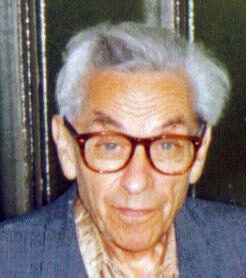
Paul Erdős
Paul Erdős was a Hungarian mathematician. Born March 26, 1913, in Budapest. Died September 20, 1996, in Warsaw. Known for Copeland–Erdős constant, Cameron–Erdős conjecture and De Bruijn–Erdős theorem. Educated at Eötvös Loránd University and Saint Stephen High School. Awards include Guggenheim Fellowship, Cole Prize in Number Theory and Kossuth Prize.
Facts
52 facts · 2 confirmed by two sources · 26 cited · 24 from one source
Where this comes from
Papalocal keeps its own record. It started from these sources; what each one said is kept here as it was copied, so a change on their side never changes this page by itself. Tap one to read its version.
What Wikidata says · copied November 16, 2026 · revision 2567873815
- Described as
- Hungarian mathematician (1913–1996)
- Other names
- Erdős Pál, Erdős, Erdos, P. Erdős, Pál Erdős, Paul Erdos, Paul Erdös
- Born
- March 26, 1913 · 7 references
- Died
- September 20, 1996 · 6 references
- Born in
- Budapest · 3 references
- Died in
- Warsaw · 6 references
- Buried in
- Kozma Street Jewish Cemetery · 1 reference
- Cause of death
- myocardial infarction
- Citizen of
- Hungary · 3 references
- Occupation
- mathematician · 2 references; university teacher · 1 reference
- Worked for
- Institute for Advanced Study (1938–1940) · 1 reference; Victoria University of Manchester (1934–1938) · 1 reference; Purdue University (1943–1945) · 1 reference; University of Notre Dame (1952–1954) · 1 reference; Technion – Israel Institute of Technology (1954–1996) · 1 reference
- Education
- Eötvös Loránd University (1930–1934) · 1 reference; Saint Stephen High School (1926–1930) · 1 reference
- Member of
- Royal Society of London (1989–) · 1 reference; Hungarian Academy of Sciences (1956–1962) · 1 reference; American Academy of Arts and Sciences (1974–) · 1 reference; Royal Netherlands Academy of Arts and Sciences (1977–) · 1 reference; National Academy of Sciences (1980–) · 2 references; Polish Academy of Sciences (1994–) · 1 reference
- Known for
- Copeland–Erdős constant; Cameron–Erdős conjecture; De Bruijn–Erdős theorem; Davenport–Erdős theorem; Erdős–Borwein constant; Erdős–Woods number; Erdős–Straus conjecture; Erdős–Kac theorem; Erdős–Szekeres theorem; Erdős–Rényi model
- Awards
- Guggenheim Fellowship (1945) · 1 reference; Cole Prize in Number Theory (1951) · 2 references; Kossuth Prize (1958) · 1 reference; Wolf Prize in Mathematics (1983) · 1 reference; honorary doctor of the University of Limoges (1986) · 3 references; Foreign Member of the Royal Society (1989) · 1 reference; honorary doctor of the Charles University of Prague (1992) · 1 reference; honorary doctorate of Haifa University (1994) · 1 reference
- Field
- probability theory; combinatorics; graph theory; number theory; set theory; real analysis
- Father
- Lajos Erdős
- Lived in
- United Kingdom; Manchester (1934–); Warsaw (–1996); Hungary; Israel
- Wikipedias with a page
- 84
Wikidata item Q173746 (wikidata.org/wiki/Q173746), public domain (CC0). Copied November 16, 2026.
What Wikipedia says · copied November 16, 2026 · revision 1385863306
Paul Erdős (Hungarian: Erdős Pál [ˈɛrdøːʃ ˈpaːl]; 26 March 1913 – 20 September 1996) was a Hungarian mathematician. He is regarded as one of the most prolific mathematicians and producers of mathematical conjectures in history. Erdős proposed and pursued problems in discrete mathematics, graph theory, number theory, mathematical analysis, approximation theory, set theory, and probability theory. Much of his work centered on discrete mathematics, cracking many previously unsolved problems in the field. He championed and contributed to Ramsey theory, which studies the conditions in which order necessarily appears. Overall, his work leaned towards solving previously open problems, rather than developing or exploring new areas of mathematics.
He taught at various universities in the United States and Israel. Erdős's output was prolific; he published around 1,500 mathematical papers during his lifetime, many being collaborations with other mathematicians, making him arguably the most prolific mathematician in history. This prompted the creation of the Erdős number, the number of steps in the shortest path between a mathematician and Erdős in terms of co-authorships.
He was known both for his social practice of mathematics, working with more than 500 collaborators, and for his eccentric lifestyle. He firmly believed mathematics to be a social activity, living a nomadic lifestyle with the sole purpose of writing mathematical papers with other mathematicians. He devoted his waking hours to mathematics, even into his later years; he died at a mathematics conference in Warsaw in 1996.
- Born, in its opening lines
- March 26, 1913
- Died, in its opening lines
- September 20, 1996
From the Wikipedia article “Paul Erdős” (en.wikipedia.org/wiki/Paul_Erdős), by its contributors, under CC BY-SA 4.0 (creativecommons.org/licenses/by-sa/4.0/). Copied November 16, 2026; not changed.
Confirmed Two sources agree. Cited One source, and it names where it got it. One source One source, without a reference of its own. Sources disagree The sources disagree. We show the best-supported value and keep theirs below.
