
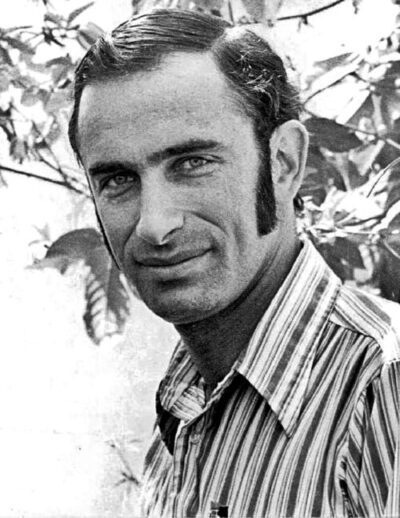
Paul R. Ehrlich
Paul R. Ehrlich was an American biologist and environmentalist. Born May 29, 1932, in Philadelphia. Died March 13, 2026, in Palo Alto. Known for The Population Bomb. Educated at University of Kansas and University of Pennsylvania. Awards include John Muir Award, Crafoord Prize in Biosciences and Volvo Environment Prize.
Facts
43 facts · 2 confirmed by two sources · 20 cited · 21 from one source
Where this comes from
Papalocal keeps its own record. It started from these sources; what each one said is kept here as it was copied, so a change on their side never changes this page by itself. Tap one to read its version.
What Wikidata says · copied November 15, 2026 · revision 2567914356
- Described as
- American biologist and environmentalist (1932–2026)
- Other names
- Paul Ehrlich, Paul R Ehrlich, Paul Ralph Ehrlich
- Born
- May 29, 1932 · 5 references
- Died
- March 13, 2026 · 2 references
- Born in
- Philadelphia · 1 reference
- Died in
- Palo Alto · 2 references
- Citizen of
- United States
- Occupation
- demographer · 1 reference; biologist · 1 reference; university teacher · 1 reference; environmentalist; ecologist; professor · 1 reference
- Worked for
- Stanford University
- Education
- University of Kansas (–1957); University of Pennsylvania (–1953); Columbia High School
- Member of
- Royal Society of London (2012–) · 1 reference; National Academy of Sciences (1985–) · 1 reference; European Academy of Sciences and Arts; American Academy of Arts and Sciences (1982–) · 1 reference; American Philosophical Society; American Association for the Advancement of Science (1978–) · 1 reference
- Known for
- The Population Bomb
- Awards
- John Muir Award (1980); Crafoord Prize in Biosciences (1990) · 1 reference; Volvo Environment Prize (1993) · 1 reference; ECI Prize (1993) · 1 reference; Heinz Award (1994) · 1 reference; Dr A. H. Heineken Prize for Environmental Sciences (1998) · 1 reference; Tyler Prize for Environmental Achievement (1998) · 1 reference; Blue Planet Prize (1999) · 1 reference; Eminent Ecologist Award (2001) · 1 reference; Ramon Margalef Prize in Ecology (2009) · 1 reference; Fellow of the Ecological Society of America (2012) · 1 reference; Foreign Member of the Royal Society (2012) · 1 reference; BBVA Foundation Frontiers of Knowledge Award (2013) · 1 reference; MacArthur Fellows Program; Heineken Prizes
- Field
- human population · 1 reference; entomology · 1 reference; endangered · 1 reference
- Spouse
- Anne H. Ehrlich · 1 reference
- Religion
- Neo-Malthusianism · 1 reference
- Website
- https://profiles.stanford.edu/paul-ehrlich
- Wikipedias with a page
- 35
Wikidata item Q377983 (wikidata.org/wiki/Q377983), public domain (CC0). Copied November 15, 2026.
What Wikipedia says · copied November 15, 2026 · revision 1385828376
Paul Ralph Ehrlich (May 29, 1932 – March 13, 2026) was an American biologist, author, and environmentalist known for his predictions and warnings about the consequences of population growth, including famine and resource depletion. Ehrlich was the Bing Professor of Population Studies of the Department of Biology of Stanford University. He started working at Jasper Ridge Biological Preserve in 1959. He along with many other biology professors, led the efforts for Stanford University to designate and protect Jasper Ridge in 1973 as a biological preserve and as a long-term research facility for faculty and students.
Ehrlich became well known for the controversial 1968 book The Population Bomb, which he co-authored with his wife Anne H. Ehrlich, in which they famously stated that "[i]n the 1970s hundreds of millions of people will starve to death in spite of any crash programs embarked upon now." This position has led historians and critics to describe Ehrlich as a neo-Malthusian.
There are mixed views on Ehrlich's assertions on the dangers of expanding human populations. While statistician Paul A. Murtaugh says that Ehrlich was largely correct, Ehrlich has been criticized for his approach and views, both for their pessimistic outlook and for the failure of his predictions. In 2004, Ehrlich had acknowledged that population growth was in decline, but had believed that overconsumption by wealthy nations was a major problem. He maintained that his warnings about disease and climate change were essentially correct. Journalist Dan Gardner criticized Ehrlich for his cognitive dissonance in forecasting, asserting that Ehrlich took credit for his successful predictions but failed to acknowledge his mistakes.
- Born, in its opening lines
- May 29, 1932
- Died, in its opening lines
- March 13, 2026
From the Wikipedia article “Paul R. Ehrlich” (en.wikipedia.org/wiki/Paul_R._Ehrlich), by its contributors, under CC BY-SA 4.0 (creativecommons.org/licenses/by-sa/4.0/). Copied November 15, 2026; not changed.
Confirmed Two sources agree. Cited One source, and it names where it got it. One source One source, without a reference of its own. Sources disagree The sources disagree. We show the best-supported value and keep theirs below.
