
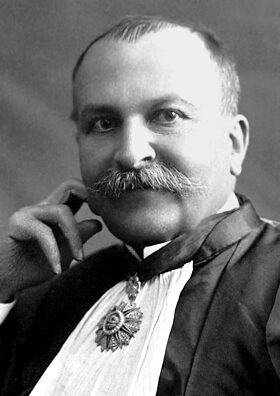
Paul Sabatier
Paul Sabatier was a French chemist. Born November 5, 1854, in Carcassonne. Died August 14, 1941, in Toulouse. Known for Sabatier reaction and Sabatier nickel. Educated at École Normale Supérieure and lycée Pierre-de-Fermat. Awards include Grand Officer of the Legion of Honour, Nobel Prize in Chemistry and Franklin Medal.
Facts
42 facts · 2 confirmed by two sources · 17 cited · 23 from one source
Where this comes from
Papalocal keeps its own record. It started from these sources; what each one said is kept here as it was copied, so a change on their side never changes this page by itself. Tap one to read its version.
What Wikidata says · copied November 16, 2026 · revision 2569149866
- Described as
- French chemist (1854–1941)
- Born
- November 5, 1854 · 11 references
- Died
- August 14, 1941 · 11 references
- Born in
- Carcassonne · 1 reference
- Died in
- Toulouse · 2 references
- Buried in
- The Saint-Vincent cemetery in Carcassonne · 1 reference
- Citizen of
- France
- Occupation
- chemist · 1 reference; university teacher
- Worked for
- University of Toulouse (1896-1968); University of Bordeaux · 1 reference
- Education
- École Normale Supérieure; lycée Pierre-de-Fermat · 1 reference; University of Toulouse (1896-1968)
- Member of
- Royal Society of London (1918–) · 1 reference; French Academy of Sciences; Royal Swedish Academy of Sciences; Académie des sciences, inscriptions et belles-lettres de Toulouse (1885–) · 1 reference; Royal Netherlands Academy of Arts and Sciences; Accademia Nazionale dei Lincei (1923–) · 1 reference; Royal Irish Academy; Consistori del Gay Saber; National Academy of Sciences (1927–); Société d'études scientifiques de l'Aude (1920–1941) · 1 reference
- Known for
- Sabatier reaction; Sabatier nickel
- Awards
- Grand Officer of the Legion of Honour (1931) · 1 reference; Nobel Prize in Chemistry (1912) · 2 references; Franklin Medal (1933); Jecker Prize (1905); La Caze Prize of the Academy of Sciences (1897); Albert Medal (1926) · 1 reference; Davy Medal (1915) · 1 reference; honorary doctorate of the University of Porto; Foreign Member of the Royal Society (1918) · 1 reference; Commander of the Legion of Honour (1922) · 1 reference; Officer of the Legion of Honour (1913) · 1 reference; Knight of the Legion of Honour (1908) · 1 reference
- Field
- inorganic chemistry; organic chemistry; chemistry · 1 reference; catalysis · 1 reference
- Lived in
- France · 1 reference
- Wikipedias with a page
- 71
Wikidata item Q104575 (wikidata.org/wiki/Q104575), public domain (CC0). Copied November 16, 2026.
What Wikipedia says · copied November 16, 2026 · revision 1371982724
Paul Sabatier (French: [sabatje]; 5 November 1854 – 14 August 1941) was a French chemist, born in Carcassonne. In 1912, Sabatier was awarded the Nobel Prize in Chemistry along with Victor Grignard. Sabatier was honoured for his work improving the hydrogenation of organic species in the presence of metals.
- Born, in its opening lines
- November 5, 1854
- Died, in its opening lines
- August 14, 1941
From the Wikipedia article “Paul Sabatier (chemist)” (en.wikipedia.org/wiki/Paul_Sabatier_(chemist)), by its contributors, under CC BY-SA 4.0 (creativecommons.org/licenses/by-sa/4.0/). Copied November 16, 2026; not changed.
Confirmed Two sources agree. Cited One source, and it names where it got it. One source One source, without a reference of its own. Sources disagree The sources disagree. We show the best-supported value and keep theirs below.
