
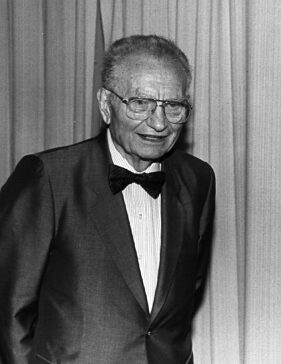
Paul Samuelson
Paul Samuelson was an American economist. Born May 15, 1915, in Gary. Died December 13, 2009, in Belmont. Educated at Hyde Park Academy High School and University of Chicago. Awards include Guggenheim Fellowship, Prize in Economic Sciences in Memory of Alfred Nobel and National Medal of Science.
Facts
41 facts · 2 confirmed by two sources · 13 cited · 26 from one source
Where this comes from
Papalocal keeps its own record. It started from these sources; what each one said is kept here as it was copied, so a change on their side never changes this page by itself. Tap one to read its version.
What Wikidata says · copied November 13, 2026 · revision 2563198997
- Described as
- American economist (1915–2009)
- Other names
- Paul Anthony Samuelson, Paul A. Samuelson
- Born
- May 15, 1915 · 8 references
- Died
- December 13, 2009 · 10 references
- Born in
- Gary · 1 reference
- Died in
- Belmont · 3 references
- Citizen of
- United States · 2 references
- Occupation
- economist · 1 reference; writer · 1 reference; university teacher · 1 reference; Master's Degree in Economics · 1 reference
- Worked for
- Massachusetts Institute of Technology; MIT Sloan School of Management; University of Chicago · 1 reference
- Education
- Hyde Park Academy High School; University of Chicago (–1935); Harvard University (1935–1941)
- Member of
- National Academy of Sciences · 1 reference; American Academy of Arts and Sciences; International Economic Association; American Economic Association; Econometric Society (1944–) · 1 reference; Royal Economic Society; Phi Beta Kappa Society; American Philosophical Society (1958–) · 1 reference; Royal Society of London · 1 reference; Accademia Nazionale dei Lincei (1978–) · 1 reference
- Awards
- Guggenheim Fellowship (1948) · 1 reference; Prize in Economic Sciences in Memory of Alfred Nobel (1970) · 1 reference; National Medal of Science (1996); John Bates Clark Medal (1947); Honorary Fellow of the Royal Society; Josiah Willard Gibbs Lectureship (1974); Fellow of the Econometric Society (1944) · 1 reference; doctor honoris causa of Keiō University; honorary doctorate from the Pontifical Catholic University of Peru; honorary doctor from the NOVA University Lisbon; honorary doctorate of the Polytechnic University of Valencia
- Field
- macroeconomics
- Siblings
- Robert Summers
- Lived in
- Gary; Chicago; Belmont (–2009)
- Wikipedias with a page
- 96
Wikidata item Q102454 (wikidata.org/wiki/Q102454), public domain (CC0). Copied November 13, 2026.
What Wikipedia says · copied November 13, 2026 · revision 1378660821
Paul Anthony Samuelson (May 15, 1915 – December 13, 2009) was an American economist who was the first American to win the Nobel Memorial Prize in Economic Sciences. When awarding the prize in 1970, the Swedish Royal Academies stated that he "has done more than any other contemporary economist to raise the level of scientific analysis in economic theory".
Samuelson was one of the most influential economists of the latter half of the 20th century. In 1996, he was awarded the National Medal of Science. Samuelson considered mathematics to be the "natural language" for economists and contributed significantly to the mathematical foundations of economics with his book Foundations of Economic Analysis. He was author of the best-selling economics textbook of all time: Economics: An Introductory Analysis, first published in 1948. It was the second American textbook that attempted to explain the principles of Keynesian economics.
Samuelson served as an advisor to President John F. Kennedy and President Lyndon B. Johnson, and was a consultant to the United States Treasury, the Bureau of the Budget and the President's Council of Economic Advisers. Samuelson wrote a weekly column for Newsweek magazine along with Chicago School economist Milton Friedman, where they represented opposing sides: Samuelson, as a self described "Cafeteria Keynesian", claimed taking the Keynesian perspective but only accepting what he felt was good in it. By contrast, Friedman represented the monetarist perspective. Together with Henry Wallich, their 1967 columns earned the magazine a Gerald Loeb Special Award in 1968.
- Born, in its opening lines
- May 15, 1915
- Died, in its opening lines
- December 13, 2009
From the Wikipedia article “Paul Samuelson” (en.wikipedia.org/wiki/Paul_Samuelson), by its contributors, under CC BY-SA 4.0 (creativecommons.org/licenses/by-sa/4.0/). Copied November 13, 2026; not changed.
Confirmed Two sources agree. Cited One source, and it names where it got it. One source One source, without a reference of its own. Sources disagree The sources disagree. We show the best-supported value and keep theirs below.
