
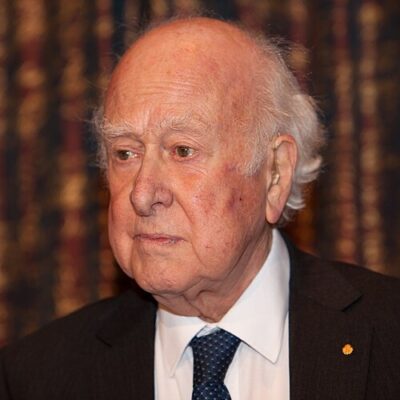
Peter Higgs
Peter Higgs was a British physicist and Nobel Prize winner. Born May 29, 1929, in Newcastle upon Tyne. Died April 8, 2024, in Edinburgh. Positions held include professor emeritus (1996–2024). Known for Higgs boson. Educated at Cotham School and City of London School. Awards include Fellow of the Royal Society of Edinburgh, Hughes Medal and Fellow of the Royal Society.
Facts
47 facts · 2 confirmed by two sources · 41 cited · 4 from one source
Where this comes from
Papalocal keeps its own record. It started from these sources; what each one said is kept here as it was copied, so a change on their side never changes this page by itself. Tap one to read its version.
What Wikidata says · copied November 16, 2026 · revision 2568470681
- Described as
- British physicist and Nobel Prize winner (1929–2024)
- Other names
- Higgs P, P Higgs, Peter W. Higgs, Peter Ware Higgs
- Born
- May 29, 1929 · 6 references
- Died
- April 8, 2024 · 2 references
- Born in
- Newcastle upon Tyne · 3 references
- Died in
- Edinburgh · 2 references
- Citizen of
- United Kingdom · 1 reference
- Occupation
- theoretical physicist · 1 reference; particle physicist; physicist · 2 references; university teacher · 1 reference
- Positions held
- professor emeritus (1996–2024) · 1 reference
- Worked for
- Royal Commission for the Exhibition of 1851 (1953–1955) · 1 reference; University of Edinburgh (2 times) (1955–1996) · 1 reference; University of London (1956–1958) · 1 reference; University College London (1959–1960) · 1 reference
- Education
- Cotham School (1941–1946) · 1 reference; City of London School (1946–1947) · 1 reference; King's College London (1947–1954) · 1 reference
- Member of
- Royal Society of London (1983–2024) · 1 reference; Royal Society of Edinburgh (1974–2024) · 1 reference; Institute of Physics (1991–2024) · 1 reference; King's College London (1998–2024) · 1 reference; Swansea University (2008–2024) · 1 reference; Royal Scottish Society of Arts (2013–2024) · 1 reference; Saltire Society (2013–2024) · 1 reference; Science Museum (2013–2024) · 1 reference; James Clerk Maxwell Foundation (2016–2024) · 1 reference
- Known for
- Higgs boson · 1 reference
- Awards
- Fellow of the Royal Society of Edinburgh (1974) · 1 reference; Hughes Medal (1981) · 1 reference; Fellow of the Royal Society (1983) · 2 references; Rutherford Medal and Prize (1984) · 2 references; Fellow of the Institute of Physics (1991) · 1 reference; James Scott Prize Lectureship (1993) · 1 reference; High Energy and Particle Physics Prize (1997) · 1 reference; IOP Dirac Medal (1997) · 2 references; honorary doctor of the University of Bristol (1997) · 1 reference; honorary doctor of the University of Edinburgh (1998) · 1 reference; Honorary Fellow of the Institute of Physics (1999) · 1 reference; honorary doctorate of the University of Glasgow (2002) · 1 reference; Wolf Prize in Physics (2004) · 1 reference; Oskar Klein Medal (2009) · 1 reference; Sakurai Prize (2010) · 2 references
- Field
- theoretical physics; molecular physics · 1 reference; Higgs boson · 1 reference
- Religion
- atheism · 3 references
- Website
- https://www.ph.ed.ac.uk/higgs · 1 reference
- Wikipedias with a page
- 96
Wikidata item Q192112 (wikidata.org/wiki/Q192112), public domain (CC0). Copied November 16, 2026.
What Wikipedia says · copied November 16, 2026 · revision 1384249596
Peter Ware Higgs (29 May 1929 – 8 April 2024) was a British theoretical physicist, professor at the University of Edinburgh, and Nobel laureate in Physics for his work on the mass of subatomic particles.
In 1964, Higgs was the single author of one of the three milestone papers published in Physical Review Letters (PRL) which proposed that spontaneous symmetry breaking in electroweak theory could explain the origin of mass of elementary particles in general and of the W and Z bosons in particular. This Higgs mechanism predicted the existence of a new particle, the Higgs boson, the detection of which became one of the great goals of physics. In 2012, CERN announced the discovery of the Higgs boson at the Large Hadron Collider. The Higgs mechanism is generally accepted as an important ingredient in the Standard Model of particle physics, without which certain particles would have no mass.
For this work, Higgs received the Nobel Prize in Physics, which he shared with Belgian François Englert in 2013.
- Born, in its opening lines
- May 29, 1929
- Died, in its opening lines
- April 8, 2024
From the Wikipedia article “Peter Higgs” (en.wikipedia.org/wiki/Peter_Higgs), by its contributors, under CC BY-SA 4.0 (creativecommons.org/licenses/by-sa/4.0/). Copied November 16, 2026; not changed.
Confirmed Two sources agree. Cited One source, and it names where it got it. One source One source, without a reference of its own. Sources disagree The sources disagree. We show the best-supported value and keep theirs below.
