
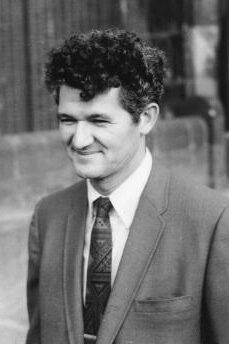
Peter Lax
Peter Lax was an American mathematician of Hungarian origin. Born May 1, 1926, in Budapest. Died May 16, 2025, in Manhattan. Positions held include Director of the Courant Institute of Mathematical Sciences (1972–1980). Known for Lax equivalence theorem, Beurling–Lax theorem and Babuška–Lax–Milgram theorem. Educated at Stuyvesant High School and New York University. Awards include Paul R. Halmos - Lester R. Ford Awards, Chauvenet Prize and Norbert Wiener Prize in Applied Mathematics.
Facts
52 facts · 2 confirmed by two sources · 26 cited · 24 from one source
Where this comes from
Papalocal keeps its own record. It started from these sources; what each one said is kept here as it was copied, so a change on their side never changes this page by itself. Tap one to read its version.
What Wikidata says · copied November 15, 2026 · revision 2560680714
- Described as
- American mathematician of Hungarian origin (1926–2025)
- Other names
- Peter David Lax, Péter Lax
- Born
- May 1, 1926 · 5 references
- Died
- May 16, 2025 · 2 references
- Born in
- Budapest · 1 reference
- Died in
- Manhattan · 1 reference
- Cause of death
- cardiac amyloidosis · 1 reference
- Name at birth
- Lax Péter Dávid
- Citizen of
- Hungary; United States
- Occupation
- mathematician · 1 reference; university teacher
- Positions held
- Director of the Courant Institute of Mathematical Sciences (1972–1980) · 1 reference
- Worked for
- New York University; Manhattan Project (2 times) (1945–1951) · 1 reference
- Education
- Stuyvesant High School (1941–1943) · 1 reference; New York University (1943–1949) · 1 reference
- Member of
- French Academy of Sciences (1981–); Norwegian Academy of Science and Letters; National Academy of Sciences (1970–); Academy of Sciences of the USSR (1988–) · 1 reference; Hungarian Academy of Sciences; Russian Academy of Sciences; American Academy of Arts and Sciences; Society for Industrial and Applied Mathematics (2009–) · 1 reference; American Mathematical Society (2012–) · 2 references; The Martians
- Known for
- Lax equivalence theorem; Beurling–Lax theorem; Babuška–Lax–Milgram theorem; Lions–Lax–Milgram theorem; Lax–Wendroff theorem; Lax–Wendroff method; Lax–Friedrichs method; lax natural transformation; lax functor
- Awards
- Paul R. Halmos - Lester R. Ford Awards (1966) · 1 reference; Chauvenet Prize (1974) · 1 reference; Norbert Wiener Prize in Applied Mathematics (1975) · 1 reference; doctor honoris causa from the Pierre and Marie Curie University (1979) · 1 reference; National Medal of Science (1986) · 1 reference; Wolf Prize in Mathematics (1987) · 1 reference; Leroy P. Steele Prize (1992) · 2 references; honorary doctor of the Peking University (1993); Abel Prize (2005) · 1 reference; Josiah Willard Gibbs Lectureship (2007) · 1 reference; Fellow of the Society for Industrial and Applied Mathematics (2009); Great Immigrants Award (2009) · 1 reference; Lomonosov Gold Medal (2013) · 1 reference; Fellow of the American Mathematical Society (2013) · 2 references
- Field
- partial differential equation; applied mathematics · 1 reference; mathematics · 1 reference
- Spouse
- Anneli Cahn Lax (1948–1999) · 1 reference
- Wikipedias with a page
- 39
Wikidata item Q323331 (wikidata.org/wiki/Q323331), public domain (CC0). Copied November 15, 2026.
What Wikipedia says · copied November 15, 2026 · revision 1371983951
Peter David Lax (1 May 1926 – 16 May 2025) was a Hungarian-born American mathematician and Abel Prize laureate working in the areas of pure and applied mathematics.
Lax made important contributions to integrable systems, fluid dynamics and shock waves, solitonic physics, hyperbolic conservation laws, and mathematical and scientific computing, among other fields. In a 1958 paper Lax stated a conjecture about matrix representations for third-order hyperbolic polynomials which remained unproven for over four decades. Interest in the "Lax conjecture" grew as mathematicians working in several different areas recognized the importance of its implications in their field, until it was finally proven to be true in 2003.
- Born, in its opening lines
- May 1, 1926
- Died, in its opening lines
- May 16, 2025
From the Wikipedia article “Peter Lax” (en.wikipedia.org/wiki/Peter_Lax), by its contributors, under CC BY-SA 4.0 (creativecommons.org/licenses/by-sa/4.0/). Copied November 15, 2026; not changed.
Confirmed Two sources agree. Cited One source, and it names where it got it. One source One source, without a reference of its own. Sources disagree The sources disagree. We show the best-supported value and keep theirs below.
