
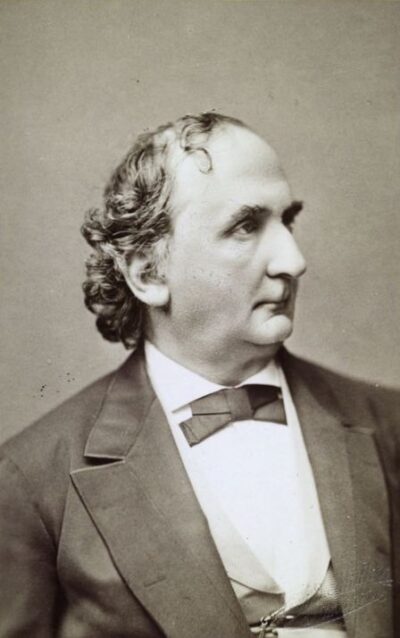
Philipp Ludwig von Seidel
Philipp Ludwig von Seidel was a German mathematician, optician and astronomer. Born October 24, 1821, in Zweibrücken. Died August 13, 1896, in Munich. Positions held include extraordinary professor (1847–1855), professor (1855–1891) and executive director (1879–1882). Known for Gauss–Seidel method. Educated at Frederick William University Berlin and University of Königsberg. Awards include Bavarian Maximilian Order for Science and Art, Order of Saint Michael and ennoblement.
Facts
37 facts · 2 confirmed by two sources · 34 cited · 1 from one source
Where this comes from
Papalocal keeps its own record. It started from these sources; what each one said is kept here as it was copied, so a change on their side never changes this page by itself. Tap one to read its version.
What Wikidata says · copied November 17, 2026 · revision 2568845541
- Described as
- German mathematician, optician and astronomer (1821-1896)
- Other names
- Philipp Ludwig Ritter von Seidel, Ludwig Seidel, Philipp Ludwig Seidel
- Born
- October 24, 1821 · 3 references
- Died
- August 13, 1896 · 4 references
- Born in
- Zweibrücken · 3 references
- Died in
- Munich · 3 references
- Name at birth
- Philipp Ludwig Seidel · 2 references
- Citizen of
- Kingdom of Bavaria · 1 reference
- Occupation
- mathematician · 3 references; astronomer · 3 references; university teacher · 3 references; scientist · 1 reference; optician · 1 reference; optician · 2 references
- Positions held
- extraordinary professor (1847–1855) · 2 references; professor (1855–1891) · 2 references; executive director (1879–1882) · 1 reference
- Worked for
- LMU Munich (1847–1891) · 2 references
- Education
- Frederick William University Berlin (1840–1842) · 2 references; University of Königsberg (1842–1843) · 2 references; LMU Munich (1843–1844) · 3 references
- Member of
- Bavarian Academy of Sciences and Humanities (1851–) · 2 references; Göttingen Academy of Sciences and Humanities in Lower Saxony (1854–) · 2 references; Royal Prussian Academy of Sciences (1863–) · 2 references; German Academy of Sciences Leopoldina (1864–) · 3 references; Central European Arc Measurement (1867–) · 2 references
- Known for
- Gauss–Seidel method
- Awards
- Bavarian Maximilian Order for Science and Art (1876) · 1 reference; Order of Saint Michael (1870) · 1 reference; ennoblement (1882) · 1 reference
- Field
- astronomy · 1 reference; mathematics · 1 reference; series · 1 reference; function · 1 reference; optics · 1 reference; telescope · 1 reference
- Father
- Justus Christian Felix Seidel · 1 reference
- Siblings
- Georg Friedrich Justus Seidel · 1 reference
- Religion
- Lutheranism · 1 reference
- Wikipedias with a page
- 26
Wikidata item Q464 (wikidata.org/wiki/Q464), public domain (CC0). Copied November 17, 2026.
What Wikipedia says · copied November 17, 2026 · revision 1382402434
Philipp Ludwig von Seidel ([fɔn ˈzaɪdəl]; 24 October 1821 in Zweibrücken, Germany – 13 August 1896 in Munich, German Empire) was a German mathematician. He was the son of Julie Reinhold and Justus Christian Felix Seidel.
Philosopher and math theorist Imre Lakatos credits von Seidel with discovering, in 1847, the crucial analytic concept of uniform convergence, while analyzing an incorrect proof put forth earlier by Augustin-Louis Cauchy.
In 1857, von Seidel contributed to the field of optics when he decomposed the first order monochromatic aberrations into five constituent aberrations. They are now commonly referred to as the five Seidel Aberrations.
The lunar crater Seidel is named after him. His doctoral students include Eduard Study and Hermann Wiener.
The Gauss–Seidel method is a useful numerical iterative method for solving linear systems.
- Born, in its opening lines
- October 24, 1821
- Died, in its opening lines
- August 13, 1896
From the Wikipedia article “Philipp Ludwig von Seidel” (en.wikipedia.org/wiki/Philipp_Ludwig_von_Seidel), by its contributors, under CC BY-SA 4.0 (creativecommons.org/licenses/by-sa/4.0/). Copied November 17, 2026; not changed.
Confirmed Two sources agree. Cited One source, and it names where it got it. One source One source, without a reference of its own. Sources disagree The sources disagree. We show the best-supported value and keep theirs below.
