
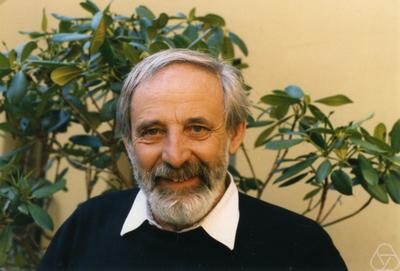
Raoul Bott
Raoul Bott was a Hungarian-born mathematician. Born September 24, 1923, in Budapest. Died December 20, 2005, in Carlsbad. Known for Bott periodicity theorem, Atiyah–Bott fixed-point theorem and Bott-Samelson Theorem. Educated at McGill University and Carnegie Institute of Technology. Awards include Guggenheim Fellowship, Leroy P. Steele Prize and National Medal of Science.
Facts
37 facts · 2 confirmed by two sources · 22 cited · 12 from one source · 1 where the sources disagree
What’s different
- Died in: we show Carlsbad (Sources disagree). Wikidata also lists San Diego
Where this comes from
Papalocal keeps its own record. It started from these sources; what each one said is kept here as it was copied, so a change on their side never changes this page by itself. Tap one to read its version.
What Wikidata says · copied November 15, 2026 · revision 2521422167
- Described as
- Hungarian-born mathematician
- Born
- September 24, 1923 · 6 references
- Died
- December 20, 2005 · 7 references
- Born in
- Budapest · 1 reference
- Died in
- Carlsbad · 1 reference; San Diego · 1 reference
- Buried in
- Chilmark Cemetery · 1 reference
- Cause of death
- lung cancer · 1 reference
- Citizen of
- United States · 1 reference
- Occupation
- mathematician · 2 references; physicist; university teacher
- Worked for
- Harvard University (1959–1999) · 1 reference; University of Michigan (1951–1959) · 1 reference; Carnegie Institute of Technology (1947–1949) · 1 reference; Institute for Advanced Study (1949–1951) · 1 reference
- Education
- McGill University (1941–1945) · 1 reference; Carnegie Institute of Technology (1945–1947) · 2 references; Carnegie Mellon University · 1 reference
- Member of
- Royal Society of London (2005–); French Academy of Sciences (1995–); American Academy of Arts and Sciences; National Academy of Sciences (1964–); German Academy of Sciences Leopoldina · 1 reference
- Known for
- Bott periodicity theorem; Atiyah–Bott fixed-point theorem; Bott-Samelson Theorem; Borel–Weil–Bott theorem
- Awards
- Guggenheim Fellowship (1976) · 2 references; Leroy P. Steele Prize (1990) · 2 references; National Medal of Science (1987) · 1 reference; Wolf Prize in Mathematics (2000) · 1 reference; Oswald Veblen Prize in Geometry (1964) · 1 reference; Foreign Member of the Royal Society (2005) · 1 reference; Sloan Fellowship (1956) · 1 reference
- Field
- differential geometry · 2 references; topology · 1 reference; geometry · 1 reference
- Lived in
- Czechoslovakia · 1 reference
- Wikipedias with a page
- 28
Wikidata item Q441185 (wikidata.org/wiki/Q441185), public domain (CC0). Copied November 15, 2026.
What Wikipedia says · copied November 15, 2026 · revision 1374935881
Raoul Bott (September 24, 1923 – December 20, 2005) was a Hungarian-American mathematician known for numerous foundational contributions to geometry in its broad sense. He is best known for his Bott periodicity theorem, the Morse–Bott functions which he used in this context, and the Borel–Bott–Weil theorem.
- Born, in its opening lines
- September 24, 1923
- Died, in its opening lines
- December 20, 2005
From the Wikipedia article “Raoul Bott” (en.wikipedia.org/wiki/Raoul_Bott), by its contributors, under CC BY-SA 4.0 (creativecommons.org/licenses/by-sa/4.0/). Copied November 15, 2026; not changed.
Confirmed Two sources agree. Cited One source, and it names where it got it. One source One source, without a reference of its own. Sources disagree The sources disagree. We show the best-supported value and keep theirs below.
