
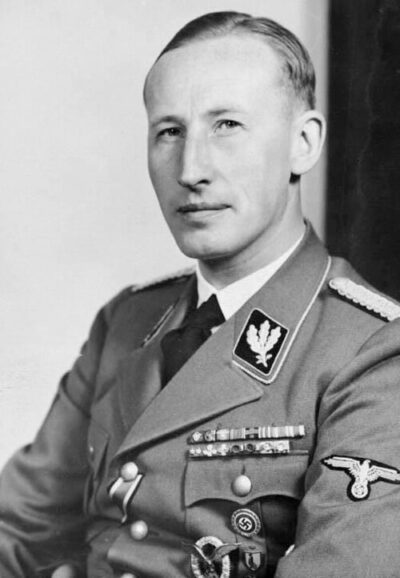
Reinhard Heydrich
Reinhard Heydrich was a German Nazi SS and Gestapo police official and main architect of the Holocaust Genocide. Born March 7, 1904, in Halle (Saale). Died June 4, 1942, in Prague. Positions held include member of the Reichstag of Nazi Germany, President of Interpol (1940–1942) and Chef der Sicherheitspolizei und des SD (1939–1942). Educated at Technical University of Munich and Hans-Dietrich-Genscher-Gymnasium. Awards include German Order, Golden Party Badge and Order of the Rising Sun, 1st class.
Facts
55 facts · 2 confirmed by two sources · 11 cited · 41 from one source · 1 where the sources disagree
What’s different
- Cause of death: we show gunshot wound (Sources disagree). Wikidata also lists sepsis
Where this comes from
Papalocal keeps its own record. It started from these sources; what each one said is kept here as it was copied, so a change on their side never changes this page by itself. Tap one to read its version.
What Wikidata says · copied November 16, 2026 · revision 2565531369
- Described as
- German Nazi SS and Gestapo police official and main architect of the Holocaust Genocide (1904-1942)
- Other names
- Heydrich, The Hangman, The Butcher of Prague, The Blond Beast, Himmler's Evil Genius, Young Evil God of Death, The Man with the Iron Heart, Reinhard Tristan Eugen Heydrich
- Born
- March 7, 1904 · 13 references
- Died
- June 4, 1942 · 12 references
- Born in
- Halle (Saale) · 3 references
- Died in
- Prague · 5 references
- Buried in
- Invalids' Cemetery
- Cause of death
- gunshot wound; sepsis
- Name at birth
- Reinhard Tristan Eugen Heydrich
- Citizen of
- Nazi Germany; Weimar Republic; German Empire
- Occupation
- politician · 1 reference; military personnel; fencer · 1 reference; aircraft pilot · 1 reference; soldier · 1 reference; Gestapo employee; Holocaust perpetrator · 1 reference
- Positions held
- member of the Reichstag of Nazi Germany; President of Interpol (1940–1942); Chef der Sicherheitspolizei und des SD (1939–1942)
- Political party
- Nazi Party (1931–) · 1 reference
- Worked for
- Gestapo
- Education
- Technical University of Munich; Hans-Dietrich-Genscher-Gymnasium (1913–1922) · 3 references
- Member of
- Schutzstaffel · 1 reference; Deutschvölkischer Schutz und Trutzbund
- Sport
- fencing
- Awards
- German Order; Golden Party Badge; Order of the Rising Sun, 1st class; Blood Order (1923) · 1 reference; Wound Badge (1939) in Gold (1942) · 2 references; Iron Cross · 1 reference; Order of the German Eagle · 1 reference; Anschluss Medal (1938) · 1 reference; Sudetenland Medal (1938) · 1 reference; Memel Medal · 1 reference; West Wall Medal · 1 reference; Nazi Party Long Service Award · 1 reference; Reichsführer-SS · 1 reference; Honour Chevron for the Old Guard · 1 reference; SS-Ehrenring · 1 reference
- Spouse
- Lina Heydrich (1931–1942)
- Children
- Heider Heydrich · 1 reference
- Father
- Richard Bruno Heydrich · 1 reference
- Mother
- Elisabeth Krantz · 1 reference
- Siblings
- Maria Heydrich; Heinz Heydrich · 1 reference
- Military branch
- Schutzstaffel
- Military rank
- SS-Oberst-Gruppenführer; Obergruppenführer · 1 reference
- Nickname
- The Hangman; The Butcher of Prague; The Blond Beast; Himmler's Evil Genius
- Wikipedias with a page
- 81
Wikidata item Q60039 (wikidata.org/wiki/Q60039), public domain (CC0). Copied November 16, 2026.
What Wikipedia says · copied November 16, 2026 · revision 1385099811
Reinhard Tristan Eugen Heydrich (; German: [ˈʁaɪnhaʁt ˈtʁɪstan ˈʔɔʏɡn̩ ˈhaɪdʁɪç] ; 7 March 1904 – 4 June 1942) was a high-ranking SS and police official in Nazi Germany as well as one of the principal architects of the Holocaust. He held the rank of SS-Obergruppenführer und General der Polizei. Many historians regard Heydrich as one of the most sinister figures within the Nazi regime. Adolf Hitler described him as "the man with the iron heart".
Beginning in September 1939, Heydrich was chief of the Reich Security Main Office (including the Gestapo, Kripo, and SD). He was also Stellvertretender Reichsprotektor (Deputy Reich-Protector) of Bohemia and Moravia. He served as president of the International Criminal Police Commission (ICPC, now known as Interpol) and chaired the January 1942 Wannsee Conference which formalised plans for the "Final Solution to the Jewish question"—the deportation and genocide of all Jews in German-occupied Europe.
Heydrich was the founding head of the Sicherheitsdienst (Security Service, SD), an intelligence organisation charged with seeking out and neutralising resistance to the Nazi Party via arrests, deportations, and murders. He helped organise Kristallnacht, a series of coordinated attacks against Jews throughout Nazi Germany and parts of Austria on 9–10 November 1938. The attacks were carried out by SA stormtroopers and civilians and presaged the Holocaust. Upon his arrival in Prague, Heydrich sought to eliminate opposition to the Nazi occupation by suppressing Czech culture and deporting and executing members of the Czech resistance. He was directly responsible for the Einsatzgruppen, the special task forces that travelled in the wake of the German armies and murdered more than two million people by mass shooting and gassing including 1.3 million Jews.
Heydrich was mortally wounded in Prague on 27 May 1942 as a result of Operation Anthropoid. He was ambushed by a team of Czech and Slovak soldiers who had been sent by the Czechoslovak government-in-exile to kill him; the team was trained by the British Special Operations Executive. Heydrich died from sepsis caused by his injuries on 4 June 1942. Nazi intelligence falsely linked the Czech and Slovak soldiers and resistance partisans to the villages of Lidice and Ležáky. Both villages were razed; the men and boys aged 14 and above were shot and most of the women and children were deported and murdered in Nazi concentration camps.
- Born, in its opening lines
- March 7, 1904
- Died, in its opening lines
- June 4, 1942
From the Wikipedia article “Reinhard Heydrich” (en.wikipedia.org/wiki/Reinhard_Heydrich), by its contributors, under CC BY-SA 4.0 (creativecommons.org/licenses/by-sa/4.0/). Copied November 16, 2026; not changed.
Confirmed Two sources agree. Cited One source, and it names where it got it. One source One source, without a reference of its own. Sources disagree The sources disagree. We show the best-supported value and keep theirs below.
