
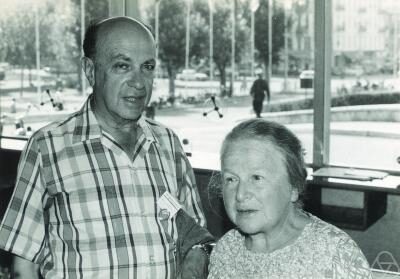
Richard Brauer
Richard Brauer was a mathematician. Born February 10, 1901, in Charlottenburg. Died April 17, 1977, in Belmont. Positions held include chairperson (1957–1958) and Perkins Professorship of Astronomy and Mathematics (1966–1971). Known for Brauer–Siegel theorem, Albert–Brauer–Hasse–Noether theorem and Brauer–Suzuki theorem. Educated at Humboldt-Universität zu Berlin and University of Freiburg. Awards include Guggenheim Fellowship, National Medal of Science and Cole Prize in Algebra.
Facts
45 facts · 2 confirmed by two sources · 20 cited · 23 from one source
Where this comes from
Papalocal keeps its own record. It started from these sources; what each one said is kept here as it was copied, so a change on their side never changes this page by itself. Tap one to read its version.
What Wikidata says · copied November 16, 2026 · revision 2568952635
- Described as
- mathematician (1901-1977)
- Other names
- Richard Dagobert Brauer, Richard (Dagobert) Brauer
- Born
- February 10, 1901 · 5 references
- Died
- April 17, 1977 · 5 references
- Born in
- Charlottenburg
- Died in
- Belmont · 1 reference
- Buried in
- Mount Auburn Cemetery · 1 reference
- Name at birth
- Richard Dagobert Brauer
- Citizen of
- Germany; United States
- Occupation
- mathematician · 1 reference; university teacher
- Positions held
- chairperson (1957–1958); Perkins Professorship of Astronomy and Mathematics (1966–1971)
- Worked for
- Harvard University (1952–1971) · 1 reference; University of Michigan (1949–1952) · 1 reference; University of Toronto (1935–1949) · 2 references; University of Königsberg (1925–1933) · 2 references; University of Kentucky (1933–1934) · 2 references; University of Wisconsin–Madison (1941) · 2 references; Institute for Advanced Study (1934–1935) · 1 reference
- Education
- Humboldt-Universität zu Berlin (1919–1926) · 2 references; University of Freiburg (1920) · 1 reference; Technische Hochschule Berlin (1919) · 1 reference
- Member of
- American Academy of Arts and Sciences; National Academy of Sciences; London Mathematical Society (1963) · 1 reference; Göttingen Academy of Sciences and Humanities in Lower Saxony; American Philosophical Society (1974–)
- Known for
- Brauer–Siegel theorem; Albert–Brauer–Hasse–Noether theorem; Brauer–Suzuki theorem; Brauer–Fowler theorem; Alperin–Brauer–Gorenstein theorem; Brauer–Suzuki–Wall theorem; Brauer–Nesbitt theorem; Brauer's theorem on induced characters; Cartan–Brauer–Hua theorem; Brauer's theorem on forms
- Awards
- Guggenheim Fellowship (1941) · 1 reference; National Medal of Science (1970) · 1 reference; Cole Prize in Algebra (1949) · 1 reference
- Field
- group theory
- Spouse
- Ilse Karger · 1 reference
- Children
- George Ulrich Brauer · 1 reference; Fred Brauer · 1 reference
- Siblings
- Alfred Brauer
- Wikipedias with a page
- 20
Wikidata item Q65201 (wikidata.org/wiki/Q65201), public domain (CC0). Copied November 16, 2026.
What Wikipedia says · copied November 16, 2026 · revision 1371988727
Richard Dagobert Brauer (February 10, 1901 – April 17, 1977) was a German and American mathematician. He worked mainly in abstract algebra, but made important contributions to number theory. He was the founder of modular representation theory.
- Born, in its opening lines
- February 10, 1901
- Died, in its opening lines
- April 17, 1977
From the Wikipedia article “Richard Brauer” (en.wikipedia.org/wiki/Richard_Brauer), by its contributors, under CC BY-SA 4.0 (creativecommons.org/licenses/by-sa/4.0/). Copied November 16, 2026; not changed.
Confirmed Two sources agree. Cited One source, and it names where it got it. One source One source, without a reference of its own. Sources disagree The sources disagree. We show the best-supported value and keep theirs below.
