
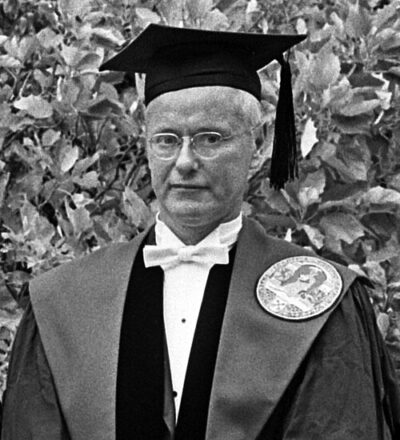
Robert K. Merton
Robert K. Merton was an American sociologist. Born July 4, 1910, in Philadelphia. Died February 23, 2003, in New York City. Positions held include President of the American Sociological Association (1957). Known for Social Theory and Social Structure. Educated at Temple University and Harvard University. Awards include Guggenheim Fellowship, MacArthur Fellows Program and National Medal of Science.
Facts
33 facts · 2 confirmed by two sources · 22 cited · 9 from one source
Where this comes from
Papalocal keeps its own record. It started from these sources; what each one said is kept here as it was copied, so a change on their side never changes this page by itself. Tap one to read its version.
What Wikidata says · copied November 13, 2026 · revision 2565544816
- Described as
- American sociologist (1910–2003)
- Other names
- Robert King Merton
- Born
- July 4, 1910 · 6 references
- Died
- February 23, 2003 · 10 references
- Born in
- Philadelphia · 1 reference
- Died in
- New York City · 1 reference
- Name at birth
- Meyer Robert Schkolnick
- Citizen of
- United States · 1 reference
- Occupation
- sociologist · 2 references; university teacher
- Positions held
- President of the American Sociological Association (1957) · 1 reference
- Worked for
- Columbia University (1941–1979) · 1 reference; Tulane University (1939–1941) · 1 reference
- Education
- Temple University; Harvard University (–1936) · 1 reference; South Philadelphia High School · 1 reference
- Member of
- Royal Swedish Academy of Sciences; National Academy of Sciences (1968–) · 1 reference; American Academy of Arts and Sciences (1950–) · 1 reference; American Philosophical Society (1959–); British Academy; Polish Academy of Sciences (1997–) · 1 reference
- Known for
- Social Theory and Social Structure · 1 reference
- Awards
- Guggenheim Fellowship (1962) · 1 reference; MacArthur Fellows Program (1983) · 1 reference; National Medal of Science (1994) · 1 reference; John Desmond Bernal Prize (1982) · 1 reference; W.E.B. Du Bois Career of Distinguished Scholarship award (1980) · 1 reference; Derek John de Solla Price Award (1995) · 1 reference; honorary doctor of the University of Madrid Complutense (1998) · 1 reference; Honorary doctor of Leiden University (1965) · 1 reference; honorary doctorate of the University of Oslo (1991) · 2 references
- Field
- sociology · 1 reference
- Spouse
- Harriet Zuckerman
- Children
- Robert C. Merton · 1 reference
- Wikipedias with a page
- 53
Wikidata item Q312843 (wikidata.org/wiki/Q312843), public domain (CC0). Copied November 13, 2026.
What Wikipedia says · copied November 13, 2026 · revision 1383117519
Robert King Merton (born Meyer Robert Schkolnick; July 4, 1910 – February 23, 2003) was an American sociologist who is considered a founding father of modern sociology, and a major contributor to the subfield of criminology. He served as the 47th president of the American Sociological Association. He spent most of his career teaching at Columbia University, where he attained the rank of University Professor. In 1994 he was awarded the National Medal of Science for his contributions to the field and for having founded the sociology of science.
Merton's contribution to sociology falls into three areas: (1) sociology of science; (2) sociology of crime and deviance; (3) sociological theory. He popularized notable concepts, such as "unintended consequences", the "reference group", and "role strain", but is perhaps best known for the terms "role model" and "self-fulfilling prophecy". The concept of self-fulfilling prophecy, which is a central element in modern sociological, political, and economic theory, is one type of process through which a belief or expectation affects the outcome of a situation or the way a person or group will behave. More specifically, as Merton defined, "the self-fulfilling prophecy is, in the beginning, a false definition of the situation evoking a new behavior, which makes the originally false conception come true".
Merton's term "role model" first appeared in a study on the socialization of medical students at Columbia University. The term grew from the concept of the reference group, the group to which individuals compare themselves but to which they do not necessarily belong. Social roles were central to the theory of social groups. Merton emphasized that, rather than a person assuming just one role and one status, they have a status set in the social structure that has, attached to it, a whole set of expected behaviors.
- Born, in its opening lines
- July 4, 1910
- Died, in its opening lines
- February 23, 2003
From the Wikipedia article “Robert K. Merton” (en.wikipedia.org/wiki/Robert_K._Merton), by its contributors, under CC BY-SA 4.0 (creativecommons.org/licenses/by-sa/4.0/). Copied November 13, 2026; not changed.
Confirmed Two sources agree. Cited One source, and it names where it got it. One source One source, without a reference of its own. Sources disagree The sources disagree. We show the best-supported value and keep theirs below.
