
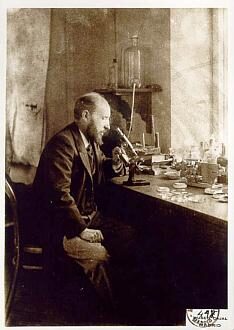
Santiago Ramón y Cajal
Santiago Ramón y Cajal was a Spanish scientist. Born May 1, 1852, in Petilla de Aragón. Died October 17, 1934, in Madrid. Positions held include president (2 times) (1896–1934), member of the Senate of Spain (1908–1910) and vocal of the Junta para Ampliación de Estudios e Investigaciones científicas (1907–1934). Educated at Faculty of Medicine of the University of Zaragoza and Universidad Central. Awards include Nobel Prize in Physiology or Medicine, Pour le Mérite for Sciences and Arts order and Helmholtz Medal.
Facts
64 facts · 2 confirmed by two sources · 29 cited · 33 from one source
Where this comes from
Papalocal keeps its own record. It started from these sources; what each one said is kept here as it was copied, so a change on their side never changes this page by itself. Tap one to read its version.
What Wikidata says · copied November 16, 2026 · revision 2569269953
- Described as
- Spanish scientist (1852-1934)
- Other names
- Santiago Ramón Cajal, Santiago Felipe Ramón Cajal, Santiago Ramón y Cajal Agüeras, Santiago Ramon y Cajal, Ramón y Cajal, Ramon y Cajal
- Born
- May 1, 1852 · 15 references
- Died
- October 17, 1934 · 11 references
- Born in
- Petilla de Aragón · 2 references
- Died in
- Madrid · 3 references
- Buried in
- La Almudena Cemetery · 1 reference
- Name at birth
- Santiago Ramón y Cajal
- Citizen of
- Spain · 2 references
- Occupation
- physician · 2 references; neurologist; chemist; photographer · 1 reference; pathologist · 1 reference; anatomist; politician; essayist · 1 reference
- Positions held
- president (2 times) (1896–1934) · 1 reference; member of the Senate of Spain (1908–1910) · 1 reference; vocal of the Junta para Ampliación de Estudios e Investigaciones científicas (1907–1934) · 1 reference; full professor (1887–) · 1 reference; Senator for Life of Spain (1910–1923) · 1 reference; Member of the Royal Academy of Exact, Physical and Natural Sciences (1897–1934) · 1 reference; Member of the Royal Spanish Academy (1905–1934) · 1 reference; academician of the Royal National Academy of Medicine (1907–1934) · 1 reference
- Worked for
- Universidad Central (1892–); University of Barcelona (1887–1892); University of Valencia (1884–1887) · 1 reference
- Education
- Faculty of Medicine of the University of Zaragoza (1870–1873); Universidad Central · 1 reference; Colegio Escuelas Pías of Jaca
- Member of
- Royal Society of London; Bavarian Academy of Sciences and Humanities; Royal Swedish Academy of Sciences; Royal Academy of Exact, Physical and Natural Sciences (1897–1934) · 1 reference; Hungarian Academy of Sciences; Royal Spanish Society of Natural History · 1 reference; Royal Society of Arts and Sciences in Gothenburg; Royal National Academy of Medicine (1907–1934) · 1 reference; Royal Netherlands Academy of Arts and Sciences · 1 reference; French Academy of Sciences (1916–) · 1 reference
- Awards
- Nobel Prize in Physiology or Medicine (1906) · 2 references; Pour le Mérite for Sciences and Arts order (1915); Helmholtz Medal (1904) · 1 reference; Grand Cross of the Order of Isabella the Catholic (1901) · 1 reference; honorary doctorate from the University of Cambridge; Grand cross of the Civil Order of Alfonso XII (1902) · 1 reference; Medalla Plus Ultra (1926) · 1 reference; Croonian Medal and Lecture (1894); honorary doctor of Harvard University (1899); Foreign Member of the Royal Society (1909) · 1 reference; Honorary Doctorate from the National Autonomous University of Mexico (1922); Dearest Son of Zaragoza province (1900) · 1 reference; Echegaray Medal (1922); doctor honoris causa from the University of Paris (1924) · 1 reference; honorary doctorate from the University of Strasbourg (1923) · 1 reference
- Field
- histology; Lippmann plate · 2 references
- Spouse
- Silveria Fañanás (1879–1930) · 1 reference
- Father
- Justo Ramón Casasús
- Mother
- Antonia Cajal Amigas
- Siblings
- Pedro Ramón y Cajal
- Lived in
- Petilla de Aragón (1852–1854); Larrés (1854–); Zaragoza; Madrid
- Wikipedias with a page
- 94
Wikidata item Q150526 (wikidata.org/wiki/Q150526), public domain (CC0). Copied November 16, 2026.
What Wikipedia says · copied November 16, 2026 · revision 1381693756
Santiago Ramón y Cajal (Spanish: [sanˈtjaɣo raˈmon i kaˈxal]; 1 May 1852 – 17 October 1934) was a Spanish neuroscientist, pathologist, and histologist specialising in neuroanatomy, and the central nervous system. He and Camillo Golgi received the Nobel Prize in Physiology or Medicine in 1906. Ramón y Cajal was the first Spaniard to win a scientific Nobel Prize. His original investigations of the microscopic structure of the brain made him a pioneer of modern neuroscience.
Hundreds of his drawings illustrating the arborization (tree-like growth) of brain cells are still in use, since the mid-20th century, for educational and training purposes.
- Born, in its opening lines
- May 1, 1852
- Died, in its opening lines
- October 17, 1934
From the Wikipedia article “Santiago Ramón y Cajal” (en.wikipedia.org/wiki/Santiago_Ramón_y_Cajal), by its contributors, under CC BY-SA 4.0 (creativecommons.org/licenses/by-sa/4.0/). Copied November 16, 2026; not changed.
Confirmed Two sources agree. Cited One source, and it names where it got it. One source One source, without a reference of its own. Sources disagree The sources disagree. We show the best-supported value and keep theirs below.
