
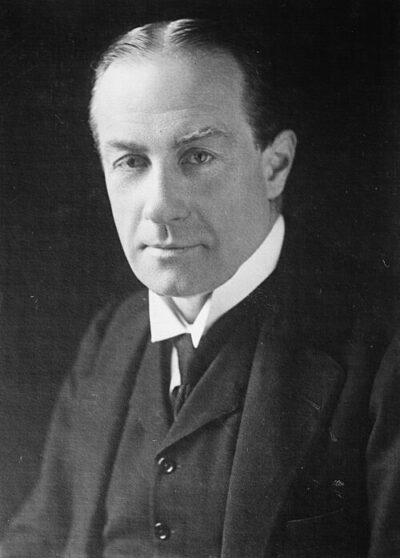
Stanley Baldwin
Stanley Baldwin was a British statesman. Born August 3, 1867, in Bewdley. Died December 14, 1947, in Bewdley. Positions held include Prime Minister of the United Kingdom (2 times) (1923–1937), Lord President of the Council (1931–1935) and Leader of the Opposition (2 times) (1924–1931). Educated at Trinity College and University of Birmingham. Awards include Knight of the Garter, King George VI Coronation Medal and Cross of Liberty 3rd Division, 1st Class.
Facts
46 facts · 2 confirmed by two sources · 19 cited · 25 from one source
Where this comes from
Papalocal keeps its own record. It started from these sources; what each one said is kept here as it was copied, so a change on their side never changes this page by itself. Tap one to read its version.
What Wikidata says · copied November 16, 2026 · revision 2567933693
- Described as
- British statesman (1867–1947)
- Other names
- Lord Baldwin, Stanley Baldwin, 1st Earl Baldwin, Stanley Baldwin, 1st Earl Baldwin of Bewdley, Sir Stanley Baldwin
- Born
- August 3, 1867 · 12 references
- Died
- December 14, 1947 · 11 references
- Born in
- Bewdley · 1 reference
- Died in
- Bewdley
- Buried in
- Worcester Cathedral
- Citizen of
- United Kingdom; United Kingdom of Great Britain and Ireland (–1927)
- Occupation
- politician · 1 reference
- Positions held
- Prime Minister of the United Kingdom (2 times) (1923–1937); Lord President of the Council (1931–1935); Leader of the Opposition (2 times) (1924–1931); Leader of the Conservative Party (–1937); Chancellor of the Exchequer (1922–1923); President of the Board of Trade (1921–1922); Member of the Privy Council of the United Kingdom; member of the 37th Parliament of the United Kingdom (1935–1937); member of the 36th Parliament of the United Kingdom (1931–1935) · 1 reference; member of the 35th Parliament of the United Kingdom (1929–1931) · 1 reference; member of the 34th Parliament of the United Kingdom (1924–1929) · 1 reference; member of the 33rd Parliament of the United Kingdom (1923–1924) · 1 reference; member of the 32nd Parliament of the United Kingdom (1922–1923) · 1 reference; member of the 31st Parliament of the United Kingdom (1918–1922) · 1 reference; member of the 30th Parliament of the United Kingdom (1910–1918) · 1 reference
- Political party
- Conservative Party
- Education
- Trinity College; University of Birmingham; Harrow School; University of London · 1 reference; Hawtreys · 1 reference
- Member of
- Royal Society of London; Privy Council of the United Kingdom; King's Privy Council for Canada
- Awards
- Knight of the Garter · 1 reference; King George VI Coronation Medal; Cross of Liberty 3rd Division, 1st Class (1925) · 1 reference
- Spouse
- Lucy Baldwin, Countess Baldwin of Bewdley (1892–) · 3 references
- Children
- Oliver Baldwin, 2nd Earl Baldwin of Bewdley · 2 references; Arthur Baldwin, 3rd Earl Baldwin of Bewdley · 1 reference; Lady Diana Lucy Baldwin · 1 reference; Lady Leonora Stanley Baldwin · 2 references; Lady Pamela Margaret Baldwin · 1 reference; Lady Esther Louisa Baldwin · 1 reference
- Father
- Alfred Baldwin · 2 references
- Mother
- Louisa Baldwin · 2 references
- Religion
- Church of England
- Military branch
- British Army
- Wikipedias with a page
- 78
Wikidata item Q166635 (wikidata.org/wiki/Q166635), public domain (CC0). Copied November 16, 2026.
What Wikipedia says · copied November 16, 2026 · revision 1385421205
Stanley Baldwin, 1st Earl Baldwin of Bewdley (3 August 1867 – 14 December 1947), was a British statesman and Conservative politician who was prominent in the political leadership of the United Kingdom between the world wars. He was prime minister on three occasions, from May 1923 to January 1924, from November 1924 to June 1929 and from June 1935 to May 1937.
Born to a prosperous family in Bewdley, Worcestershire, Baldwin was educated at Harrow School and Trinity College, Cambridge. He joined the family iron- and steel-making business and entered the House of Commons in 1908 as the member for Bewdley, succeeding his father Alfred. He was Financial Secretary to the Treasury (1917–1921) and President of the Board of Trade (1921–1922) in the coalition ministry of David Lloyd George and then rose rapidly. In 1922, Baldwin was one of the prime movers in the withdrawal of Conservative support from Lloyd George; he subsequently became Chancellor of the Exchequer in Bonar Law's Conservative ministry. Upon Law's resignation for health reasons in May 1923, Baldwin became prime minister and leader of the Conservative Party. He called an election in December 1923 on the issue of tariffs and lost the Conservatives' parliamentary majority, after which Ramsay MacDonald formed a minority Labour government.
After winning the 1924 general election, Baldwin formed his second government, which saw important tenures of office by Austen Chamberlain (Foreign Secretary), Winston Churchill (at the Exchequer) and Neville Chamberlain (Health). The latter two ministers strengthened Conservative appeal by reforms in areas formerly associated with the Liberal Party. They included industrial conciliation, unemployment insurance, a more extensive old-age pension system, slum clearance, more private housing and expansion of maternal care and childcare. However, continuing sluggish economic growth and declines in mining and heavy industry weakened Baldwin's base of support. His government also saw the General Strike in 1926 and introduced the Trade Disputes and Trade Unions Act 1927 to curb the powers of trade unions.
Baldwin narrowly lost the 1929 general election and his continued leadership of the party was subject to extensive criticism by press barons Lord Rothermere and Lord Beaverbrook. In 1931, with the onset of the Great Depression, Labour Prime Minister Ramsay MacDonald formed a National Government, most of whose ministers were Conservatives, which won an enormous majority at the 1931 general election. As Lord President of the Council and one of four Conservatives among the small ten-member Cabinet, Baldwin took over many of the Prime Minister's duties when MacDonald's health deteriorated. This government saw an Act delivering increased self-government for India, a measure opposed by Churchill and by many rank-and-file Conservatives. The Statute of Westminster 1931 gave Dominion status to Canada, Australia, Newfoundland, New Zealand, and South Africa, while taking the first step towards the Commonwealth of Nations. As party leader, Baldwin made many striking innovations, such as clever use of radio and film, that made him highly visible to the public and strengthened Conservative appeal.
In 1935, Baldwin replaced MacDonald as prime minister and won the 1935 general election with another large majority. During this time, he oversaw the beginning of British rearmament and the abdication of King Edward VIII. Baldwin's third government saw a number of crises in foreign affairs, including the public uproar over the Hoare–Laval Pact, the remilitarisation of the Rhineland, and the outbreak of the Spanish Civil War. Baldwin stepped down on 28 May 1937 and was succeeded by Neville Chamberlain.
Historical retrospection and analysis of Baldwin's political career have been complex. During his tenure, Baldwin was regarded as a popular and successful prime minister, but for the final decade of his life and for many years afterwards he was vilified for having presided over high unemployment in the 1930s and as one of those who appeased Adolf Hitler and – supposedly – failed to rearm sufficiently to prepare for the Second World War. Baldwin has been widely praised for forcing and expediting the abdication of Edward VIII. Today, modern scholars generally rank him in the upper half of British prime ministers.
- Born, in its opening lines
- August 3, 1867
- Died, in its opening lines
- December 14, 1947
From the Wikipedia article “Stanley Baldwin” (en.wikipedia.org/wiki/Stanley_Baldwin), by its contributors, under CC BY-SA 4.0 (creativecommons.org/licenses/by-sa/4.0/). Copied November 16, 2026; not changed.
Confirmed Two sources agree. Cited One source, and it names where it got it. One source One source, without a reference of its own. Sources disagree The sources disagree. We show the best-supported value and keep theirs below.
