
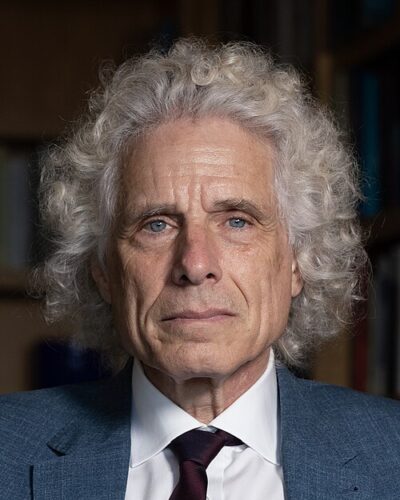
Steven Pinker
Steven Pinker is a Canadian-American cognitive psychologist, linguist, and author, an advocate of evolutionary psychology and the computational theory of the mind. Born September 18, 1954, in Montreal. Known for The Language Instinct, How the Mind Works and The Blank Slate. Educated at Wagar High School and Dawson College. Awards include APA Distinguished Scientific Award for an Early Career Contribution to Psychology, Boyd McCandless Award and Troland Research Awards.
Facts
55 facts · 1 confirmed by two sources · 35 cited · 19 from one source
Where this comes from
Papalocal keeps its own record. It started from these sources; what each one said is kept here as it was copied, so a change on their side never changes this page by itself. Tap one to read its version.
What Wikidata says · copied November 13, 2026 · revision 2558246052
- Described as
- Canadian-American cognitive psychologist, linguist, and author, an advocate of evolutionary psychology and the computational theory of the mind
- Other names
- Steven Arthur Pinker, Dr. Steven Pinker, Pinker, Steven
- Born
- September 18, 1954 · 4 references
- Born in
- Montreal · 4 references
- Citizen of
- United States; Canada
- Occupation
- psychologist · 2 references; linguist · 2 references; anthropologist; philosopher; university teacher; non-fiction writer · 1 reference; evolutionary psychologist · 1 reference; experimental psychologist · 1 reference
- Worked for
- Massachusetts Institute of Technology (1979–2003) · 2 references; Stanford University (1981–1982) · 1 reference; University of California, Santa Barbara (1995–1996) · 1 reference; Harvard University (2003–) · 2 references
- Education
- Wagar High School; Dawson College (–1973); McGill University (–1976) · 2 references; Harvard University (–1979) · 3 references
- Member of
- American Psychological Association; American Academy of Arts and Sciences; National Academy of Sciences · 1 reference; intellectual dark web · 1 reference
- Known for
- The Language Instinct · 2 references; How the Mind Works · 2 references; The Blank Slate · 1 reference; The Better Angels of Our Nature · 1 reference; Enlightenment Now · 1 reference; Words and Rules · 1 reference; The Sense of Style · 1 reference; The Stuff of Thought · 1 reference
- Awards
- APA Distinguished Scientific Award for an Early Career Contribution to Psychology (1984) · 1 reference; Boyd McCandless Award (1986) · 1 reference; Troland Research Awards (1993) · 2 references; Emperor Has No Clothes Award (2 times) (2004, 2017); Walter P. Kistler Book Award (2005); Humanist of the Year (2006); Richard Dawkins Award (2013) · 1 reference; William James Fellow Award (2016) · 1 reference; Carl Sagan Award for Public Understanding of Science (2018) · 1 reference; Fellow of the Cognitive Science Society; Fellow of the Committee for Skeptical Inquiry; Kistler Prize · 1 reference; honorary doctor of the University of Tromso
- Field
- experimental psychology; evolutionary psychology · 1 reference; linguistics · 1 reference
- Spouse
- Nancy Etcoff (1980–1992) · 1 reference; Ilavenil Subbiah (1995–2006) · 2 references; Rebecca Goldstein (2007–) · 1 reference
- Siblings
- Susan Pinker · 1 reference
- Religion
- atheism · 1 reference
- Lived in
- Boston · 1 reference
- Website
- http://stevenpinker.com/
- Wikipedias with a page
- 62
Wikidata item Q212730 (wikidata.org/wiki/Q212730), public domain (CC0). Copied November 13, 2026.
What Wikipedia says · copied November 13, 2026 · revision 1382261371
Steven Arthur Pinker (born September 18, 1954) is a Canadian cognitive psychologist, psycholinguist, popular science author, and public intellectual. He is an advocate of evolutionary psychology and the computational theory of mind. Pinker is the Johnstone Family professor of psychology at Harvard University.
Pinker specializes in visual cognition and developmental linguistics, as well as a number of experimental topics. He has written two technical books that propose a general theory of language acquisition. In particular, his work with Alan Prince posits that children use default rules sometimes in error but are obliged to learn irregular forms one by one. Pinker is the author of nine books for general audiences. The Language Instinct (1994), How the Mind Works (1997), Words and Rules (2000), The Blank Slate (2002), and The Stuff of Thought (2007) posit that language is an innate behavior shaped by natural selection and adapted to our communication needs. The Sense of Style (2014) is a general language-oriented style guide. The Better Angels of Our Nature (2010) posits that violence in human societies has generally declined over time, and identifies six major trends and five historical forces of this decline. Enlightenment Now (2018) further argues that the human condition has generally improved over recent history because of reason, science, and humanism. The nature and importance of reason is also discussed in his book Rationality: What It Is, Why It Seems Scarce, Why It Matters (2021).
In 2004, Pinker was named in Time's "The 100 Most Influential People in the World Today", and in 2005, 2008, 2010, and 2011 in Foreign Policy's list of "Top 100 Global Thinkers". He was also included in Prospect Magazine's top 10 "World Thinkers" in 2013. He has won awards from the American Psychological Association, the National Academy of Sciences, the Royal Institution, the Cognitive Neuroscience Society, and the American Humanist Association. He has served on the editorial boards of various journals and the advisory boards of several institutions. Pinker chaired the Usage Panel of the American Heritage Dictionary from 2008 to 2018.
- Born, in its opening lines
- September 18, 1954
From the Wikipedia article “Steven Pinker” (en.wikipedia.org/wiki/Steven_Pinker), by its contributors, under CC BY-SA 4.0 (creativecommons.org/licenses/by-sa/4.0/). Copied November 13, 2026; not changed.
Confirmed Two sources agree. Cited One source, and it names where it got it. One source One source, without a reference of its own. Sources disagree The sources disagree. We show the best-supported value and keep theirs below.
