
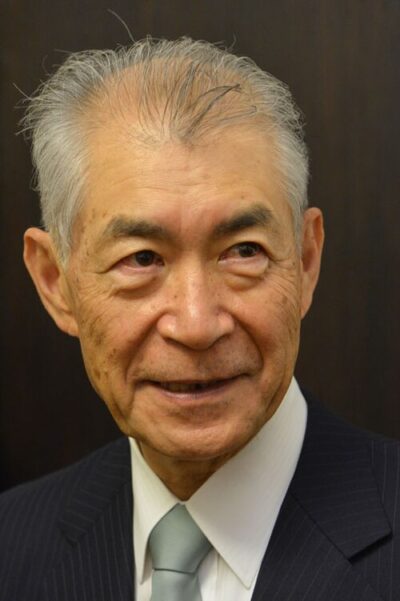
Tasuku Honjo
Tasuku Honjo is a Japanese professor of immunology and genomic medicine. Born January 27, 1942, in Kyoto. Educated at Kyoto University and Yamaguchi Prefectural Ube High School. Awards include Tang Prize, Asahi Prize and Imperial Prize of Japan Academy.
Facts
30 facts · 1 confirmed by two sources · 18 cited · 11 from one source
Where this comes from
Papalocal keeps its own record. It started from these sources; what each one said is kept here as it was copied, so a change on their side never changes this page by itself. Tap one to read its version.
What Wikidata says · copied November 16, 2026 · revision 2566823238
- Described as
- Japanese professor of immunology and genomic medicine (1942–)
- Born
- January 27, 1942 · 4 references
- Born in
- Kyoto · 1 reference
- Citizen of
- Japan
- Occupation
- immunologist · 1 reference; biochemist; university teacher; physician · 1 reference
- Worked for
- University of Tokyo; Kyoto University · 1 reference; University of Osaka; Hirosaki University
- Education
- Kyoto University; Yamaguchi Prefectural Ube High School
- Member of
- German Academy of Sciences Leopoldina (2003–) · 1 reference; National Academy of Sciences (2001–) · 1 reference; Japan Academy (2005–) · 1 reference
- Awards
- Tang Prize (2014) · 1 reference; Asahi Prize (1981) · 1 reference; Imperial Prize of Japan Academy (1996) · 1 reference; Person of Cultural Merit (2000); Robert Koch Prize (2012) · 2 references; Order of Culture (2013); William B. Coley Award (2014) · 1 reference; Keio Medical Science Prize (2016) · 1 reference; Kyoto Prize in Basic Sciences (2016) · 1 reference; Clarivate Citation Laureates (2016) · 1 reference; Warren Alpert Foundation Prize (2017) · 1 reference; Nobel Prize in Physiology or Medicine (2018) · 1 reference; honorary doctor of the Aix-Marseille University (2021) · 1 reference
- Field
- immunology
- Wikipedias with a page
- 58
Wikidata item Q2395341 (wikidata.org/wiki/Q2395341), public domain (CC0). Copied November 16, 2026.
What Wikipedia says · copied November 16, 2026 · revision 1381094924
Tasuku Honjo (本庶 佑, Honjo Tasuku; born January 27, 1942) is a Japanese physician-scientist and immunologist. He won the 2018 Nobel Prize in Physiology or Medicine and is best known for his identification of programmed cell death protein 1 (PD-1). He is also known for his molecular identification of cytokines IL-4 and IL-5, as well as the discovery of activation-induced cytidine deaminase (AID) that is essential for class switch recombination and somatic hypermutation.
He was elected as an international member of the National Academy of Sciences of the United States in 2001, a member of the German National Academy of Sciences Leopoldina in 2003, and as a member of the Japan Academy in 2005. In 2018, he was awarded a Nobel Prize with James P. Allison. He and Allison together had won the 2014 Tang Prize in Biopharmaceutical Science for the same achievement.
- Born, in its opening lines
- January 27, 1942
From the Wikipedia article “Tasuku Honjo” (en.wikipedia.org/wiki/Tasuku_Honjo), by its contributors, under CC BY-SA 4.0 (creativecommons.org/licenses/by-sa/4.0/). Copied November 16, 2026; not changed.
Confirmed Two sources agree. Cited One source, and it names where it got it. One source One source, without a reference of its own. Sources disagree The sources disagree. We show the best-supported value and keep theirs below.
