
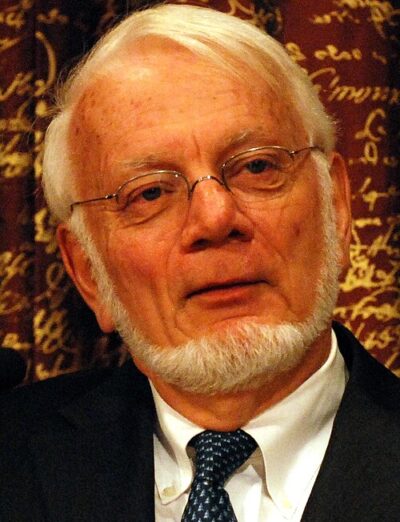
Thomas A. Steitz
Thomas A. Steitz was an American biochemist. Born August 23, 1940, in Milwaukee. Died October 9, 2018, in Branford. Educated at Harvard University and Lawrence University. Awards include Nobel Prize in Chemistry, Keio Medical Science Prize and Canada Gairdner International Award.
Facts
37 facts · 2 confirmed by two sources · 15 cited · 20 from one source
Where this comes from
Papalocal keeps its own record. It started from these sources; what each one said is kept here as it was copied, so a change on their side never changes this page by itself. Tap one to read its version.
What Wikidata says · copied November 13, 2026 · revision 2563198076
- Described as
- American biochemist (1940–2018)
- Other names
- Thomas Arthur Steitz, Thomas A Steitz, Thomas Steitz
- Born
- August 23, 1940 · 7 references
- Died
- October 9, 2018 · 3 references
- Born in
- Milwaukee · 3 references
- Died in
- Branford
- Buried in
- Grove Street Cemetery · 1 reference
- Cause of death
- pancreatic cancer · 1 reference
- Citizen of
- United States · 3 references
- Occupation
- biochemist; molecular biologist; university teacher · 2 references; chemist · 3 references; crystallographer; biophysicist; biologist
- Worked for
- Yale School of Medicine · 1 reference
- Education
- Harvard University (–1966) · 2 references; Lawrence University; Wauwatosa East High School · 1 reference
- Member of
- Royal Society of London (2011); National Academy of Sciences · 1 reference; American Academy of Arts and Sciences; American Association for the Advancement of Science · 1 reference
- Awards
- Nobel Prize in Chemistry (2009) · 2 references; Keio Medical Science Prize (2006) · 1 reference; Canada Gairdner International Award (2007); Pfizer Award in Enzyme Chemistry (1980); Rosenstiel Award (2000) · 1 reference; Sir Hans Krebs Medal (2000); Sterling Professor; Honorary Doctorate of University of Buenos Aires; Foreign Member of the Royal Society (2011) · 1 reference; Newcomb Cleveland Prize; honorary doctor of the University of Bordeaux (2014) · 1 reference; Fellow of the American Association for the Advancement of Science (2007) · 1 reference
- Field
- crystallography
- Spouse
- Joan A. Steitz · 1 reference
- Lived in
- United States
- Wikipedias with a page
- 58
Wikidata item Q109559 (wikidata.org/wiki/Q109559), public domain (CC0). Copied November 13, 2026.
What Wikipedia says · copied November 13, 2026 · revision 1381366328
Thomas Arthur Steitz (August 23, 1940 – October 9, 2018) was an American biochemist, a Sterling Professor of Molecular Biophysics and Biochemistry at Yale University, and investigator at the Howard Hughes Medical Institute, best known for his pioneering work on the ribosome.
Steitz was awarded the 2009 Nobel Prize in Chemistry along with Venkatraman Ramakrishnan and Ada Yonath "for studies of the structure and function of the ribosome". Steitz also won the Gairdner International Award in 2007 "for his studies on the structure and function of the ribosome which showed that the peptidyl transferase (EC 2.3.2.12) was an RNA catalyzed reaction, and for revealing the mechanism of inhibition of this function by antibiotics".
- Born, in its opening lines
- August 23, 1940
- Died, in its opening lines
- October 9, 2018
From the Wikipedia article “Thomas A. Steitz” (en.wikipedia.org/wiki/Thomas_A._Steitz), by its contributors, under CC BY-SA 4.0 (creativecommons.org/licenses/by-sa/4.0/). Copied November 13, 2026; not changed.
Confirmed Two sources agree. Cited One source, and it names where it got it. One source One source, without a reference of its own. Sources disagree The sources disagree. We show the best-supported value and keep theirs below.
