
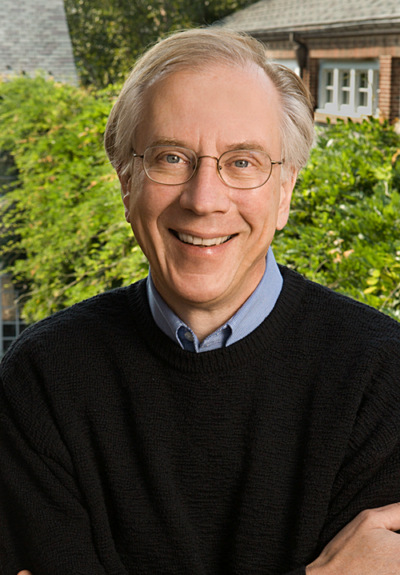
Thomas Cech
Thomas Cech is an American chemist, biochemistry professor. Born December 8, 1947, in Chicago. Educated at University of California, Berkeley and Grinnell College. Awards include Guggenheim Fellowship, Albert Lasker Award for Basic Medical Research and Nobel Prize in Chemistry.
Facts
34 facts · 1 confirmed by two sources · 13 cited · 20 from one source
Where this comes from
Papalocal keeps its own record. It started from these sources; what each one said is kept here as it was copied, so a change on their side never changes this page by itself. Tap one to read its version.
What Wikipedia says · copied November 13, 2026 · revision 1382359367
Thomas Robert Cech (born 8 December 1947) is an American chemist who shared the 1989 Nobel Prize in Chemistry with Sidney Altman “for their discovery of catalytic properties of RNA.”
Cech discovered that RNA could itself cut strands of RNA, suggesting that life might have started as RNA. He found that RNA can not only transmit instructions, but can act as a catalyst to speed up the necessary reactions.
He has also studied telomeres, and his lab discovered an enzyme, TERT (telomerase reverse transcriptase), which is part of the process of restoring telomeres after they are shortened during cell division.
As president of Howard Hughes Medical Institute (2000–2008) he promoted science education, and he teaches an undergraduate chemistry course at the University of Colorado.
- Born, in its opening lines
- December 8, 1947
From the Wikipedia article “Thomas Cech” (en.wikipedia.org/wiki/Thomas_Cech), by its contributors, under CC BY-SA 4.0 (creativecommons.org/licenses/by-sa/4.0/). Copied November 13, 2026; not changed.
What Wikidata says · copied November 14, 2026 · revision 2569090354
- Described as
- American chemist, biochemistry professor
- Other names
- Thomas Robert Cech, Thomas R. Cech
- Born
- December 8, 1947 · 4 references
- Born in
- Chicago · 1 reference
- Citizen of
- United States
- Occupation
- biochemist; chemist · 1 reference; university teacher · 1 reference
- Worked for
- University of Colorado; University of Colorado Boulder · 1 reference
- Education
- University of California, Berkeley; Grinnell College; Iowa City High School
- Member of
- National Academy of Sciences; American Academy of Arts and Sciences; European Molecular Biology Organization; Academia Europaea (1999–) · 1 reference
- Awards
- Guggenheim Fellowship (1985) · 1 reference; Albert Lasker Award for Basic Medical Research (1988) · 1 reference; Nobel Prize in Chemistry (1989) · 2 references; Canada Gairdner International Award (1988); Pfizer Award in Enzyme Chemistry (1985); National Medal of Science (1995); Louisa Gross Horwitz Prize (1988) · 1 reference; Dr H.P. Heineken Prize for Biochemistry and Biophysics (1988); Rosenstiel Award (1988); NAS Award in Molecular Biology (1987) · 1 reference; Fellow of the AACR Academy (2016); honorary doctor of Harvard University (2010) · 1 reference; Othmer Gold Medal (2007) · 1 reference; Newcomb Cleveland Prize (1986); Distinguished Eagle Scout Award · 1 reference
- Field
- biochemistry; molecular biology, genetics, and bioengineering · 1 reference; cancer biology
- Website
- https://experts.colorado.edu/display/fisid_103252
- Wikipedias with a page
- 55
Wikidata item Q135180 (wikidata.org/wiki/Q135180), public domain (CC0). Copied November 14, 2026.
Confirmed Two sources agree. Cited One source, and it names where it got it. One source One source, without a reference of its own. Sources disagree The sources disagree. We show the best-supported value and keep theirs below.
