
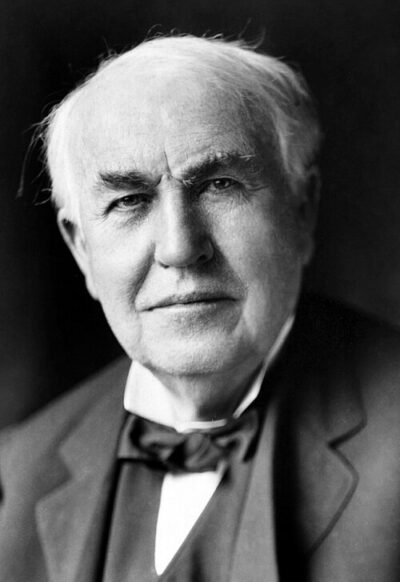
Thomas Edison
Thomas Edison was an American inventor and businessman. Born February 11, 1847, in Milan. Died October 18, 1931, in West Orange. Known for incandescent light bulb and phonograph. Educated at Cooper Union. Awards include Congressional Gold Medal, Commander of the Legion of Honour and Grammy Trustees Award.
Facts
61 facts · 2 confirmed by two sources · 18 cited · 41 from one source
Where this comes from
Papalocal keeps its own record. It started from these sources; what each one said is kept here as it was copied, so a change on their side never changes this page by itself. Tap one to read its version.
What Wikidata says · copied November 13, 2026 · revision 2567566000
- Described as
- American inventor and businessman (1847–1931)
- Other names
- Thomas A. Edison, Thomas Alva Edison, Edison
- Born
- February 11, 1847 · 12 references
- Died
- October 18, 1931 · 12 references
- Born in
- Milan · 2 references
- Died in
- West Orange · 2 references
- Buried in
- Thomas Edison National Historical Park · 1 reference
- Cause of death
- type 2 diabetes · 1 reference
- Name at birth
- Thomas Alva Edison
- Citizen of
- United States
- Occupation
- engineer · 2 references; inventor · 4 references; entrepreneur · 2 references; physicist · 2 references; mathematician · 1 reference; screenwriter · 1 reference; film director; film producer · 1 reference
- Worked for
- General Electric; Continental Edison
- Education
- Cooper Union (1875–1879)
- Member of
- National Academy of Sciences (1927–); Royal Swedish Academy of Sciences; American Philosophical Society (1896–); Academy of Sciences of the USSR; Russian Academy of Sciences; Naval Advisory Board of Inventions
- Known for
- incandescent light bulb; phonograph
- Awards
- Congressional Gold Medal (1928); Commander of the Legion of Honour (1889); Grammy Trustees Award (1977); Benjamin Franklin Medal; Matteucci Medal (1887); Rumford Prize (1895) · 1 reference; John Scott Award (2 times) (1889, 1929) · 1 reference; Franklin Medal (1915); National Inventors Hall of Fame (1973) · 2 references; Navy Distinguished Service Medal (1920) · 1 reference; Albert Medal (1892) · 1 reference; Edward Longstreth Medal (1899); Technical Grammy Award (2010); John Fritz Medal (1908) · 1 reference; honorary doctor of Rutgers University
- Field
- invention · 1 reference; entrepreneurship · 1 reference; electrical engineering · 1 reference; engineering; inventor · 1 reference; entrepreneur · 1 reference
- Spouse
- Mary Stilwell Edison (1871–1884) · 1 reference; Mina Miller (1886–1931) · 1 reference
- Children
- Charles Edison · 1 reference; Theodore Miller Edison; Thomas Alva Edison Jr. · 1 reference; Marion Estelle Edison Oeser; Madeleine Edison; William Leslie Edison · 1 reference
- Father
- Samuel Ogden Edison · 1 reference
- Mother
- Nancy Elliott · 1 reference
- Siblings
- Carlisle Snow Edison
- Religion
- deism
- Lived in
- Thomas Edison Winter Estate · 1 reference
- Wikipedias with a page
- 256
Wikidata item Q8743 (wikidata.org/wiki/Q8743), public domain (CC0). Copied November 13, 2026.
What Wikipedia says · copied November 13, 2026 · revision 1381361637
Thomas Alva Edison (February 11, 1847 – October 18, 1931) was an American inventor and businessman known for his work on the incandescent light bulb, the phonograph, electric power distribution and early motion pictures. The merger of the Edison General Electric Company and the competitor Thomson-Houston Electric Company resulted in the formation of General Electric. Edison registered 1,093 patents in the United States.
Edison was born in Milan, Ohio, but grew up in Michigan with little formal schooling. He became deaf as a child and learned through books and tinkering. Edison began working at a young age; as a railroad telegrapher, he spent much of his time inventing improvements to telegraph systems. By the age of 22, he had sold a few of his early inventions and moved to New York City to focus on engineering. He had three children with his first wife, Mary, but Edison was neglectful. She died at 29 years old. Edison had troubled relationships with his children for the rest of his life. With the help of friends, the inventor attracted investment and grew his company. By the age of 29, he owned a telegraph recorder factory in Newark with over one hundred employees.
Edison expanded, developing Menlo Park, now considered the first industrial research laboratory. Edison, known as "The Wizard of Menlo Park", drove his staff extremely hard and constantly worked himself and his associates to exhaustion. The inventor also drove up investment and publicity. He rose to international fame with the invention of the phonograph which took many years to turn into a commercial success. He later built a larger research lab in West Orange, New Jersey.
In 1878, Edison began working on an electrical lighting system which he hoped would replace the common gas lamp. Going from electrical light bulb to the modern electric grid took decades of invention, investment, and influence. Edison and his colleagues had the opportunity to get enormously wealthy as they designed and built a nation of light bulbs, generators, and electric distribution systems. Competition with Westinghouse's AC system forced Edison to yield and resulted in the creation of General Electric.
Edison simultaneously created a mining company, which was never profitable, and he nearly went bankrupt. As his role in the illumination business declined, he established a cement company and began work on a motion picture camera. The motion picture camera went from an invention to the first movie production studio. He traveled around the United States and Europe promoting his many innovations, during which he met Mina, his second wife. They had three children together, and Edison was again neglectful. During their adulthood, he began to take more interest in his sons and they eventually worked for him. Charles Edison took over his father's business when he died. In addition to acute health issues from handling toxic and radioactive chemicals during his various experiments, Thomas faced a lifelong battle against diabetes. He worked vigorously until his death. Following the success of the illumination business, he ran several companies which produced batteries, movies, musical records, and phenol. His last obsession was the search for domestic rubber production.
- Born, in its opening lines
- February 11, 1847
- Died, in its opening lines
- October 18, 1931
From the Wikipedia article “Thomas Edison” (en.wikipedia.org/wiki/Thomas_Edison), by its contributors, under CC BY-SA 4.0 (creativecommons.org/licenses/by-sa/4.0/). Copied November 13, 2026; not changed.
Confirmed Two sources agree. Cited One source, and it names where it got it. One source One source, without a reference of its own. Sources disagree The sources disagree. We show the best-supported value and keep theirs below.
