
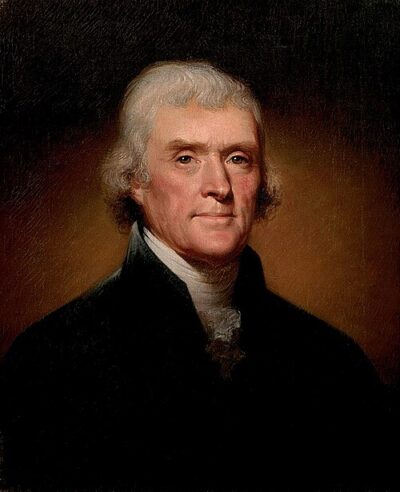
Thomas Jefferson
Thomas Jefferson was a Founding Father, U.S. president from 1801 to 1809. Born April 2, 1743, in Shadwell. Died July 4, 1826, in Monticello. Positions held include Vice President of the United States (1797–1801), United States Secretary of State (1790–1793) and United States Ambassador to France (1785–1789). Educated at College of William & Mary. Awards include Fellow of the American Academy of Arts and Sciences.
Facts
58 facts · 1 confirmed by two sources · 25 cited · 30 from one source · 2 where the sources disagree
What’s different
- Born: we show April 2, 1743 (Sources disagree). Wikipedia says April 13, 1743
- Buried in: we show Monticello (Sources disagree). Wikidata also lists grave of Thomas Jefferson
Where this comes from
Papalocal keeps its own record. It started from these sources; what each one said is kept here as it was copied, so a change on their side never changes this page by itself. Tap one to read its version.
What Wikidata says · copied November 13, 2026 · revision 2568753283
- Described as
- Founding Father, U.S. president from 1801 to 1809 (1743–1826)
- Other names
- T. Jefferson, President Jefferson
- Born
- April 2, 1743 · 2 references
- Died
- July 4, 1826 · 20 references
- Born in
- Shadwell · 1 reference
- Died in
- Monticello · 1 reference
- Buried in
- grave of Thomas Jefferson; Monticello · 1 reference
- Cause of death
- uremia · 1 reference
- Citizen of
- United States
- Occupation
- teacher; cryptographer; architect · 4 references; lawyer; writer · 2 references; diplomat; politician · 2 references; philosopher
- Positions held
- Vice President of the United States (1797–1801) · 1 reference; United States Secretary of State (1790–1793); United States Ambassador to France (1785–1789); Governor of Virginia (1779–1781); President of the United States (1801–1809); President-elect of the United States (1801); member of the Virginia House of Delegates · 1 reference
- Political party
- Democratic-Republican Party
- Education
- College of William & Mary
- Member of
- American Philosophical Society (1780–); American Academy of Arts and Sciences; Académie des Inscriptions et Belles-Lettres (1801–1826) · 1 reference; Royal Netherlands Academy of Arts and Sciences; Warsaw Society of Friends of Learning; American Antiquarian Society
- Instrument
- violin
- Awards
- Fellow of the American Academy of Arts and Sciences (1787–) · 1 reference
- Field
- plantation; law · 1 reference; philosophy · 1 reference; diplomacy · 1 reference; architecture · 1 reference
- Spouse
- Martha Jefferson (1772–1782) · 2 references
- Children
- Martha Jefferson Randolph · 1 reference; Mary Jefferson Eppes · 1 reference; Madison Hemings; Harriet Hemings; Eston Hemings; Jane Randolph Jefferson · 1 reference; unnamed son Jefferson · 1 reference; Lucy Elizabeth Jefferson I · 1 reference; Lucy Elizabeth Jefferson II · 1 reference
- Father
- Peter Jefferson · 1 reference
- Mother
- Jane Randolph Jefferson · 1 reference
- Siblings
- Lucy Jefferson Lewis; Randolph Jefferson · 1 reference; Martha Jefferson Carr · 1 reference; Anna Scott Jefferson · 1 reference
- Religion
- deism · 2 references; Anglicanism · 1 reference
- Lived in
- Monticello; Hôtel de Langeac
- Height
- 1.89 m (6 ft 2 in) · 1 reference; 1.89 m (6 ft 2 in) · 1 reference
- Wikipedias with a page
- 225
Wikidata item Q11812 (wikidata.org/wiki/Q11812), public domain (CC0). Copied November 13, 2026.
What Wikipedia says · copied November 13, 2026 · revision 1384663719
Thomas Jefferson (April 13 [O.S. April 2], 1743 – July 4, 1826) was a Founding Father and the third president of the United States, serving from 1801 to 1809. A prolific writer and philosopher, Jefferson was the primary author of the Declaration of Independence. His political philosophy formed the basis for Jeffersonian democracy, which dominated early American politics alongside federalism. Jefferson remains celebrated as an icon of American political values, but is also controversial for being a lifelong slave owner.
Born into a slave-owning family in Shadwell, Virginia, Jefferson emerged as an ideological leader of the American Revolution through his fierce advocacy for civil liberties, including the freedoms of speech, religion, and thought. He was elected to represent Virginia in the Second Continental Congress in 1775 and selected a member of the Committee of Five. Jefferson drafted the Declaration of Independence largely alone, and the document was unanimously passed by the Congress in 1776. Jefferson was appointed U.S. Minister to France in 1785 by the Confederation Congress, maintaining the American–French alliance against the British. He was appointed the first U.S. Secretary of State by President George Washington in 1790, helping administer Washington's policy of neutrality in European conflicts. Jefferson and his political ally James Madison founded the Democratic-Republican Party in 1792, centered on republicanism, individual rights, agrarianism, and limited government. Running against Federalist Party candidate John Adams in 1796, Jefferson finished with the second-highest number of votes and became Adams's vice president. He ran again in 1800, winning against Adams, and in 1804 overwhelmingly defeating the Federalists' Charles Cotesworth Pinckney of South Carolina.
Jefferson's presidency assertively defended the nation's shipping and trade interests against Barbary pirates and aggressive British trade policies, promoted a western expansionist policy with the Louisiana Purchase, which doubled the nation's geographic size, and reduced military forces and expenditures following successful negotiations with France. In his second presidential term, he was beset by difficulties at home, including the trial of his former vice president Aaron Burr. In 1807, Jefferson implemented the Embargo Act to defend the nation's industries from British threats to U.S. shipping, limit foreign trade, and stimulate the birth of American manufacturing.
Jefferson is ranked among the upper tier of U.S. presidents both by scholars and in public opinion. Presidential scholars and historians have praised Jefferson's advocacy of religious freedom and tolerance, his peaceful acquisition of the Louisiana Territory from France, and his leadership in supporting the Lewis and Clark Expedition. They acknowledge his lifelong ownership of large numbers of slaves, but offer varying interpretations of his views on and relationship with slavery.
- Born, in its opening lines
- April 13, 1743
- Died, in its opening lines
- July 4, 1826
From the Wikipedia article “Thomas Jefferson” (en.wikipedia.org/wiki/Thomas_Jefferson), by its contributors, under CC BY-SA 4.0 (creativecommons.org/licenses/by-sa/4.0/). Copied November 13, 2026; not changed.
Confirmed Two sources agree. Cited One source, and it names where it got it. One source One source, without a reference of its own. Sources disagree The sources disagree. We show the best-supported value and keep theirs below.
