
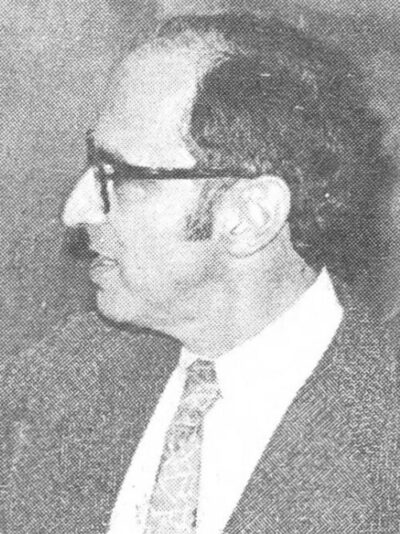
Thomas Kuhn
Thomas Kuhn was an American historian, physicist and philosopher. Born July 18, 1922, in Cincinnati. Died June 17, 1996, in Cambridge. Known for The Structure of Scientific Revolutions and The Copernican Revolution. Educated at Harvard University (3 times) and Hessian Hills School. Awards include Guggenheim Fellowship, John Desmond Bernal Prize and George Sarton Medal.
Facts
41 facts · 2 confirmed by two sources · 8 cited · 31 from one source
Where this comes from
Papalocal keeps its own record. It started from these sources; what each one said is kept here as it was copied, so a change on their side never changes this page by itself. Tap one to read its version.
What Wikidata says · copied November 13, 2026 · revision 2565595175
- Described as
- American historian, physicist and philosopher (1922 – 1996)
- Other names
- Thomas Samuel Kuhn, Thomas S. Kuhn
- Born
- July 18, 1922 · 11 references
- Died
- June 17, 1996 · 10 references
- Born in
- Cincinnati · 1 reference
- Died in
- Cambridge · 1 reference
- Cause of death
- lung cancer · 1 reference
- Citizen of
- United States
- Occupation
- physicist · 1 reference; historian of science · 2 references; philosopher of science; university teacher · 1 reference; philosopher · 1 reference
- Worked for
- Princeton University; Harvard University; Massachusetts Institute of Technology; University of California, Berkeley
- Education
- Harvard University (3 times) (1943–1949) · 1 reference; Hessian Hills School (–1937); Taft School (–1940)
- Member of
- German Academy of Sciences Leopoldina · 1 reference; European Academy of Sciences and Arts; Harvard Society of Fellows; American Academy of Arts and Sciences; International Academy of the History of Science; National Academy of Sciences (1979–); American Philosophical Society (1974–)
- Known for
- The Structure of Scientific Revolutions · 1 reference; The Copernican Revolution · 1 reference
- Awards
- Guggenheim Fellowship (1954) · 1 reference; John Desmond Bernal Prize (1983); George Sarton Medal (1982); honorary doctor of the University of Padua
- Field
- philosophy of science; analytic philosophy; history of science · 1 reference
- Spouse
- Jehane Barton Burns; Kathryn Muhs
- Father
- Samuel Kuhn
- Lived in
- Cambridge (–1996); Cincinnati; Berkeley; Princeton
- Wikipedias with a page
- 78
Wikidata item Q184980 (wikidata.org/wiki/Q184980), public domain (CC0). Copied November 13, 2026.
What Wikipedia says · copied November 13, 2026 · revision 1385457154
Thomas Samuel Kuhn (; July 18, 1922 – June 17, 1996) was an American historian and philosopher of science whose 1962 book The Structure of Scientific Revolutions was influential in both academic and popular circles. The book popularized the term paradigm shift, which has since become an English-language idiom.
Kuhn made several claims concerning the progress of scientific knowledge: that scientific fields undergo periodic "paradigm shifts" rather than solely progressing in a linear and continuous way, and that these paradigm shifts open up new approaches to understanding what scientists would never have considered valid before; and that the notion of scientific truth, at any given moment, cannot be established solely by objective criteria but is defined by a consensus of a scientific community. Competing paradigms are frequently incommensurable; that is, there is no one-to-one correspondence of assumptions and terms. Thus, our comprehension of science can never rely wholly upon "objectivity" alone. Science must account for subjective perspectives as well, since all objective conclusions are ultimately founded upon the subjective conditioning/worldview of its researchers and participants.
- Born, in its opening lines
- July 18, 1922
- Died, in its opening lines
- June 17, 1996
From the Wikipedia article “Thomas Kuhn” (en.wikipedia.org/wiki/Thomas_Kuhn), by its contributors, under CC BY-SA 4.0 (creativecommons.org/licenses/by-sa/4.0/). Copied November 13, 2026; not changed.
Confirmed Two sources agree. Cited One source, and it names where it got it. One source One source, without a reference of its own. Sources disagree The sources disagree. We show the best-supported value and keep theirs below.
