
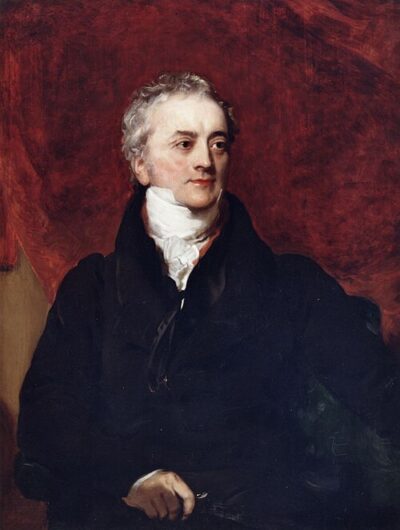
Thomas Young
Thomas Young was an English polymath. Born June 13, 1773, in Milverton. Died May 10, 1829, in London. Known for double-slit experiment, Wave theory of light and astigmatism. Educated at University of Edinburgh and Emmanuel College. Awards include Fellow of the Royal Society, Croonian Medal and Lecture and Royal Society Bakerian Medal.
Facts
50 facts · 2 confirmed by two sources · 21 cited · 27 from one source
Where this comes from
Papalocal keeps its own record. It started from these sources; what each one said is kept here as it was copied, so a change on their side never changes this page by itself. Tap one to read its version.
What Wikidata says · copied November 16, 2026 · revision 2564322762
- Described as
- English polymath (1773-1829)
- Other names
- Tomas Yunq
- Born
- June 13, 1773 · 11 references
- Died
- May 10, 1829 · 10 references
- Born in
- Milverton · 3 references
- Died in
- London · 3 references
- Buried in
- Church of St Giles the Abbot · 1 reference
- Citizen of
- United Kingdom of Great Britain and Ireland · 1 reference
- Occupation
- astronomer; physicist · 3 references; anthropologist; physician · 2 references; archaeologist; university teacher; physiologist; entomologist
- Worked for
- Royal Society of London (1804–1829) · 2 references; Hudson Gurney (1787–1792) · 1 reference; Royal Institution (1801–1803) · 1 reference; St George's Hospital (1811–) · 1 reference
- Education
- University of Edinburgh (1794–1795) · 1 reference; Emmanuel College (1797–1798) · 1 reference; University of Göttingen (1795–1796) · 1 reference; St Bartholomew's Medical College (1792–1794) · 1 reference
- Member of
- Royal Society of London (1794–); Royal Swedish Academy of Sciences; American Academy of Arts and Sciences; French Academy of Sciences · 1 reference; Royal Netherlands Academy of Arts and Sciences · 1 reference; Academy of Sciences of Turin (1827–) · 1 reference
- Known for
- double-slit experiment · 1 reference; Wave theory of light; astigmatism; Young–Dupré Equation; Young–Helmholtz theory; Young–Laplace equation; Young temperament; Young's modulus
- Awards
- Fellow of the Royal Society (1794) · 1 reference; Croonian Medal and Lecture (1808) · 1 reference; Royal Society Bakerian Medal (1803) · 3 references; Fellow of the American Academy of Arts and Sciences (1822) · 1 reference
- Field
- physics · 1 reference; mechanics; linguistics; materials science
- Spouse
- Eliza Maxwell (1804–) · 1 reference
- Father
- Thomas Young · 1 reference
- Mother
- Sarah Davies · 1 reference
- Religion
- Quakers (–1804) · 1 reference; Anglicanism (1804–) · 1 reference
- Lived in
- 48, Welbeck Street W1
- Wikipedias with a page
- 91
Wikidata item Q25820 (wikidata.org/wiki/Q25820), public domain (CC0). Copied November 16, 2026.
What Wikipedia says · copied November 16, 2026 · revision 1385369532
Thomas Young (13 June 1773 – 10 May 1829) was a British polymath who made notable contributions to the fields of vision, light, solid mechanics, energy, physiology, language, musical harmony, and Egyptology. He was instrumental in the decipherment of Egyptian hieroglyphs, specifically the Rosetta Stone.
Young's work influenced that of William Herschel, Hermann von Helmholtz, James Clerk Maxwell, and Albert Einstein. Young is credited with establishing Christiaan Huygens' wave theory of light, in contrast to the corpuscular theory of Isaac Newton. Young's work was subsequently supported by the work of Augustin-Jean Fresnel.
- Born, in its opening lines
- June 13, 1773
- Died, in its opening lines
- May 10, 1829
From the Wikipedia article “Thomas Young (scientist)” (en.wikipedia.org/wiki/Thomas_Young_(scientist)), by its contributors, under CC BY-SA 4.0 (creativecommons.org/licenses/by-sa/4.0/). Copied November 16, 2026; not changed.
Confirmed Two sources agree. Cited One source, and it names where it got it. One source One source, without a reference of its own. Sources disagree The sources disagree. We show the best-supported value and keep theirs below.
