
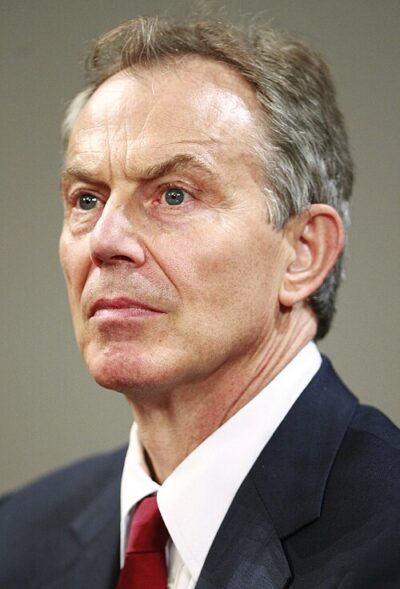
Tony Blair
Tony Blair is a Prime Minister of the United Kingdom from 1997 to 2007. Born May 6, 1953, in Edinburgh. Positions held include Shadow Home Secretary (1992–1994), Prime Minister of the United Kingdom (1997–2007) and Leader of the Labour Party (1994–2007). Educated at St John's College and Fettes College. Awards include Charlemagne Prize, Presidential Medal of Freedom and Philadelphia Liberty Medal.
Facts
53 facts · 1 confirmed by two sources · 27 cited · 25 from one source
Where this comes from
Papalocal keeps its own record. It started from these sources; what each one said is kept here as it was copied, so a change on their side never changes this page by itself. Tap one to read its version.
What Wikidata says · copied November 16, 2026 · revision 2562947227
- Described as
- Prime Minister of the United Kingdom from 1997 to 2007
- Other names
- Rt. Hon. Anthony Charles Lynton Blair, Anthony Charles Lynton Blair, Sir Tony Blair, Rt. Hon. Tony Blair, The Rt. Hon. Sir Anthony Charles Lynton Blair PC KC, Anthony Blair, Sir Anthony Charles Lynton Blair
- Born
- May 6, 1953 · 13 references
- Born in
- Edinburgh · 3 references
- Citizen of
- United Kingdom
- Occupation
- politician · 2 references; diplomat; lawyer; autobiographer; jurist · 1 reference
- Positions held
- Shadow Home Secretary (1992–1994) · 1 reference; Prime Minister of the United Kingdom (1997–2007) · 1 reference; Leader of the Labour Party (1994–2007) · 2 references; First Lord of the Treasury (1997–2007); Member of the Privy Council of the United Kingdom (1994–) · 1 reference; member of the 54th Parliament of the United Kingdom (2005–2007) · 1 reference; member of the 53rd Parliament of the United Kingdom (2001–2005) · 1 reference; member of the 52nd Parliament of the United Kingdom (1997–2001) · 1 reference; member of the 51st Parliament of the United Kingdom (1992–1997) · 1 reference; member of the 50th Parliament of the United Kingdom (1987–1992) · 1 reference; member of the 49th Parliament of the United Kingdom (1983–1987) · 1 reference; Shadow Secretary of State for Energy Security and Net Zero (1988–1989) · 1 reference; Shadow Secretary of State for Employment (1989–1992) · 1 reference; Leader of the Opposition (1994–1997)
- Political party
- Labour Party
- Worked for
- Yale University; Quartet on the Middle East (2007–2015)
- Education
- St John's College (–1976); Fettes College · 1 reference; City Law School; Chorister School (1961–1966) · 1 reference; St. Peter's Boys School
- Member of
- Order of the Garter (2022–)
- Awards
- Charlemagne Prize (1999) · 1 reference; Presidential Medal of Freedom (2009) · 2 references; Philadelphia Liberty Medal; Thomas J. Dodd Prize in International Justice and Human Rights (2003); Congressional Gold Medal; Dan David Prize (2009) · 1 reference; honorary doctorate of Haifa University; honorary doctor of the Hebrew University of Jerusalem; Knight of the Garter (2022) · 1 reference; Financial Times Person of the Year (1997)
- Spouse
- Cherie Blair (1980–) · 2 references
- Children
- Euan Blair · 1 reference; Nicholas Blair · 1 reference; Kathryn Blair · 1 reference; Leo George Blair · 1 reference
- Father
- Leo Blair · 3 references
- Mother
- Hazel Elizabeth Rosaleen Corscaden · 1 reference
- Siblings
- William Blair · 1 reference
- Religion
- Catholic Church (2007–); Anglicanism (–2007)
- Height
- 1.83 m (6 ft 0 in) · 1 reference
- Website
- https://institute.global/
- Wikipedias with a page
- 156
Wikidata item Q9545 (wikidata.org/wiki/Q9545), public domain (CC0). Copied November 16, 2026.
What Wikipedia says · copied November 16, 2026 · revision 1385760151
Sir Anthony Charles Lynton Blair (born 6 May 1953) is a British politician who served as Prime Minister of the United Kingdom from 1997 to 2007 and Leader of the Labour Party from 1994 to 2007. He was Leader of the Opposition from 1994 to 1997, held shadow cabinet posts from 1987 to 1994, and was Member of Parliament (MP) for Sedgefield from 1983 to 2007. He is the longest-serving Labour prime minister and only person to lead Labour to three consecutive general election victories. Blair founded the Tony Blair Institute for Global Change in 2016 and serves as its executive chairman.
Blair attended the independent school Fettes College, studied law at St John's College, Oxford, and worked as a barrister. He became involved in the Labour Party and was elected to the House of Commons in 1983 for Sedgefield. Blair supported moving Labour to the political centre of British politics. He was appointed to Neil Kinnock's shadow cabinet in 1988 and as shadow home secretary by John Smith in 1992. Following Smith's death in 1994, Blair won the Labour leadership election, and went on to rebrand the party as "New Labour". He became the youngest prime minister of the 20th century after Labour won a landslide of 418 seats in the 1997 general election, ending 18 years in opposition. It was the first Labour victory for 23 years.
During his first term, Blair enacted constitutional reforms and increased public spending on healthcare and education, while introducing market-based reforms in these areas. He introduced a minimum wage, tuition fees for higher education, devolution in Scotland and Wales, expansion of LGBTQ rights and significant progress in the Northern Ireland peace process with the landmark Good Friday Agreement. He oversaw successful interventions in Kosovo in 1999 and Sierra Leone in 2000. Blair secured a second term with another landslide victory in 2001. These years in office were shaped by the 9/11 terrorist attacks, resulting in the war on terror. Blair supported the 2003 invasion of Iraq and had British Forces participate in the Iraq War, on the false beliefs that Saddam Hussein's regime had weapons of mass destruction and ties with al-Qaeda. The invasion was controversial and attracted widespread opposition. As the casualties of the Iraq War mounted, Blair was accused of misleading Parliament and his popularity dropped. He won a third term in the 2005 general election, but with a reduced majority. He pushed for more public sector reform and brokered an agreement to restore powersharing in Northern Ireland. Amid the Cash-for-Honours scandal, Blair was interviewed as a witness. In 2006, Blair announced he would resign within a year. He resigned as party leader and prime minister in June 2007, and was succeeded by Gordon Brown, his chancellor; on the day he ceased to be prime minister, he gave up his parliamentary seat.
Blair was immediately appointed special envoy of the Quartet on the Middle East, a post he held until 2015. He has been chairman of the Tony Blair Institute for Global Change since 2016, made political interventions, and influenced Keir Starmer. In 2009, Blair was awarded the Presidential Medal of Freedom by George W. Bush. Since leaving office, Blair has played a crucial role in the creation and development of the Board of Peace seeking to govern a post-Hamas Gaza Strip.
Blair has been among the most popular and unpopular politicians in British history; as prime minister, he achieved the highest recorded approval ratings in his first term, but one of the lowest after the Iraq War. The 2016 Iraq Inquiry report gave a damning assessment of Blair's role in the Iraq War. Blair is rated as above average in historical rankings and public opinion of British prime ministers. Followers of his political philosophy, known as Blairism, are often called "Blairites", which has also become a more general term to refer to those on the right of the Labour Party.
- Born, in its opening lines
- May 6, 1953
From the Wikipedia article “Tony Blair” (en.wikipedia.org/wiki/Tony_Blair), by its contributors, under CC BY-SA 4.0 (creativecommons.org/licenses/by-sa/4.0/). Copied November 16, 2026; not changed.
Confirmed Two sources agree. Cited One source, and it names where it got it. One source One source, without a reference of its own. Sources disagree The sources disagree. We show the best-supported value and keep theirs below.
