
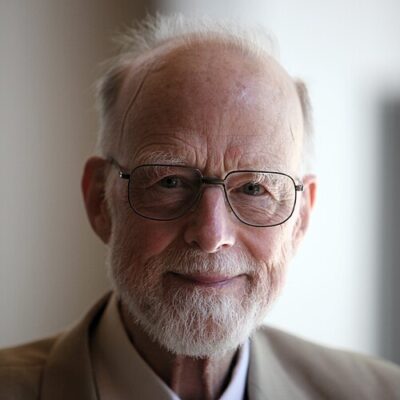
Tony Hoare
Tony Hoare was a British computer scientist. Born January 11, 1934, in Colombo. Died March 5, 2026, in Cambridge. Known for quicksort, Hoare logic and communicating sequential processes. Educated at Lomonosov Moscow State University and Merton College. Awards include Fellow of the Royal Society, Turing Award and IEEE John von Neumann Medal.
Facts
52 facts · 2 confirmed by two sources · 26 cited · 24 from one source
Where this comes from
Papalocal keeps its own record. It started from these sources; what each one said is kept here as it was copied, so a change on their side never changes this page by itself. Tap one to read its version.
What Wikidata says · copied November 16, 2026 · revision 2568951750
- Described as
- British computer scientist
- Other names
- Sir Charles Antony Richard Hoare, C.A.R. Hoare, Charles Antony Richard Hoare, C. A. R. Hoare
- Born
- January 11, 1934 · 4 references
- Died
- March 5, 2026 · 2 references
- Born in
- Colombo · 1 reference
- Died in
- Cambridge · 1 reference
- Name at birth
- Charles Antony Richard Hoare
- Citizen of
- United Kingdom · 1 reference
- Occupation
- computer scientist · 1 reference; engineer; programmer; writer; university teacher · 1 reference
- Worked for
- Microsoft · 1 reference; University of Oxford (1977–1999) · 1 reference; Queen's University Belfast (1968–1977) · 1 reference
- Education
- Lomonosov Moscow State University; Merton College; University of Oxford; Dragon School; The King's School Canterbury · 1 reference
- Member of
- Royal Society of London (1982–) · 1 reference; Accademia Nazionale dei Lincei (1988–) · 1 reference; Academia Europaea (1989–) · 1 reference; Bavarian Academy of Sciences and Humanities; National Academy of Sciences (2017–); UK Computing Research Committee · 1 reference; Association for Computing Machinery (2021–) · 1 reference
- Known for
- quicksort · 1 reference; Hoare logic; communicating sequential processes; null
- Awards
- Fellow of the Royal Society (1982) · 1 reference; Turing Award (1980) · 1 reference; IEEE John von Neumann Medal (2011) · 1 reference; Faraday Medal (1985); Friedrich L. Bauer Prize (2007); Computer History Museum Fellow; Kyoto Prize in Advanced Technology (2000) · 1 reference; Computer Pioneer Award (1990); Programming Languages Achievement Award (2011); Harry H. Goode Memorial Award (1981) · 1 reference; honorary doctor of the University of Madrid Complutense (2013) · 1 reference; Fellow of the Royal Academy of Engineering (2005) · 1 reference; Fellow of the British Computer Society; Knight Bachelor (2000) · 1 reference; ACM Fellow (2020) · 1 reference
- Field
- informatics; computer science
- Spouse
- Jill Pym (1962–) · 2 references
- Father
- Henry Samuel Malortie Hoare · 2 references
- Mother
- Marjorie Francis Villiers · 2 references
- Nickname
- Tony
- Website
- http://www.cs.ox.ac.uk/people/tony.hoare/ · 1 reference
- Wikipedias with a page
- 47
Wikidata item Q92602 (wikidata.org/wiki/Q92602), public domain (CC0). Copied November 16, 2026.
What Wikipedia says · copied November 16, 2026 · revision 1383769730
Sir Charles Antony Richard Hoare ( HOR; 11 January 1934 – 5 March 2026), known as Sir Tony Hoare or C. A. R. Hoare, was a British computer scientist who made foundational contributions to programming languages, algorithms, operating systems, formal verification, and concurrent computing. His work earned him the 1980 ACM Turing Award, usually regarded as the highest distinction in computer science.
Hoare developed the sorting algorithm quicksort in 1959–1960. He developed Hoare logic, an axiomatic basis for verifying program correctness. In the semantics of concurrency, he introduced the formal language communicating sequential processes (CSP) to specify the interactions of concurrent processes, and along with Edsger Dijkstra, formulated the dining philosophers problem. From 1977 on, he held positions at the University of Oxford as well as at Microsoft Research in Cambridge.
- Born, in its opening lines
- January 11, 1934
- Died, in its opening lines
- March 5, 2026
From the Wikipedia article “Tony Hoare” (en.wikipedia.org/wiki/Tony_Hoare), by its contributors, under CC BY-SA 4.0 (creativecommons.org/licenses/by-sa/4.0/). Copied November 16, 2026; not changed.
Confirmed Two sources agree. Cited One source, and it names where it got it. One source One source, without a reference of its own. Sources disagree The sources disagree. We show the best-supported value and keep theirs below.
