
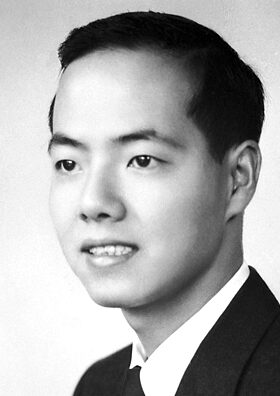
Tsung-Dao Lee
Tsung-Dao Lee was a Chinese-American physicist. Born November 24, 1926, in Shanghai. Died August 4, 2024, in San Francisco. Known for Question of Parity Conservation in Weak Interactions, Lee–Yang theory and Lee–Yang theorem. Educated at Zhejiang University and National Southwestern Associated University. Awards include Nobel Prize in Physics, Guggenheim Fellowship and Oskar Klein Medal.
Facts
49 facts · 2 confirmed by two sources · 10 cited · 37 from one source
Where this comes from
Papalocal keeps its own record. It started from these sources; what each one said is kept here as it was copied, so a change on their side never changes this page by itself. Tap one to read its version.
What Wikidata says · copied November 13, 2026 · revision 2567228485
- Described as
- Chinese-American physicist (1926–2024)
- Other names
- Tsung Dao Lee, Li Zhengdao, T. D. Lee
- Born
- November 24, 1926 · 2 references
- Died
- August 4, 2024 · 3 references
- Born in
- Shanghai · 2 references
- Died in
- San Francisco · 1 reference
- Citizen of
- United States (1962–); Republic of China (1926–1949); Taiwan (1949–)
- Occupation
- physicist · 2 references; university teacher; theoretical physicist
- Worked for
- Columbia University; University of California, Berkeley · 1 reference; Zhejiang University · 1 reference
- Education
- Zhejiang University; National Southwestern Associated University; University of Chicago; Tsinghua University; Peking University; Nankai University · 1 reference
- Member of
- Accademia Nazionale dei Lincei (1984–) · 1 reference; Pontifical Academy of Sciences; National Academy of Sciences (1964–); Chinese Academy of Sciences; American Academy of Arts and Sciences; Academia Sinica; American Physical Society · 1 reference; Committee of 100; The World Academy of Sciences; American Philosophical Society (1972–)
- Known for
- Question of Parity Conservation in Weak Interactions; Lee–Yang theory; Lee–Yang theorem; CUSPEA
- Awards
- Nobel Prize in Physics (1957) · 2 references; Guggenheim Fellowship (1966) · 1 reference; Oskar Klein Medal (1993) · 1 reference; Matteucci Medal (1995); Fellow of the American Physical Society; honorary doctor of the Peking University (1985); honorary doctor of the Chinese University of Hong Kong; Great Immigrants Award (2009) · 1 reference
- Field
- particle physics; physics · 1 reference; theoretical physics · 1 reference
- Spouse
- Jeannette Hui-Chun Chin · 1 reference
- Children
- Stephen Lee; James Z. Lee
- Father
- Tsing Kong Lee
- Siblings
- Robert C. T. Lee
- Wikipedias with a page
- 78
Wikidata item Q183679 (wikidata.org/wiki/Q183679), public domain (CC0). Copied November 13, 2026.
What Wikipedia says · copied November 13, 2026 · revision 1374718523
Tsung-Dao Lee (Chinese: 李政道; pinyin: Lǐ Zhèngdào; November 24, 1926 – August 4, 2024) was a Chinese-American physicist known for his work on parity violation, the Lee–Yang theorem, particle physics, relativistic heavy ion (RHIC) physics, nontopological solitons, and soliton stars. He was a university professor emeritus at Columbia University in New York City, where he taught from 1953 until his retirement in 2012.
In 1957, at the age of 30, Lee won the Nobel Prize in Physics with Chen Ning Yang for their work on the violation of the parity law in weak interactions, which Chien-Shiung Wu experimentally proved from 1956 to 1957, with her well known Wu experiment.
Lee remains the youngest Nobel laureate in the science fields after World War II. He is the third-youngest Nobel laureate in sciences in history after William L. Bragg (who won the prize at 25 with his father William H. Bragg in 1915) and Werner Heisenberg (who won in 1932 also at 30). Lee and Yang were the first Chinese laureates. Since he became a naturalized American citizen in 1963, Lee is also the youngest American ever to have won a Nobel Prize.
- Born, in its opening lines
- November 24, 1926
- Died, in its opening lines
- August 4, 2024
From the Wikipedia article “Tsung-Dao Lee” (en.wikipedia.org/wiki/Tsung-Dao_Lee), by its contributors, under CC BY-SA 4.0 (creativecommons.org/licenses/by-sa/4.0/). Copied November 13, 2026; not changed.
Confirmed Two sources agree. Cited One source, and it names where it got it. One source One source, without a reference of its own. Sources disagree The sources disagree. We show the best-supported value and keep theirs below.
