
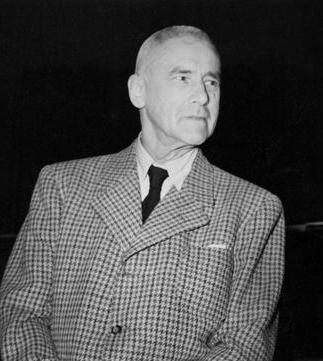
Wilhelm Frick
Wilhelm Frick was a German Nazi Party politician. Born March 12, 1877, in Alsenz. Died October 16, 1946, in Nuremberg Court Prison. Positions held include Protectorate of Bohemia and Moravia (1943–1945), member of the Reichstag of the Weimar Republic and member of the Reichstag of Nazi Germany. Educated at LMU Munich and Heidelberg University. Awards include Blood Order.
Facts
25 facts · 2 confirmed by two sources · 5 cited · 18 from one source
Where this comes from
Papalocal keeps its own record. It started from these sources; what each one said is kept here as it was copied, so a change on their side never changes this page by itself. Tap one to read its version.
What Wikidata says · copied November 16, 2026 · revision 2568850897
- Described as
- German Nazi Party politician (1877–1946)
- Born
- March 12, 1877 · 9 references
- Died
- October 16, 1946 · 8 references
- Born in
- Alsenz · 1 reference
- Died in
- Nuremberg Court Prison · 1 reference
- Buried in
- Wenzbach · 1 reference
- Cause of death
- hanging to death · 1 reference
- Citizen of
- Germany
- Occupation
- politician · 1 reference; diplomat; lawyer; Holocaust perpetrator · 1 reference
- Positions held
- Protectorate of Bohemia and Moravia (1943–1945); member of the Reichstag of the Weimar Republic; member of the Reichstag of Nazi Germany; Reichsminister des Innern (1933–1943)
- Political party
- Nazi Party; German Völkisch Freedom Party; National Socialist Freedom Movement
- Education
- LMU Munich; Heidelberg University; University of Göttingen · 1 reference
- Member of
- Thule Society; AGV München · 1 reference
- Awards
- Blood Order · 1 reference
- Religion
- Lutheranism
- Wikipedias with a page
- 57
Wikidata item Q76887 (wikidata.org/wiki/Q76887), public domain (CC0). Copied November 16, 2026.
What Wikipedia says · copied November 16, 2026 · revision 1383192056
Wilhelm Frick (12 March 1877 – 16 October 1946) was a German politician of the Nazi Party (NSDAP) and convicted war criminal. He served as Minister of the Interior in Adolf Hitler's cabinet from 1933 to 1943 and as the last governor of the Protectorate of Bohemia and Moravia.
As the head of the Kriminalpolizei (criminal police) in Munich, Frick took part in Hitler's failed Beer Hall Putsch of 1923, for which he was convicted of high treason. He managed to avoid imprisonment and soon afterwards became a leading figure of the Nazi Party (NSDAP) in the Reichstag. In 1930, Frick became the first Nazi to hold a ministerial-level post at any level in Germany. He served in Thuringia as the state Minister of the Interior.
After Hitler became Chancellor of Germany in 1933, Frick joined the new government and was named Minister of the Interior. Additionally, on 21 May 1935, Frick was named Generalbevollmächtigter für die Reichsverwaltung (General Plenipotentiary for the Administration of the Reich). He was instrumental in formulating laws that consolidated the Nazi regime (Gleichschaltung), as well as laws that defined the Nazi racial policy, most notoriously the Nuremberg Laws. On 30 August 1939, immediately prior to the outbreak of the Second World War, Frick was appointed by Hitler to the six-person Council of Ministers for Defense of the Reich which operated as a war cabinet. Following the rise of the SS, Frick gradually lost favour within the party, and in 1943 he was replaced by Heinrich Himmler as interior minister. Frick remained in the cabinet as a minister without portfolio until Hitler's death in 1945.
After World War II, Frick was tried and convicted of war crimes at the Nuremberg trials and executed by hanging.
- Born, in its opening lines
- March 12, 1877
- Died, in its opening lines
- October 16, 1946
From the Wikipedia article “Wilhelm Frick” (en.wikipedia.org/wiki/Wilhelm_Frick), by its contributors, under CC BY-SA 4.0 (creativecommons.org/licenses/by-sa/4.0/). Copied November 16, 2026; not changed.
Confirmed Two sources agree. Cited One source, and it names where it got it. One source One source, without a reference of its own. Sources disagree The sources disagree. We show the best-supported value and keep theirs below.
