
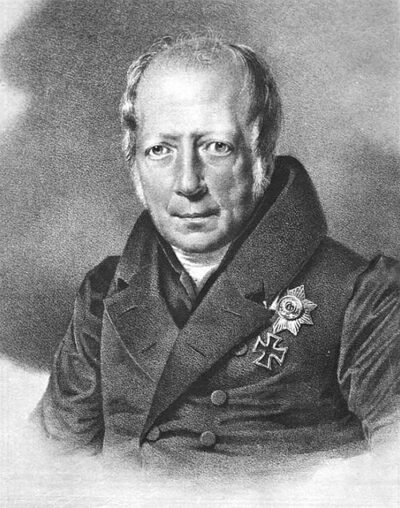
Wilhelm von Humboldt
Wilhelm von Humboldt was a Prussian philosopher, government official, diplomat, and educator. Born June 22, 1767, in Kabinetthaus. Died April 8, 1835, in Tegel. Positions held include ambassador of Germany to the United Kingdom. Educated at University of Frankfurt an der Oder and University of Göttingen. Awards include Order of the Black Eagle, Fellow of the American Academy of Arts and Sciences and Order of the Dannebrog.
Facts
47 facts · 2 confirmed by two sources · 20 cited · 25 from one source
Where this comes from
Papalocal keeps its own record. It started from these sources; what each one said is kept here as it was copied, so a change on their side never changes this page by itself. Tap one to read its version.
What Wikidata says · copied November 16, 2026 · revision 2568735928
- Described as
- Prussian philosopher, government official, diplomat, and educator (1767–1835)
- Other names
- Friedrich Wilhelm Christian Karl Ferdinand von Humboldt, Karl Wilhelm von Humboldt, Friedrich Wilhelm Christian Karl Ferdinand Freiherr von Humboldt
- Born
- June 22, 1767 · 15 references
- Died
- April 8, 1835 · 14 references
- Born in
- Kabinetthaus · 1 reference
- Died in
- Tegel · 1 reference
- Buried in
- the Humboldt family’s burial place · 1 reference
- Name at birth
- Friedrich Wilhelm Christian Karl Ferdinand von Humboldt · 1 reference
- Citizen of
- Kingdom of Prussia
- Occupation
- linguist · 2 references; diplomat · 2 references; anthropologist; teacher; politician · 1 reference; philosopher · 2 references; writer · 3 references; historian · 1 reference
- Positions held
- ambassador of Germany to the United Kingdom
- Worked for
- Humboldt-Universität zu Berlin
- Education
- University of Frankfurt an der Oder; University of Göttingen
- Member of
- Royal Prussian Academy of Sciences; Academy of Science for Public Utility; German Archaeological Institute; Bavarian Academy of Sciences and Humanities; Saint Petersburg Academy of Sciences; Hungarian Academy of Sciences; American Academy of Arts and Sciences; Russian Academy of Sciences; American Antiquarian Society; Académie des Inscriptions et Belles-Lettres (1825–1835) · 1 reference
- Awards
- Order of the Black Eagle; Fellow of the American Academy of Arts and Sciences; Order of the Dannebrog · 1 reference
- Field
- philosophy; politics · 1 reference; diplomacy · 1 reference; linguistics · 1 reference; translating activity · 1 reference
- Spouse
- Caroline von Humboldt · 2 references
- Children
- Gabriele von Bülow · 2 references; Adelheid von Hedemann · 2 references; Caroline von Humboldt · 2 references; Theodor von Humboldt · 1 reference; Theodor von Humboldt-Dachroeden · 1 reference
- Father
- Alexander Georg von Humboldt · 2 references
- Mother
- Marie-Elisabeth von Humboldt · 2 references
- Siblings
- Alexander von Humboldt · 2 references
- Religion
- Lutheranism
- Wikipedias with a page
- 98
Wikidata item Q77888 (wikidata.org/wiki/Q77888), public domain (CC0). Copied November 16, 2026.
What Wikipedia says · copied November 16, 2026 · revision 1384929345
Friedrich Wilhelm Christian Karl Ferdinand von Humboldt (22 June 1767 – 8 April 1835) was a German philosopher, linguist, government functionary, diplomat, and founder of the Humboldt University of Berlin. In 1949, the university was named after him and his younger brother, Alexander von Humboldt, a naturalist.
He was a linguist who made contributions to the philosophy of language, ethnolinguistics, and to the theory and practice of education. He made a major contribution to the development of liberalism by envisioning education as a means of realizing individual possibility rather than a way of drilling traditional ideas into youth to suit them for an already established occupation or social role. In particular, he was the architect of the Humboldtian education ideal, which was used from the beginning in Prussia as a model for its system of public education, as well as in the United States and Japan. He was elected as a member of the American Philosophical Society in 1822.
- Born, in its opening lines
- June 22, 1767
- Died, in its opening lines
- April 8, 1835
From the Wikipedia article “Wilhelm von Humboldt” (en.wikipedia.org/wiki/Wilhelm_von_Humboldt), by its contributors, under CC BY-SA 4.0 (creativecommons.org/licenses/by-sa/4.0/). Copied November 16, 2026; not changed.
Confirmed Two sources agree. Cited One source, and it names where it got it. One source One source, without a reference of its own. Sources disagree The sources disagree. We show the best-supported value and keep theirs below.
