
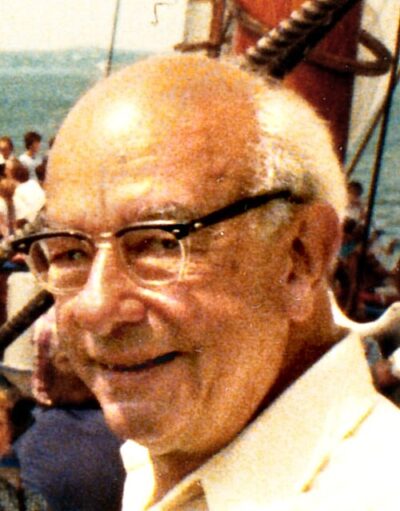
Willard Van Orman Quine
Willard Van Orman Quine was an American philosopher and logician. Born June 25, 1908, in Akron. Died December 25, 2000, in Boston. Known for Word and Object, The Roots of Reference and Two Dogmas of Empiricism. Educated at Harvard University and Oberlin College. Awards include Rolf Schock Prizes, Kyoto Prize in Arts and Philosophy and Fellow of the Committee for Skeptical Inquiry.
Facts
39 facts · 2 confirmed by two sources · 10 cited · 26 from one source · 1 where the sources disagree
What’s different
- Buried in: we show Glendale Cemetery (Sources disagree). Wikidata also lists Harvard University
Where this comes from
Papalocal keeps its own record. It started from these sources; what each one said is kept here as it was copied, so a change on their side never changes this page by itself. Tap one to read its version.
What Wikidata says · copied November 13, 2026 · revision 2568572562
- Described as
- American philosopher and logician (1908–2000)
- Other names
- Quien, W.V. Quine, W.V.O. Quine, W. V. O. Quine, W. V. Quine
- Born
- June 25, 1908 · 10 references
- Died
- December 25, 2000 · 10 references
- Born in
- Akron · 1 reference
- Died in
- Boston · 2 references
- Buried in
- Harvard University · 1 reference; Glendale Cemetery · 2 references
- Citizen of
- United States
- Occupation
- mathematician · 1 reference; analytic philosopher; philosopher of language; epistemologist; philosopher of science; university teacher; philosopher · 2 references; logician
- Worked for
- Harvard University (1933–1978) · 2 references; Wesleyan University (1964–1965); United States Navy (1942–1945) · 1 reference
- Education
- Harvard University (1930–1932) · 1 reference; Oberlin College (1926–1930) · 1 reference
- Member of
- American Academy of Arts and Sciences; National Academy of Sciences; American Philosophical Society (1957–)
- Known for
- Word and Object; The Roots of Reference; Two Dogmas of Empiricism; Quine–McCluskey algorithm; Duhem–Quine thesis; Quine's paradox; Quine–Putnam indispensability argument
- Awards
- Rolf Schock Prizes (1993); Kyoto Prize in Arts and Philosophy (1996); Fellow of the Committee for Skeptical Inquiry; honorary doctor of Harvard University (1979) · 1 reference; Carus Lectures (1971) · 1 reference
- Field
- model theory; set theory; ontology
- Children
- Douglas Boynton Quine
- Religion
- atheism
- Wikipedias with a page
- 63
Wikidata item Q214969 (wikidata.org/wiki/Q214969), public domain (CC0). Copied November 13, 2026.
What Wikipedia says · copied November 13, 2026 · revision 1383700155
Willard Van Orman Quine ( KWYNE; June 25, 1908 – December 25, 2000) was an American logician and philosopher in the analytic tradition, recognized as "one of the most influential philosophers of the twentieth century". He held the Edgar Pierce Chair of Philosophy at Harvard University from 1956 to 1978.
Quine was a teacher of logic and set theory. He was famous for his position that first-order logic is the only kind worthy of the name, and developed his own system of mathematics and set theory, known as New Foundations. In the philosophy of mathematics, he and his Harvard colleague Hilary Putnam developed the Quine–Putnam indispensability argument, an argument for the reality of mathematical entities. He was the main proponent of the view that philosophy is not conceptual analysis, but continuous with science; it is the abstract branch of the empirical sciences. This led to his famous quip that "philosophy of science is philosophy enough". He led a "systematic attempt to understand science from within the resources of science itself" and developed an influential naturalized epistemology that tried to provide "an improved scientific explanation of how we have developed elaborate scientific theories on the basis of meager sensory input". He also advocated holism in science, known as the Duhem–Quine thesis.
His major writings include the papers "On What There Is" (1948), which elucidated Bertrand Russell's theory of descriptions and contains Quine's famous dictum of ontological commitment, "To be is to be the value of a variable", and "Two Dogmas of Empiricism" (1951), which attacked the traditional analytic-synthetic distinction and reductionism, undermining the then-popular logical positivism, advocating instead a form of semantic holism and ontological relativity. They also include the books The Web of Belief (1970), which advocates a kind of coherentism, and Word and Object (1960), which further developed these positions and introduced Quine's famous indeterminacy of translation thesis, advocating a behaviorist theory of meaning.
- Born, in its opening lines
- June 25, 1908
- Died, in its opening lines
- December 25, 2000
From the Wikipedia article “Willard Van Orman Quine” (en.wikipedia.org/wiki/Willard_Van_Orman_Quine), by its contributors, under CC BY-SA 4.0 (creativecommons.org/licenses/by-sa/4.0/). Copied November 13, 2026; not changed.
Confirmed Two sources agree. Cited One source, and it names where it got it. One source One source, without a reference of its own. Sources disagree The sources disagree. We show the best-supported value and keep theirs below.
