
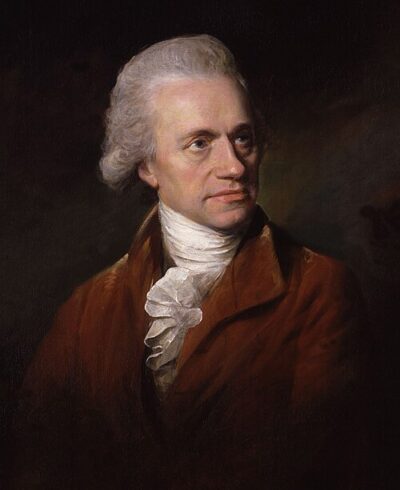
William Herschel
William Herschel was a German-born British astronomer and composer. Born November 15, 1738, in Hanover. Died August 25, 1822, in Slough. Positions held include President of the Royal Astronomical Society (1821–1823). Known for Account of a Comet. By Mr. Herschel, F. R. S.; Communicated by Dr. Watson, Jun. of Bath, F. R. S, discovery of Uranus and Herschel wedge. Awards include Copley Medal, Royal Order of the Welfs and Fellow of the American Academy of Arts and Sciences.
Facts
62 facts · 2 confirmed by two sources · 33 cited · 27 from one source
Where this comes from
Papalocal keeps its own record. It started from these sources; what each one said is kept here as it was copied, so a change on their side never changes this page by itself. Tap one to read its version.
What Wikidata says · copied November 16, 2026 · revision 2567366617
- Described as
- German-born British astronomer and composer (1738–1822)
- Other names
- Sir William Herschel, Sir Frederick William Herschel, Frederick William Herschel, Friedrich Wilhelm Herschel, Wilhelm Herschel
- Born
- November 15, 1738 · 17 references
- Died
- August 25, 1822 · 5 references
- Born in
- Hanover · 6 references
- Died in
- Slough · 2 references
- Buried in
- Church of St Laurence, Upton-cum-Chalvey · 1 reference
- Name at birth
- Friedrich Wilhelm Herschel · 1 reference
- Citizen of
- Kingdom of Hanover; United Kingdom of Great Britain and Ireland · 1 reference; Kingdom of Great Britain
- Occupation
- astronomer (1774–) · 1 reference; composer · 1 reference; oboist · 1 reference; musician (1753–1781) · 1 reference; physicist; choir director · 1 reference
- Positions held
- President of the Royal Astronomical Society (1821–1823) · 1 reference
- Worked for
- Hanoverian Foot Guards (1753–1758) · 1 reference; Militia and Volunteers of County Durham (1760–1761) · 1 reference; Charles Avison (1761–1762) · 1 reference; Leeds (1762–1766); Octagon Chapel, Bath (1767–1780) · 1 reference; Bath Philharmonia (1780–1782) · 1 reference; Observatory House (1782–1822) · 1 reference
- Member of
- Royal Society of London (1781–); Academy of Science for Public Utility; German Academy of Sciences Leopoldina; Royal Swedish Academy of Sciences; Saint Petersburg Academy of Sciences (1789–); French Academy of Sciences (1789–); American Academy of Arts and Sciences (1788–) · 1 reference; Royal Prussian Academy of Sciences; Accademia Nazionale delle Scienze detta dei XL; Academy of Sciences of Turin (1789–) · 1 reference
- Instrument
- pipe organ; oboe; violin
- Known for
- Account of a Comet. By Mr. Herschel, F. R. S.; Communicated by Dr. Watson, Jun. of Bath, F. R. S · 1 reference; discovery of Uranus; Herschel wedge; infrared radiation
- Awards
- Copley Medal (1781) · 2 references; Royal Order of the Welfs (1816) · 1 reference; Fellow of the American Academy of Arts and Sciences (1788) · 1 reference; Fellow of the Royal Society (1781) · 1 reference
- Field
- astronomy; optics · 1 reference
- Spouse
- Mary Baldwin (1788–) · 2 references
- Children
- John Frederick William Herschel · 2 references
- Father
- Isaac Herschel · 1 reference
- Mother
- Anna Ilse Moritzen · 1 reference
- Siblings
- Alexander Herschel · 1 reference; Caroline Herschel · 1 reference; Jacob Herschel · 1 reference; Johann Dietrich Herschel · 1 reference; Sophia Elizabeth Griesbach · 1 reference; Johann Alexander Herschel · 1 reference
- Religion
- Lutheranism
- Lived in
- England (1757–) · 1 reference; Bath (1766–1782) · 1 reference; Datchet (1782–1785) · 1 reference; Old Windsor (1785–1786) · 1 reference; Observatory House (1786–) · 1 reference
- Wikipedias with a page
- 114
Wikidata item Q14277 (wikidata.org/wiki/Q14277), public domain (CC0). Copied November 16, 2026.
What Wikipedia says · copied November 16, 2026 · revision 1382896100
Frederick William Herschel ( HUR-shəl; German: Friedrich Wilhelm Herschel [ˈfʁiːdʁɪç ˈvɪlhɛlm ˈhɛʁʃl̩]; 15 November 1738 – 25 August 1822), generally known as William Herschel, was a German–British astronomer and composer. He frequently collaborated with his younger sister and fellow astronomer Caroline Herschel. Born in the Electorate of Hanover, he followed his father into the military band of Hanover, before emigrating to Britain in 1757 at the age of 19.
Taking an interest in astronomy in 1766, Herschel constructed his first large telescope in 1774, after which he spent nine years carrying out sky surveys to investigate double stars. Herschel published catalogues of nebulae in 1802 (2,500 objects) and in 1820 (5,000 objects). The resolving power of the Herschel telescopes revealed that many objects called nebulae in the Messier catalogue were actually clusters of stars. On 13 March 1781 while making observations he made note of a new object in the constellation of Gemini. This would, after several weeks of verification and consultation with other astronomers, be confirmed to be a new planet, eventually given the name of Uranus. This was the first planet to be discovered since antiquity, and Herschel became famous overnight. As a result of this discovery, George III appointed him Court Astronomer. He was elected a Fellow of the Royal Society and grants were provided for the construction of new telescopes.
Herschel pioneered the use of astronomical spectrophotometry, using prisms and temperature measuring equipment to measure the wavelength distribution of stellar spectra. In the course of these investigations, Herschel discovered infrared radiation.
Other work included an improved determination of the rotation period of Mars, the discovery that the Martian polar ice caps vary seasonally, the discovery of Titania and Oberon (moons of Uranus) and Enceladus and Mimas (moons of Saturn). Herschel was made a Knight of the Royal Guelphic Order in 1816. He was the first President of the Royal Astronomical Society when it was founded in 1820. He died in August 1822, and his work was continued by his only son, John Herschel.
- Born, in its opening lines
- November 15, 1738
- Died, in its opening lines
- August 25, 1822
From the Wikipedia article “William Herschel” (en.wikipedia.org/wiki/William_Herschel), by its contributors, under CC BY-SA 4.0 (creativecommons.org/licenses/by-sa/4.0/). Copied November 16, 2026; not changed.
Confirmed Two sources agree. Cited One source, and it names where it got it. One source One source, without a reference of its own. Sources disagree The sources disagree. We show the best-supported value and keep theirs below.
