
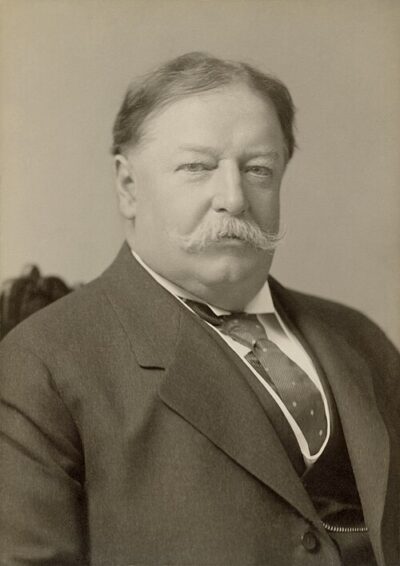
William Howard Taft
William Howard Taft was the 27th President of the United States from 1909 to 1913. Born September 15, 1857, in Cincinnati. Died March 8, 1930, in Washington metropolitan area. Positions held include President of the United States (1909–1913), Chief Justice of the United States (1921–1930) and United States Secretary of War (1904–1908). Educated at Yale College and University of Cincinnati College of Law. Awards include Fellow of the American Academy of Arts and Sciences.
Facts
46 facts · 2 confirmed by two sources · 11 cited · 33 from one source
Where this comes from
Papalocal keeps its own record. It started from these sources; what each one said is kept here as it was copied, so a change on their side never changes this page by itself. Tap one to read its version.
What Wikidata says · copied November 13, 2026 · revision 2567579496
- Described as
- 27th President of the United States from 1909 to 1913 (1857–1930)
- Other names
- William H. Taft, W. Taft, William Taft, President Taft, W. H. Taft
- Born
- September 15, 1857 · 11 references
- Died
- March 8, 1930 · 11 references
- Born in
- Cincinnati · 2 references
- Died in
- Washington metropolitan area
- Buried in
- Arlington National Cemetery (1930) · 1 reference
- Cause of death
- heart failure
- Citizen of
- United States
- Occupation
- judge · 1 reference; lawyer; prosecutor; pedagogue; university teacher; politician · 1 reference; statesperson; writer · 1 reference
- Positions held
- President of the United States (1909–1913) · 1 reference; Chief Justice of the United States (1921–1930); United States Secretary of War (1904–1908); Governor of Cuba (1906); Governor-General of the Philippines (1901–1903); Solicitor General of the United States (1890–) · 1 reference; Judge of the United States Court of Appeals for the Sixth Circuit (1892–1900) · 1 reference; President-elect of the United States (1908–1909); president · 1 reference
- Political party
- Republican Party
- Worked for
- Yale Law School; Boston University; University of Cincinnati · 1 reference; University of Cincinnati College of Law · 1 reference
- Education
- Yale College; University of Cincinnati College of Law; University of Cincinnati · 1 reference
- Member of
- American Philosophical Society (1909–); American Academy of Arts and Sciences
- Awards
- Fellow of the American Academy of Arts and Sciences · 1 reference
- Spouse
- Helen Herron Taft (1886–1930) · 1 reference
- Children
- Robert A. Taft; Helen Taft Manning; Charles Phelps Taft II
- Father
- Alphonso Taft
- Mother
- Louise Taft
- Siblings
- Charles Phelps Taft; Henry Waters Taft; Horace Dutton Taft
- Religion
- Unitarianism
- Height
- 1.82 m (6 ft 0 in) · 1 reference
- Wikipedias with a page
- 148
Wikidata item Q35648 (wikidata.org/wiki/Q35648), public domain (CC0). Copied November 13, 2026.
What Wikipedia says · copied November 13, 2026 · revision 1384498920
William Howard Taft (September 15, 1857 – March 8, 1930) was the 27th president of the United States from 1909 to 1913 and the tenth chief justice of the United States from 1921 to 1930. He is the only person to have held both offices.
Taft was born in Cincinnati, Ohio. His father, Alphonso Taft, was a U.S. attorney general and secretary of war. Taft attended Yale University and the Cincinnati Law School. After becoming a lawyer, he was appointed a judge while still in his twenties and continued a rapid rise, being named solicitor general and a judge of the Sixth Circuit Court of Appeals in the 1890s. President William McKinley appointed Taft civilian governor of the Philippines in 1901. President Theodore Roosevelt made him secretary of war in 1904, and he became Roosevelt's hand-picked successor. With Roosevelt's help, Taft easily won the Republican nomination for president in 1908 and defeated William Jennings Bryan for the presidency in the general election.
As president, Taft focused on East Asia more than European affairs and repeatedly intervened to prop up or remove Latin American governments. While Taft sought reductions to trade tariffs, the resulting bill was heavily influenced by special interests. His administration was filled with conflict between the Republican Party's conservative wing, with which Taft often sympathized, and its progressive wing, towards which Roosevelt increasingly gravitated. Controversies over conservation and antitrust cases filed by the Taft administration served to further separate the two men. The 1912 presidential election was a three-way race, as Roosevelt challenged Taft for renomination. Taft used his control of the party machinery to gain a bare majority of delegates and Roosevelt bolted the party. The split left Taft with little chance of reelection, and he took only Utah and Vermont in his loss to Democratic nominee Woodrow Wilson.
After leaving office, Taft returned to Yale as a professor, continuing his political activity and working against war through the League to Enforce Peace. Despite his personal ambition to become chief justice, Taft had previously declined repeated offers of appointment to the Supreme Court of the United States, believing his political work to be more important. In 1921, President Warren G. Harding appointed Taft chief justice. As a member of the court, he was a conservative on business issues, and under him there were advances in individual rights. His work towards administrative reform of the court culminated in the Judiciary Act of 1925. In poor health, he resigned in February 1930, and died the following month. He was buried at Arlington National Cemetery, the first president and first Supreme Court justice to be interred there.
Taft is generally listed near the middle in historians' rankings of U.S. presidents; his work as chief justice has been evaluated more positively. In popular memory his political achievements and role in Republican Party history have been overshadowed by his weight and physical appearance.
- Born, in its opening lines
- September 15, 1857
- Died, in its opening lines
- March 8, 1930
From the Wikipedia article “William Howard Taft” (en.wikipedia.org/wiki/William_Howard_Taft), by its contributors, under CC BY-SA 4.0 (creativecommons.org/licenses/by-sa/4.0/). Copied November 13, 2026; not changed.
Confirmed Two sources agree. Cited One source, and it names where it got it. One source One source, without a reference of its own. Sources disagree The sources disagree. We show the best-supported value and keep theirs below.
