
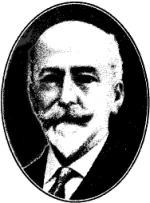
William Morris Davis
William Morris Davis was an American geographer. Born February 12, 1850, in Philadelphia. Died February 5, 1934, in Pasadena. Positions held include President of the Geological Society of America (1911–1912). Known for cycle of erosion. Educated at Harvard University. Awards include Penrose Medal, Vega Medal and Patron’s Medal.
Facts
35 facts · 2 confirmed by two sources · 8 cited · 25 from one source
Where this comes from
Papalocal keeps its own record. It started from these sources; what each one said is kept here as it was copied, so a change on their side never changes this page by itself. Tap one to read its version.
What Wikidata says · copied November 15, 2026 · revision 2567351392
- Described as
- American geographer (1850–1934)
- Other names
- William M. Davis, William Davis, W. M. Davis
- Born
- February 12, 1850 · 8 references
- Died
- February 5, 1934 · 9 references
- Born in
- Philadelphia · 1 reference
- Died in
- Pasadena · 1 reference
- Buried in
- Mountain View Cemetery and Mausoleum · 1 reference
- Citizen of
- United States
- Occupation
- geologist · 1 reference; geographer · 1 reference; writer; meteorologist
- Positions held
- President of the Geological Society of America (1911–1912)
- Worked for
- United States Geological Survey
- Education
- Harvard University
- Member of
- Royal Swedish Academy of Sciences; French Academy of Sciences; American Academy of Arts and Sciences; National Academy of Sciences; Norwegian Academy of Science and Letters; Accademia Nazionale dei Lincei (1923–) · 1 reference; American Philosophical Society; Royal Danish Academy of Sciences and Letters; Royal Prussian Academy of Sciences
- Known for
- cycle of erosion
- Awards
- Penrose Medal (1931) · 1 reference; Vega Medal (1920); Patron’s Medal (1919) · 1 reference; Hayden Memorial Geological Award (1917); Cullum Geographical Medal (1908); honorary doctorate of the University of Oslo; Fellow of the American Academy of Arts and Sciences; Honorary Fellow of the Royal Society Te Apārangi (1913–) · 1 reference
- Field
- geology
- Children
- Edward Mott Davis
- Father
- Edward M. Davis
- Mother
- Maria Mott
- Wikipedias with a page
- 39
Wikidata item Q315967 (wikidata.org/wiki/Q315967), public domain (CC0). Copied November 15, 2026.
What Wikipedia says · copied November 15, 2026 · revision 1366968245
William Morris Davis (February 12, 1850 – February 5, 1934) was an American geographer, geologist, geomorphologist, and meteorologist, often called the "father of American geography".
He was born into a prominent Quaker family in Philadelphia, Pennsylvania, son of Edward M. Davis and Maria Mott Davis (a daughter of the women's advocate Lucretia Mott). Davis studied geology and geography at Harvard's Lawrence Scientific School and then joined the Harvard sponsored geographic exploration party to the Colorado territory, led by the inaugural Sturgis-Hooper professor of geology, Josiah Dwight Whitney. Wild stories had circulated since soon after the Louisiana Purchase about Rocky Mountains peaks 18,000 feet or higher. The Harvard expedition set out to investigate, and found none, but they did find "14ers" (14,000-plus feet). He graduated from Harvard University in 1869 and received a Master of Mining Engineering in the following year. Davis worked for Nathaniel Shaler as a field assistant, and was later hired to teach at Harvard. Though his legacy lives on in geomorphology, he also advanced theories of scientific racism in his writings about physical geography.
After his first wife died, Davis married Mary M. Wyman from Cambridge, Massachusetts in 1914, and, after her death, he married Lucy L. Tennant from Milton, Massachusetts
in 1928, who survived him.
He died in Pasadena, California, shortly before his 84th birthday. His Cambridge home is a National Historic Landmark.
- Born, in its opening lines
- February 12, 1850
- Died, in its opening lines
- February 5, 1934
From the Wikipedia article “William Morris Davis” (en.wikipedia.org/wiki/William_Morris_Davis), by its contributors, under CC BY-SA 4.0 (creativecommons.org/licenses/by-sa/4.0/). Copied November 15, 2026; not changed.
Confirmed Two sources agree. Cited One source, and it names where it got it. One source One source, without a reference of its own. Sources disagree The sources disagree. We show the best-supported value and keep theirs below.
