
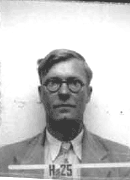
William Penney, Baron Penney
William Penney, Baron Penney was an English mathematician and physicist. Born June 24, 1909, in Gibraltar. Died March 3, 1991, in East Hendred. Positions held include member of the House of Lords (1967–1991), chairperson (1964–1967) and rector (1967–1973). Known for Particle in a one-dimensional lattice. Educated at Royal College of Science and University of Cambridge. Awards include Fellow of the Royal Society, Knight Commander of the Order of the British Empire and Wilhelm Exner Medal.
Facts
38 facts · 2 confirmed by two sources · 24 cited · 12 from one source
Where this comes from
Papalocal keeps its own record. It started from these sources; what each one said is kept here as it was copied, so a change on their side never changes this page by itself. Tap one to read its version.
What Wikidata says · copied November 18, 2026 · revision 2559450906
- Described as
- English mathematician and physicist (1909-1991)
- Other names
- William Penney, William Gordon Penney, Baron Penney, William George Penney
- Born
- June 24, 1909 · 5 references
- Died
- March 3, 1991 · 5 references
- Born in
- Gibraltar · 1 reference
- Died in
- East Hendred · 2 references
- Buried in
- cremation
- Name at birth
- William George Penney
- Citizen of
- United Kingdom
- Occupation
- politician · 1 reference; physicist · 1 reference; mathematician; nuclear physicist · 1 reference
- Positions held
- member of the House of Lords (1967–1991); chairperson (1964–1967) · 1 reference; rector (1967–1973) · 2 references
- Worked for
- Imperial College London (2 times) (1936–1973) · 1 reference; Manhattan Project (1944–1945) · 1 reference; Atomic Weapons Establishment (1946–1954) · 1 reference; United Kingdom Atomic Energy Authority (1954–1967) · 1 reference
- Education
- Royal College of Science (1927–1929) · 1 reference; University of Cambridge (1933–1935) · 2 references; University of Groningen (1929–1930) · 1 reference; Imperial College London (1930–1931) · 1 reference; University of Wisconsin–Madison (1931–1933) · 1 reference; Gilberd School
- Member of
- Royal Society of London (1946–); Royal Society of Edinburgh; National Academy of Sciences (1962–)
- Known for
- Particle in a one-dimensional lattice
- Awards
- Fellow of the Royal Society (1946) · 1 reference; Knight Commander of the Order of the British Empire (1952) · 1 reference; Wilhelm Exner Medal (1967) · 2 references; Rumford Medal (1966) · 2 references; Glazebrook Medal (1969) · 1 reference; Fellow of the Royal Society of Edinburgh (1970) · 1 reference; Order of Merit (1969) · 1 reference; James Alfred Ewing Medal (1969) · 1 reference; Medal of Freedom (1946)
- Field
- nuclear physics · 1 reference
- Wikipedias with a page
- 20
Wikidata item Q336759 (wikidata.org/wiki/Q336759), public domain (CC0). Copied November 18, 2026.
What Wikipedia says · copied November 18, 2026 · revision 1384435566
William George Penney, Baron Penney, (24 June 1909 – 3 March 1991) was an English mathematician and professor of mathematical physics at the Imperial College London and later the rector of Imperial College London. He had a leading role in the development of High Explosive Research, Britain's clandestine nuclear programme that started in 1942 during the Second World War which produced the first British atomic bomb in 1952.
As the head of the British delegation working on the Manhattan Project at Los Alamos Laboratory, Penney initially carried out calculations to predict the damage effects generated by the blast wave of an atomic bomb. Upon returning home, Penney directed the British nuclear weapons directorate, codenamed Tube Alloys and directed scientific research at the Atomic Weapons Research Establishment which resulted in the first detonation of a British nuclear bomb in Operation Hurricane in 1952. After the test, Penney became chief advisor to the new United Kingdom Atomic Energy Authority (UKAEA). He was later chairman of the authority, which he used in international negotiations to control nuclear testing with the Partial Nuclear Test Ban Treaty.
Penney's notable scientific contributions included the mathematics for complex wave dynamics, both in shock and gravity waves, proposing optimisation problems and solutions in hydrodynamics (which plays a major role in materials science and metallurgy.) During his later years, Penney lectured in mathematics and physics; he was the Rector of Imperial College London 1967–1973.
- Born, in its opening lines
- June 24, 1909
- Died, in its opening lines
- March 3, 1991
From the Wikipedia article “William Penney, Baron Penney” (en.wikipedia.org/wiki/William_Penney,_Baron_Penney), by its contributors, under CC BY-SA 4.0 (creativecommons.org/licenses/by-sa/4.0/). Copied November 18, 2026; not changed.
Confirmed Two sources agree. Cited One source, and it names where it got it. One source One source, without a reference of its own. Sources disagree The sources disagree. We show the best-supported value and keep theirs below.
