
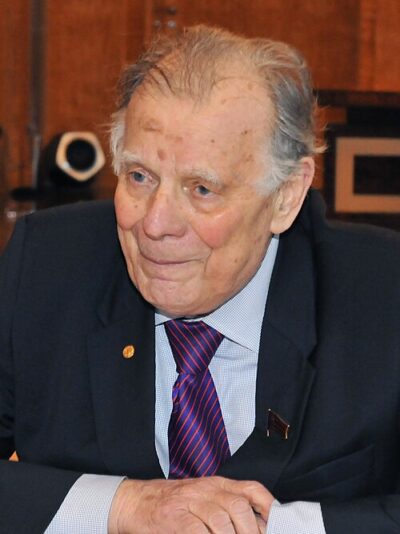
Zhores Alferov
Zhores Alferov was a Soviet-Russian physicist. Born March 15, 1930, in Vitebsk. Died March 1, 2019, in Saint Petersburg. Positions held include member of the State Duma (1995–2019). Educated at Vladimir Ulyanov (Lenin) LETI Saint Petersburg State Electrotechnical University and Belarusian National Technical University. Awards include USSR State Prize, Order of Lenin and Order of the October Revolution.
Facts
48 facts · 2 confirmed by two sources · 26 cited · 19 from one source · 1 where the sources disagree
What’s different
- Cause of death: we show malignant hypertension (Sources disagree). Wikidata also lists heart failure
Where this comes from
Papalocal keeps its own record. It started from these sources; what each one said is kept here as it was copied, so a change on their side never changes this page by itself. Tap one to read its version.
What Wikidata says · copied November 16, 2026 · revision 2563197789
- Described as
- Soviet-Russian physicist (1930–2019)
- Other names
- Zhores Ivanovich Alferov, Zhores Alfyorov
- Born
- March 15, 1930 · 8 references
- Died
- March 1, 2019 · 6 references
- Born in
- Vitebsk · 3 references
- Died in
- Saint Petersburg · 2 references
- Buried in
- Cemetery in Komarovo · 1 reference
- Cause of death
- malignant hypertension; heart failure
- Citizen of
- Soviet Union (1930–1991); Russia (1991–2019)
- Occupation
- physicist · 2 references; politician · 1 reference; inventor
- Positions held
- member of the State Duma (1995–2019)
- Political party
- Communist Party of the Soviet Union
- Worked for
- Russian Academy of Sciences; Alferov Saint Petersburg National Research Academic University of the Russian Academy of Sciences
- Education
- Vladimir Ulyanov (Lenin) LETI Saint Petersburg State Electrotechnical University (–1952); Belarusian National Technical University · 1 reference
- Member of
- Leibniz Society of Sciences · 1 reference; National Academy of Sciences (1990–) · 1 reference; Russian Academy of Sciences (1979–) · 1 reference; Academy of Sciences of the USSR; Academy of Sciences of Moldova · 1 reference; National Academy of Sciences of Ukraine; Chinese Academy of Sciences · 1 reference; Royal Academy of Engineering of Spain (2001–) · 1 reference; Polish Academy of Sciences (1988–) · 1 reference; German Academy of Sciences at Berlin
- Awards
- USSR State Prize (1984) · 1 reference; Order of Lenin (1986) · 1 reference; Order of the October Revolution (1980) · 1 reference; Order of the Badge of Honour (1959) · 1 reference; Nobel Prize in Physics (2000) · 2 references; Stuart Ballantine Medal (1971) · 1 reference; Order "For Merit to the Fatherland", 1st class (2005) · 1 reference; SPIE Gold Medal (2002) · 1 reference; Order of the Red Banner of Labour (1975); Medal "Veteran of Labour"; A. S. Popov Gold Medal (1999) · 1 reference; Officer of the Legion of Honour (2011) · 2 references; Order of Alexander Nevsky (2015) · 1 reference; Lenin Prize (1972); Kyoto Prize in Advanced Technology (2001) · 1 reference
- Field
- semiconductor physics; physics · 1 reference; semiconductor · 1 reference; politics · 1 reference
- Spouse
- Tamara Darskaya (1967–)
- Religion
- atheism
- Wikipedias with a page
- 82
Wikidata item Q183279 (wikidata.org/wiki/Q183279), public domain (CC0). Copied November 16, 2026.
What Wikipedia says · copied November 16, 2026 · revision 1385516684
Zhores Ivanovich Alferov (15 March 1930 – 1 March 2019) was a Soviet and Russian physicist who contributed significantly to the creation of modern heterostructure physics and electronics. In 2000, Alferov shared the Nobel Prize in Physics for the development of the semiconductor heterojunction for optoelectronics. He also became a politician in his later life, serving in the State Duma as a member of the Communist Party from 1999.
- Born, in its opening lines
- March 15, 1930
- Died, in its opening lines
- March 1, 2019
From the Wikipedia article “Zhores Alferov” (en.wikipedia.org/wiki/Zhores_Alferov), by its contributors, under CC BY-SA 4.0 (creativecommons.org/licenses/by-sa/4.0/). Copied November 16, 2026; not changed.
Confirmed Two sources agree. Cited One source, and it names where it got it. One source One source, without a reference of its own. Sources disagree The sources disagree. We show the best-supported value and keep theirs below.
