
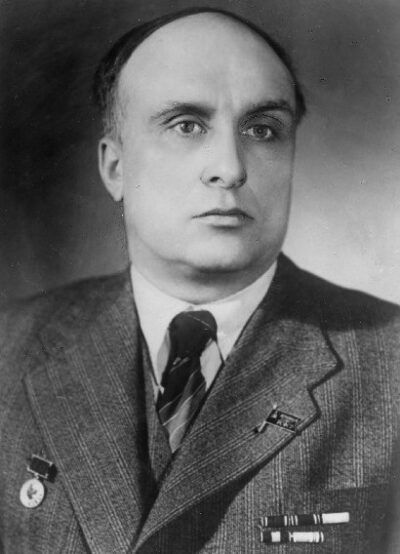
Alexander Nesmeyanov
Alexander Nesmeyanov was a Soviet chemist specializing in organometallic chemistry. Born August 28, 1899, in Moscow. Died January 17, 1980, in Moscow. Positions held include Rector of Moscow State University (1947–1951), deputy of the Supreme Soviet of the Soviet Union and president of the Russian Academy of Sciences (1951–1961). Educated at Lomonosov Moscow State University. Awards include State Stalin Prize, 1st degree (2 times), Order of Lenin (7 times) and Order of the Red Banner of Labour.
Facts
42 facts · 1 confirmed by two sources · 13 cited · 27 from one source · 1 where the sources disagree
What’s different
- Born: we show August 28, 1899 (Sources disagree). Wikipedia says September 9, 1899
Where this comes from
Papalocal keeps its own record. It started from these sources; what each one said is kept here as it was copied, so a change on their side never changes this page by itself. Tap one to read its version.
What Wikidata says · copied November 18, 2026 · revision 2567370808
- Described as
- Soviet chemist specializing in organometallic chemistry
- Other names
- Aleksandr Nikolaevich Nesmeyanov, Alexander Nikolaevich Nesmeyanov, Alexander Nikolayevich Nesmeyanov
- Born
- August 28, 1899
- Died
- January 17, 1980 · 3 references
- Born in
- Moscow · 1 reference
- Died in
- Moscow · 1 reference
- Buried in
- Novodevichy Cemetery
- Citizen of
- Russian Empire; Soviet Union
- Occupation
- chemist · 1 reference
- Positions held
- Rector of Moscow State University (1947–1951) · 2 references; deputy of the Supreme Soviet of the Soviet Union; president of the Russian Academy of Sciences (1951–1961) · 1 reference
- Political party
- Communist Party of the Soviet Union (1944–)
- Worked for
- Lomonosov Moscow State University (1948–) · 1 reference; Nesmeyanov Institute of Organoelement Compounds (1954–); Moscow State University of Fine Chemical Technologies (1938–); N.D. Zelinsky Institute of Organic Chemistry (1939–1954); Russian Academy of Sciences (1951–1961) · 3 references
- Education
- Lomonosov Moscow State University (–1922)
- Member of
- Russian Academy of Sciences (1939–) · 1 reference; Royal Society of London (1961–); German Academy of Sciences Leopoldina (1958–) · 1 reference; American Academy of Arts and Sciences (1960–) · 1 reference; Indian National Science Academy; Polish Academy of Sciences; National Academy of Sciences of Armenia · 1 reference
- Awards
- State Stalin Prize, 1st degree (2 times) (1942, 1943) · 1 reference; Order of Lenin (7 times) (1944, 1945, 1953, 1959, 1967, 1969, 1979); Order of the Red Banner of Labour (1949); Lomonosov Gold Medal (2 times) (1961, 1962) · 1 reference; Foreign Member of the Royal Society (1961) · 1 reference; doctor honoris causa from the University of Paris (1964) · 2 references; Lenin Prize (1966); honorary doctor of the University of Bordeaux (1966) · 1 reference; "Hammer and Sickle" gold medal (2 times) (1969, 1979); Order of Cyril and Methodius (1969); Hero of Socialist Labour (2 times) (1969, 1979) · 2 references; Jubilee Medal "50 Years of the Mongolian People's Revolution" (1972); Order of the October Revolution (1974); D. I. Mendeleyev Gold Medal (1977); Medal "For Valiant Labour in the Great Patriotic War 1941–1945"
- Field
- organic chemistry
- Siblings
- Andrei Nesmeyanov
- Wikipedias with a page
- 24
Wikidata item Q2388810 (wikidata.org/wiki/Q2388810), public domain (CC0). Copied November 18, 2026.
What Wikipedia says · copied November 18, 2026 · revision 1385777575
Alexander Nikolayevich Nesmeyanov (Russian: Александр Николаевич Несмеянов; 9 September [O.S. 28 August] 1899 – 17 January 1980) was a Soviet chemist and academician (1943) specializing in organometallic chemistry.
- Born, in its opening lines
- September 9, 1899
- Died, in its opening lines
- January 17, 1980
From the Wikipedia article “Alexander Nesmeyanov” (en.wikipedia.org/wiki/Alexander_Nesmeyanov), by its contributors, under CC BY-SA 4.0 (creativecommons.org/licenses/by-sa/4.0/). Copied November 18, 2026; not changed.
Confirmed Two sources agree. Cited One source, and it names where it got it. One source One source, without a reference of its own. Sources disagree The sources disagree. We show the best-supported value and keep theirs below.
