
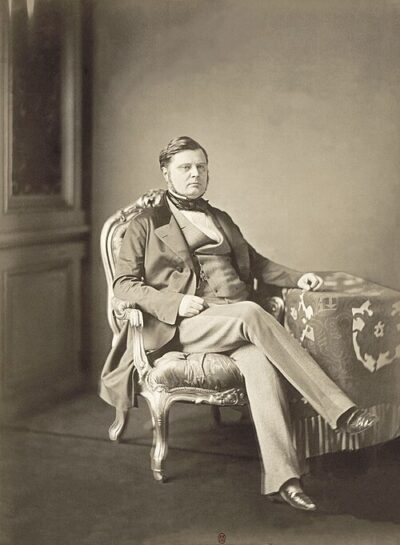
Alexandre Colonna-Walewski
Alexandre Colonna-Walewski was a French politician. Born May 4, 1810, in Walewice. Died September 27, 1868, in Strasbourg. Positions held include Deputy of the Corps législatif (1865–1867), ambassador and Second Empire senator. Awards include Grand Cross of the Legion of Honour, Virtuti Militari and Order of St. Andrew.
Facts
52 facts · 2 confirmed by two sources · 14 cited · 36 from one source
What’s different
- Died: we show September 27, 1868 (Confirmed). Wikidata also lists October 27, 1868
Where this comes from
Papalocal keeps its own record. It started from these sources; what each one said is kept here as it was copied, so a change on their side never changes this page by itself. Tap one to read its version.
What Wikidata says · copied November 17, 2026 · revision 2567558602
- Described as
- French politician (1810-1868)
- Other names
- Alexandre Colonna Walewski, Alexandre Florian Joseph, comte, Duke Alexandre Walewski, Count Alexandre Joseph Colonna-Walewski, Alexandre Joseph Colonna-Walewski, Count Alexander Walewski, Alexander Walewski, Count Alexandre Colonna-Walewski, Alexandre Joseph Colonna Walewski
- Born
- May 4, 1810 · 11 references
- Died
- September 27, 1868 · 3 references; October 27, 1868 · 2 references
- Born in
- Walewice
- Died in
- Strasbourg · 1 reference
- Buried in
- Père Lachaise Cemetery · 1 reference
- Cause of death
- stroke
- Citizen of
- France; Congress Poland; Russian Empire
- Occupation
- politician · 2 references; diplomat · 2 references; military personnel; writer · 1 reference
- Positions held
- Deputy of the Corps législatif (1865–1867) · 1 reference; ambassador; Second Empire senator · 1 reference
- Political party
- Bonapartism
- Member of
- Académie des beaux-arts
- Awards
- Grand Cross of the Legion of Honour (1856–); Virtuti Militari (1831–); Order of St. Andrew; Order of Saint Alexander Nevsky; Knight Grand Cross of the Order of Saint Joseph; Grand Officer of the Legion of Honour; Commander of the Legion of Honour; Order of the Black Eagle; Order of Saint Hubert; Royal Order of the Seraphim; Order of the Most Holy Annunciation; Order of Saint Januarius; Order of the Immaculate Conception of Vila Viçosa; 1st class, Order of the Medjidie; Knight of the Order of St. Alexander Nevsky
- Field
- diplomat; politics · 2 references
- Spouse
- Catherine Montagu (1831–) · 2 references; Marianna Walewska · 1 reference
- Children
- Charles Walewski; Count Alexandre Antoine Colonna-Walewski, Comte Walewski, Comte Colonna-Walewski · 1 reference
- Father
- Napoleon · 2 references
- Mother
- Marie Walewska · 2 references
- Siblings
- Émilie Pellapra; Stéphanie de Beauharnais; Napoleon II; Jules Barthélemy-Saint-Hilaire; Charles Léon; Eugène de Beauharnais; Eugen Megerle von Mühlfeld; Rudolf-August d'Ornano; Antoni Walewski · 1 reference
- Military branch
- Foreign Legion
- Military rank
- captain
- Wikipedias with a page
- 26
Wikidata item Q435375 (wikidata.org/wiki/Q435375), public domain (CC0). Copied November 17, 2026.
What Wikipedia says · copied November 17, 2026 · revision 1347238992
Alexandre Florian Joseph, Count Colonna-Walewski (French pronunciation: [alɛksɑ̃dʁ kɔlɔna valɛvski]; Polish: Aleksander Florian Józef Colonna-Walewski; 4 May 1810 – 27 September 1868), also Count of the Empire, was a Polish and French politician and diplomat, the unacknowledged son of French emperor Napoleon I.
He is best known for his position as foreign minister of France under his cousin Napoleon III and for his diplomatic efforts presiding over the Congress of Paris, which ended the Crimean War and laid the base for modern international law of the sea with the Paris Declaration Respecting Maritime Law.
- Born, in its opening lines
- May 4, 1810
- Died, in its opening lines
- September 27, 1868
From the Wikipedia article “Alexandre Colonna-Walewski” (en.wikipedia.org/wiki/Alexandre_Colonna-Walewski), by its contributors, under CC BY-SA 4.0 (creativecommons.org/licenses/by-sa/4.0/). Copied November 17, 2026; not changed.
Confirmed Two sources agree. Cited One source, and it names where it got it. One source One source, without a reference of its own. Sources disagree The sources disagree. We show the best-supported value and keep theirs below.
