
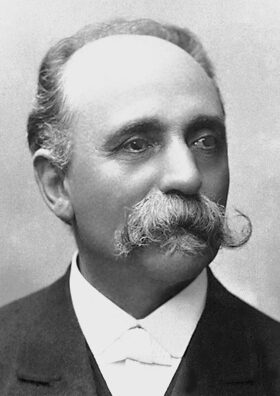
Camillo Golgi
Camillo Golgi was an Italian physician, pathologist, scientist, and Nobel laureate. Born July 7, 1843, in Corteno Golgi. Died January 21, 1926, in Pavia. Positions held include senator of the Kingdom of Italy (1900–1926) and rector. Educated at Ugo Foscolo - Pavia and University of Pavia. Awards include Nobel Prize in Physiology or Medicine, Pour le Mérite for Sciences and Arts order and doctor honoris causa from the University of Paris.
Facts
42 facts · 2 confirmed by two sources · 17 cited · 23 from one source
Where this comes from
Papalocal keeps its own record. It started from these sources; what each one said is kept here as it was copied, so a change on their side never changes this page by itself. Tap one to read its version.
What Wikidata says · copied November 16, 2026 · revision 2563199823
- Described as
- Italian physician, pathologist, scientist, and Nobel laureate (1843-1926)
- Born
- July 7, 1843 · 10 references
- Died
- January 21, 1926 · 10 references
- Born in
- Corteno Golgi · 5 references
- Died in
- Pavia · 5 references
- Buried in
- monumental cemetery of Pavia · 1 reference
- Citizen of
- Kingdom of Italy (1861–); Austrian Empire (–1859); Kingdom of Sardinia (1859–1861)
- Occupation
- cell biologist; physician · 2 references; neurologist; professor; pathologist; anatomist; politician; scientist · 1 reference
- Positions held
- senator of the Kingdom of Italy (1900–1926); rector · 1 reference
- Worked for
- University of Siena (1876–) · 1 reference; University of Pavia (1876–1918) · 1 reference
- Education
- Ugo Foscolo - Pavia · 1 reference; University of Pavia (1860–1865) · 1 reference
- Member of
- German Academy of Sciences Leopoldina; Göttingen Academy of Sciences and Humanities in Lower Saxony; Academy of Sciences of the USSR; Saint Petersburg Academy of Sciences; Royal Swedish Academy of Sciences; Russian Academy of Sciences; Royal Prussian Academy of Sciences; Royal Netherlands Academy of Arts and Sciences; Accademia Nazionale delle Scienze detta dei XL; Académie Nationale de Médecine
- Awards
- Nobel Prize in Physiology or Medicine (1906) · 2 references; Pour le Mérite for Sciences and Arts order; doctor honoris causa from the University of Paris (1923) · 1 reference
- Field
- malaria; medicine · 1 reference; histology · 1 reference; anatomy · 1 reference; pathology · 1 reference; science · 1 reference
- Spouse
- Lina Aletti
- Wikipedias with a page
- 80
Wikidata item Q150630 (wikidata.org/wiki/Q150630), public domain (CC0). Copied November 16, 2026.
What Wikipedia says · copied November 16, 2026 · revision 1383429633
Camillo Golgi (, Italian: [kaˈmilːo ˈɡɔldʒi]; 7 July 1843 – 21 January 1926) was an Italian biologist and pathologist who was awarded the 1906 Nobel Prize in Physiology or Medicine for his works on the central nervous system. He studied medicine at the University of Pavia (where he later spent most of his professional career) between 1860 and 1868 under the tutelage of Cesare Lombroso. Inspired by pathologist Giulio Bizzozero, he pursued research in the nervous system. His discovery of a staining technique called black reaction (sometimes called Golgi's method or Golgi's staining in his honour) in 1873 was a major breakthrough in neuroscience. Several structures and phenomena in anatomy and physiology are named for him, including the Golgi apparatus, the Golgi tendon organ and the Golgi tendon reflex.
Golgi and the Spanish biologist Santiago Ramón y Cajal were jointly awarded the Nobel Prize in Physiology or Medicine in 1906 "in recognition of their work on the structure of the nervous system".
- Born, in its opening lines
- July 7, 1843
- Died, in its opening lines
- January 21, 1926
From the Wikipedia article “Camillo Golgi” (en.wikipedia.org/wiki/Camillo_Golgi), by its contributors, under CC BY-SA 4.0 (creativecommons.org/licenses/by-sa/4.0/). Copied November 16, 2026; not changed.
Confirmed Two sources agree. Cited One source, and it names where it got it. One source One source, without a reference of its own. Sources disagree The sources disagree. We show the best-supported value and keep theirs below.
