
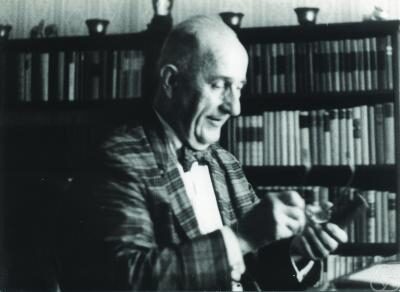
Carl Ludwig Siegel
Carl Ludwig Siegel was a German mathematician. Born December 31, 1896, in Berlin. Died April 4, 1981, in Göttingen. Known for Brauer–Siegel theorem, Siegel–Walfisz theorem and Thue–Siegel–Roth theorem. Educated at University of Göttingen and Frederick William University Berlin. Awards include doctor honoris causa from the University of Nancy, Pour le Mérite for Sciences and Arts order and Knight Commander's Cross of the Order of Merit of the Federal Republic of Germany.
Facts
44 facts · 2 confirmed by two sources · 18 cited · 24 from one source
Where this comes from
Papalocal keeps its own record. It started from these sources; what each one said is kept here as it was copied, so a change on their side never changes this page by itself. Tap one to read its version.
What Wikidata says · copied November 16, 2026 · revision 2569129314
- Described as
- German mathematician (1896-1981)
- Born
- December 31, 1896 · 7 references
- Died
- April 4, 1981 · 7 references
- Born in
- Berlin · 2 references
- Died in
- Göttingen · 1 reference
- Buried in
- Göttingen City Cemetery · 1 reference
- Citizen of
- Weimar Republic; Nazi Germany; Germany
- Occupation
- mathematician · 1 reference; university teacher
- Worked for
- Goethe University Frankfurt (1922–1938) · 1 reference; University of Göttingen (3 times) (1920–1967) · 1 reference; Institute for Advanced Study (1940–1951) · 1 reference; Imperial German Army (1917–1919) · 1 reference
- Education
- University of Göttingen (1919–1920) · 1 reference; Frederick William University Berlin (1915–1917) · 1 reference
- Member of
- Royal Swedish Academy of Sciences; American Academy of Arts and Sciences; German Academy of Sciences Leopoldina · 1 reference; Bavarian Academy of Sciences and Humanities; National Academy of Sciences (1968–); International Academy of the History of Science; Göttingen Academy of Sciences and Humanities in Lower Saxony; Accademia Nazionale dei Lincei (1956–) · 1 reference
- Known for
- Brauer–Siegel theorem; Siegel–Walfisz theorem; Thue–Siegel–Roth theorem; Siegel's theorem on integral points; Siegel's lemma; Riemann–Siegel theta function; Siegel G-function; Siegel disc; Siegel upper half-space; Riemann–Siegel formula
- Awards
- doctor honoris causa from the University of Nancy (1954) · 1 reference; Pour le Mérite for Sciences and Arts order (1963) · 1 reference; Knight Commander's Cross of the Order of Merit of the Federal Republic of Germany (1964); Wolf Prize in Mathematics (1978) · 1 reference; honorary doctor of the University of Vienna · 1 reference; honorary doctorate of the University of Basel
- Field
- number theory; mathematics · 1 reference; function theory · 1 reference; celestial mechanics · 1 reference
- Wikipedias with a page
- 36
Wikidata item Q61721 (wikidata.org/wiki/Q61721), public domain (CC0). Copied November 16, 2026.
What Wikipedia says · copied November 16, 2026 · revision 1378937318
Carl Ludwig Siegel (31 December 1896 – 4 April 1981) was a German mathematician specialising in analytic number theory. He is known for, amongst other things, his contributions to the Thue–Siegel–Roth theorem in Diophantine approximation, Siegel's method, Siegel's lemma and the Siegel mass formula for quadratic forms. He has been named one of the most important mathematicians of the 20th century.
André Weil, without hesitation, named Siegel as the greatest mathematician of the first half of the 20th century. Atle Selberg said of Siegel and his work:He was in some ways, perhaps, the most impressive mathematician I have met. I would say, in a way, devastatingly so. The things that Siegel tended to do were usually things that seemed impossible. Also after they were done, they still seemed almost impossible.
- Born, in its opening lines
- December 31, 1896
- Died, in its opening lines
- April 4, 1981
From the Wikipedia article “Carl Ludwig Siegel” (en.wikipedia.org/wiki/Carl_Ludwig_Siegel), by its contributors, under CC BY-SA 4.0 (creativecommons.org/licenses/by-sa/4.0/). Copied November 16, 2026; not changed.
Confirmed Two sources agree. Cited One source, and it names where it got it. One source One source, without a reference of its own. Sources disagree The sources disagree. We show the best-supported value and keep theirs below.
