
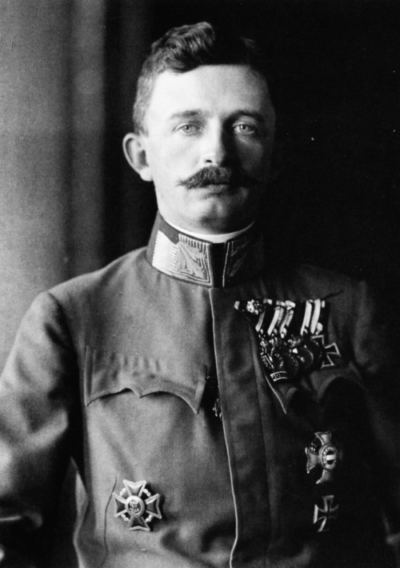
Charles I of Austria
Charles I of Austria was a Last monarch of Austria-Hungary (r. 1916–1918). Born August 17, 1887, in Persenbeug Castle. Died April 1, 1922, in Funchal. Positions held include Apostolic King of Hungary (1916–1918), Emperor of Austria (1916–1918) and Member of the House of Lords (Austria) (1907–1916). Educated at Charles University and Schottengymnasium. Awards include Pour le Mérite, Knight of the Order of the Golden Fleece and Grand Cross of the Military Order of Maria Theresa.
Facts
49 facts · 2 confirmed by two sources · 6 cited · 41 from one source
Where this comes from
Papalocal keeps its own record. It started from these sources; what each one said is kept here as it was copied, so a change on their side never changes this page by itself. Tap one to read its version.
What Wikidata says · copied November 16, 2026 · revision 2569061361
- Described as
- Last monarch of Austria-Hungary (r. 1916–1918)
- Other names
- Karl I, Karl I and IV of Austria-Hungary, Blessed Charles of Austria-Hungary, Karl I of Austria
- Born
- August 17, 1887 · 9 references
- Died
- April 1, 1922 · 10 references
- Born in
- Persenbeug Castle
- Died in
- Funchal · 2 references
- Buried in
- Igreja de Nossa Senhora do Monte
- Cause of death
- pneumonia
- Name at birth
- Karl Franz Josef Ludwig Hubert Georg Maria von Österreich
- Citizen of
- Austria · 1 reference; Cisleithania
- Occupation
- military officer · 1 reference; politician; monarch
- Positions held
- Apostolic King of Hungary (1916–1918); Emperor of Austria (1916–1918); Member of the House of Lords (Austria) (1907–1916); King of Bohemia (1916–1918); Head of the House of Habsburg
- Education
- Charles University; Schottengymnasium (1899–1901)
- Member of
- Karl I of Austria and Empress Zita
- Awards
- Pour le Mérite; Knight of the Order of the Golden Fleece (1905); Grand Cross of the Military Order of Maria Theresa; Order of the Black Eagle; Order of the Iron Crown (Kingdom of Italy); Military Merit Cross; Military Order of Max Joseph; Sovereign Military Order of Malta; Order of the Iron Crown (Austria); Order of Saint Stephen of Hungary; Military Order of Maria Theresa; Order of the Golden Fleece; Order of Leopold; Order of Franz Joseph; Franz Joseph Cross
- Spouse
- Zita of Bourbon-Parma (1911–1922) · 1 reference
- Children
- Otto von Habsburg; Robert, Archduke of Austria-Este; Archduke Carl Ludwig of Austria; Archduke Rudolf of Austria; Archduchess Elisabeth of Austria · 1 reference; Archduchess Adelheid of Austria · 1 reference; Archduke Felix of Austria · 1 reference; Duchess Charlotte, Duchess of Mecklenburg-Strelitz · 1 reference
- Father
- Archduke Otto of Austria
- Mother
- Princess Maria Josepha of Saxony
- Siblings
- Archduke Maximilian Eugen of Austria
- Religion
- Catholic Church
- Military rank
- Generalfeldmarschall
- Wikipedias with a page
- 72
Wikidata item Q51068 (wikidata.org/wiki/Q51068), public domain (CC0). Copied November 16, 2026.
What Wikipedia says · copied November 16, 2026 · revision 1385952275
Charles I and IV (German: Karl Franz Josef Ludwig Hubert Georg Otto Maria, Hungarian: Károly Ferenc József Lajos Hubert György Ottó Mária; 17 August 1887 – 1 April 1922) was Emperor of Austria (as Charles I), King of Hungary (as Charles IV), and the ruler of the other states of the Habsburg monarchy from November 1916 until the monarchy was abolished in November 1918. He was the last of the monarchs belonging to the House of Habsburg-Lorraine to rule over Austria-Hungary. The son of Archduke Otto of Austria and Princess Maria Josepha of Saxony, Charles became heir presumptive of Emperor Franz Joseph when his uncle Archduke Franz Ferdinand of Austria was assassinated in 1914. In 1911, he married Princess Zita of Bourbon-Parma.
Charles succeeded to the thrones in November 1916 following the death of his grand-uncle, Franz Joseph. He began secret negotiations with the Allies, hoping to peacefully end the First World War, but was unsuccessful. Despite Charles's efforts to preserve the empire by returning it to federalism and by championing Austro-Slavism, Austria-Hungary hurtled into disintegration: Czechoslovakia and the State of Slovenes, Croats and Serbs were proclaimed, and Hungary broke monarchic ties to Austria by the end of October 1918. Following the Armistice of 11 November 1918, Charles "renounced any participation" in government affairs, but did not abdicate. However, the Republic of German-Austria was proclaimed the following day, and in April 1919 the National Assembly formally dethroned the Habsburgs and banished Charles from German-Austria for life.
Charles spent the early part of his exile in Switzerland. He spent the remaining years of his life attempting to restore the monarchy. He made two attempts to reclaim the Hungarian throne in 1921, but failed due to the opposition of Hungary's Calvinist regent, Admiral Miklós Horthy. Charles was exiled for a second time to the Portuguese island of Madeira, where he soon fell ill and died of respiratory failure in 1922. A deeply religious man, Charles was beatified by the Catholic Church in 2004, with October 21 as his feast day.
- Born, in its opening lines
- August 17, 1887
- Died, in its opening lines
- April 1, 1922
From the Wikipedia article “Charles I of Austria” (en.wikipedia.org/wiki/Charles_I_of_Austria), by its contributors, under CC BY-SA 4.0 (creativecommons.org/licenses/by-sa/4.0/). Copied November 16, 2026; not changed.
Confirmed Two sources agree. Cited One source, and it names where it got it. One source One source, without a reference of its own. Sources disagree The sources disagree. We show the best-supported value and keep theirs below.
