
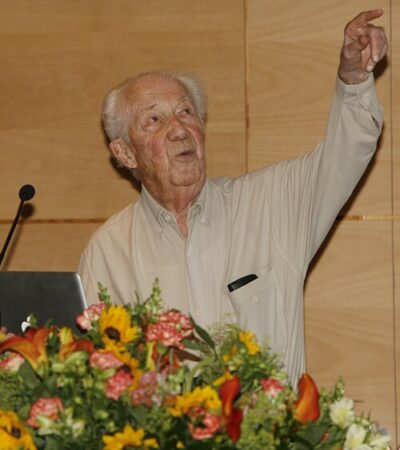
Christian de Duve
Christian de Duve was a Belgian biochemist, cytologist. Born October 2, 1917, in Thames Ditton. Died May 4, 2013, in Nethen. Educated at Catholic University of Leuven (1834–1968) and Our Lady College, Antwerp. Awards include Nobel Prize in Physiology or Medicine, Knight Grand Cross of the Order of Leopold II and Commander of the Order of the Crown.
Facts
44 facts · 2 confirmed by two sources · 21 cited · 21 from one source
Where this comes from
Papalocal keeps its own record. It started from these sources; what each one said is kept here as it was copied, so a change on their side never changes this page by itself. Tap one to read its version.
What Wikidata says · copied November 16, 2026 · revision 2563199355
- Described as
- Belgian biochemist, cytologist (1917–2013)
- Born
- October 2, 1917 · 13 references
- Died
- May 4, 2013 · 11 references
- Born in
- Thames Ditton · 1 reference
- Died in
- Nethen
- Citizen of
- Belgium
- Occupation
- university teacher; biochemist · 1 reference; chemist; physician · 1 reference; physiologist · 1 reference; cell biologist · 1 reference
- Worked for
- The Rockefeller University; Catholic University of Leuven (1834–1968)
- Education
- Catholic University of Leuven (1834–1968); Our Lady College, Antwerp
- Member of
- Royal Society of London (1988–) · 1 reference; German Academy of Sciences Leopoldina (1973–) · 1 reference; Pontifical Academy of Sciences (1970–) · 1 reference; National Academy of Sciences (1975–) · 1 reference; French Academy of Sciences (1978–) · 1 reference; Royal Society of Canada; Royal Academy of Science, Letters and Fine Arts of Belgium (1975–) · 1 reference; Romanian Academy (1999–) · 2 references; American Academy of Arts and Sciences (1971–) · 1 reference; Royal Academy of Medicine of Belgium (1969–) · 1 reference
- Awards
- Nobel Prize in Physiology or Medicine (1974) · 2 references; Knight Grand Cross of the Order of Leopold II; Commander of the Order of the Crown; Order of Leopold; Francqui Prize (1960) · 1 reference; Canada Gairdner International Award (1967) · 1 reference; Honorary doctor of Leiden University (1970) · 1 reference; Dr H.P. Heineken Prize for Biochemistry and Biophysics (1973) · 1 reference; honorary doctor of the University Lille-II (1973) · 1 reference; honorary doctor of Paris Descartes University (1974) · 1 reference; Foreign Member of the Royal Society (1988) · 1 reference; E. B. Wilson Medal (1989) · 1 reference; honorary doctor of the Université libre de Bruxelles (2010); honorary doctorate of the University of the Mediterranean - Aix Marseille II (1978) · 1 reference
- Field
- cell biology; biochemistry
- Children
- Thierry de Duve
- Siblings
- Jacques de Duve
- Religion
- agnosticism
- Wikipedias with a page
- 67
Wikidata item Q234590 (wikidata.org/wiki/Q234590), public domain (CC0). Copied November 16, 2026.
What Wikipedia says · copied November 16, 2026 · revision 1378990696
Christian René Marie Joseph, Viscount de Duve (2 October 1917 – 4 May 2013) was a Nobel Prize-winning Belgian cytologist and biochemist. He made serendipitous discoveries of two cell organelles, peroxisomes and lysosomes, for which he shared the Nobel Prize in Physiology or Medicine in 1974 with Albert Claude and George E. Palade ("for their discoveries concerning the structural and functional organization of the cell"). In addition to peroxisome and lysosome, he invented scientific names such as autophagy, endocytosis, and exocytosis on a single occasion.
The son of Belgian refugees during the First World War, de Duve was born in Thames Ditton, Surrey, England. His family returned to Belgium in 1920. He was educated by the Jesuits at Our Lady College, Antwerp, and studied medicine at the Catholic University of Louvain. Upon earning his MD in 1941, he joined research in chemistry, working on insulin and its role in diabetes mellitus. His thesis earned him the highest university degree agrégation de l'enseignement supérieur (equivalent to PhD) in 1945.
With his work on the purification of penicillin, he obtained an MSc degree in 1946. He went for further training under later Nobel Prize winners Hugo Theorell at the Karolinska Institutet in Stockholm, and Carl and Gerti Cori at the Washington University in St. Louis. He joined the faculty of medicine at Leuven in 1947. In 1960 he was invited to the Rockfeller Institute (now Rockefeller University). With mutual arrangement with Leuven, he became professor in both universities from 1962, dividing his time between Leuven and New York. In 1974, the same year he received his Nobel Prize, he founded the ICP, which would later be renamed the de Duve Institute. He became emeritus professor of the University of Louvain in 1985, and of Rockefeller in 1988.
De Duve was granted the rank of Viscount in 1989 by King Baudouin of Belgium. He was also a recipient of Francqui Prize, Gairdner Foundation International Award, Heineken Prize, and E.B. Wilson Medal. In 1974, he founded the International Institute of Cellular and Molecular Pathology in Brussels, eventually renamed the de Duve Institute in 2005. He was the founding President of the L'Oréal-UNESCO For Women in Science Awards. He died by legal euthanasia after long suffering from cancer and atrial fibrillation.
- Born, in its opening lines
- October 2, 1917
- Died, in its opening lines
- May 4, 2013
From the Wikipedia article “Christian de Duve” (en.wikipedia.org/wiki/Christian_de_Duve), by its contributors, under CC BY-SA 4.0 (creativecommons.org/licenses/by-sa/4.0/). Copied November 16, 2026; not changed.
Confirmed Two sources agree. Cited One source, and it names where it got it. One source One source, without a reference of its own. Sources disagree The sources disagree. We show the best-supported value and keep theirs below.
