
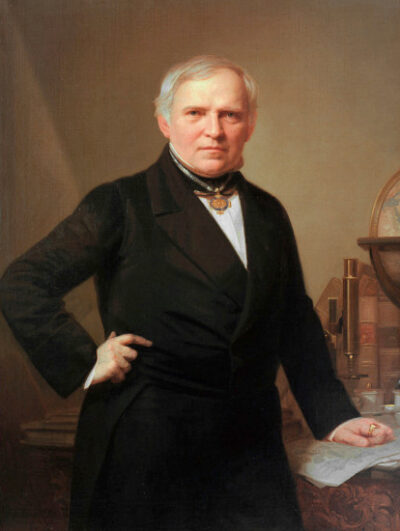
Christian Gottfried Ehrenberg
Christian Gottfried Ehrenberg was a German biologist. Born April 19, 1795, in Delitzsch. Died June 27, 1876, in Berlin. Educated at Humboldt-Universität zu Berlin and Leipzig University. Awards include Leeuwenhoek Medal, Pour le Mérite for Sciences and Arts order and Bavarian Maximilian Order for Science and Art.
Facts
44 facts · 2 confirmed by two sources · 14 cited · 28 from one source
Where this comes from
Papalocal keeps its own record. It started from these sources; what each one said is kept here as it was copied, so a change on their side never changes this page by itself. Tap one to read its version.
What Wikidata says · copied November 16, 2026 · revision 2569063172
- Described as
- German biologist (1795–1876)
- Other names
- Ehrenb., Ehrenberg, C. G. Ehrenberg, Christian Ehrenberg
- Born
- April 19, 1795 · 8 references
- Died
- June 27, 1876 · 7 references
- Born in
- Delitzsch · 1 reference
- Died in
- Berlin · 2 references
- Buried in
- St. Marien- und St. Nikolai-Friedhof I
- Citizen of
- Kingdom of Prussia
- Occupation
- biologist · 1 reference; paleontologist · 1 reference; zoologist · 1 reference; naturalist · 1 reference; botanist · 1 reference; university teacher; mycologist; entomologist
- Worked for
- Frederick William University Berlin
- Education
- Humboldt-Universität zu Berlin; Leipzig University · 1 reference; Schulpforta
- Member of
- Royal Society of London (1837–); Royal Prussian Academy of Sciences; German Academy of Sciences Leopoldina; Royal Swedish Academy of Sciences; Saint Petersburg Academy of Sciences; American Academy of Arts and Sciences; Russian Academy of Sciences; Accademia Nazionale delle Scienze detta dei XL; Académie Nationale de Médecine; Bavarian Academy of Sciences and Humanities
- Awards
- Leeuwenhoek Medal (1877); Pour le Mérite for Sciences and Arts order; Bavarian Maximilian Order for Science and Art (1853); Fellow of the American Academy of Arts and Sciences; Foreign Member of the Royal Society (1837) · 1 reference; Wollaston Medal (1839) · 1 reference
- Field
- natural history; medicine · 1 reference; natural science · 1 reference
- Spouse
- Julie Rose
- Children
- Clara Ehrenberg · 1 reference; Mathilde Ehrenberg; Helene von Hanstein · 1 reference
- Father
- Johann Gottfried Ehrenberg
- Mother
- Christiane Dorothea Becker
- Siblings
- Carl August Ehrenberg · 1 reference
- Wikipedias with a page
- 43
Wikidata item Q76549 (wikidata.org/wiki/Q76549), public domain (CC0). Copied November 16, 2026.
What Wikipedia says · copied November 16, 2026 · revision 1386029478
Christian Gottfried Ehrenberg (19 April 1795 – 27 June 1876) was a German naturalist, zoologist, botanist, comparative anatomist, geologist, and microscopist. He was one of the most productive and renowned scientists of his time and a friend of the famous explorer Alexander von Humboldt. As a professor of medicine at the University of Berlin he was primarily interested in biology, naturalist studies and microscopy. His studies on micro-organisms led him to discover a number of protozoa, including the organisms giving the colour of the Red Sea, and he was among the first to suggest the separation of microscopic organisms into a grouping separate from the plants and animals. He wrote a major book on the life of microbes which included his own illustrations, 'Die Infusionsthierchen als vollkommene Organismen. Ein Blick in das tiefere organische Leben der Natur' ('The Microscopic Infusoria as Complete Organisms. An Examination of the Deeper Organic Life in Nature'). He was also a pioneer of micropaleontology.
- Born, in its opening lines
- April 19, 1795
- Died, in its opening lines
- June 27, 1876
From the Wikipedia article “Christian Gottfried Ehrenberg” (en.wikipedia.org/wiki/Christian_Gottfried_Ehrenberg), by its contributors, under CC BY-SA 4.0 (creativecommons.org/licenses/by-sa/4.0/). Copied November 16, 2026; not changed.
Confirmed Two sources agree. Cited One source, and it names where it got it. One source One source, without a reference of its own. Sources disagree The sources disagree. We show the best-supported value and keep theirs below.
