
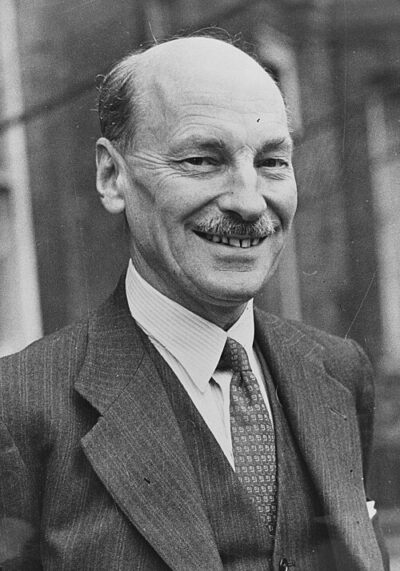
Clement Attlee
Clement Attlee was a Prime Minister of the United Kingdom from 1945 to 1951. Born January 3, 1883, in Putney. Died October 8, 1967, in Westminster Hospital. Positions held include Prime Minister of the United Kingdom (1945–1951), Deputy Prime Minister of the United Kingdom (1942–1945) and Leader of the Opposition (3 times) (1935–1955). Educated at University College, Oxford and City Law School. Awards include Fellow of the Royal Society, Knight of the Garter and Order of Merit.
Facts
51 facts · 2 confirmed by two sources · 23 cited · 26 from one source
Where this comes from
Papalocal keeps its own record. It started from these sources; what each one said is kept here as it was copied, so a change on their side never changes this page by itself. Tap one to read its version.
What Wikidata says · copied November 16, 2026 · revision 2562947453
- Described as
- Prime Minister of the United Kingdom from 1945 to 1951 (1883–1967)
- Other names
- Viscount Prestwood, Earl Attlee, Lord Attlee, Clement Richard Lord Attlee, Clement Richard Attlee
- Born
- January 3, 1883 · 3 references
- Died
- October 8, 1967 · 3 references
- Born in
- Putney · 2 references
- Died in
- Westminster Hospital · 1 reference
- Buried in
- Westminster Abbey · 1 reference
- Cause of death
- pneumonia · 1 reference
- Name at birth
- Clement Richard Attlee · 1 reference
- Citizen of
- United Kingdom · 1 reference
- Occupation
- politician · 4 references; diplomat; professor
- Positions held
- Prime Minister of the United Kingdom (1945–1951) · 1 reference; Deputy Prime Minister of the United Kingdom (1942–1945) · 2 references; Leader of the Opposition (3 times) (1935–1955); Leader of the Labour Party (1935–1955); Deputy Leader of the Labour Party (1932–1935); Lord President of the Council (1943–1945); member of the House of Lords (1956–1967) · 1 reference; Secretary of State for Dominion Affairs (1942–1943); Lord Privy Seal (1940–1942) · 2 references; Chancellor of the Duchy of Lancaster (1930–1931); Member of the Privy Council of the United Kingdom (1935–) · 1 reference; member of the 41st Parliament of the United Kingdom (1955); member of the 40th Parliament of the United Kingdom (1951–1955) · 1 reference; member of the 39th Parliament of the United Kingdom (1950–1951) · 1 reference; member of the 38th Parliament of the United Kingdom (1945–1950) · 1 reference
- Political party
- Labour Party · 1 reference
- Worked for
- London School of Economics and Political Science
- Education
- University College, Oxford; City Law School; Haileybury and Imperial Service College · 1 reference
- Member of
- Royal Society of London
- Awards
- Fellow of the Royal Society (1947) · 1 reference; Knight of the Garter (1956) · 1 reference; Order of Merit (1951) · 1 reference; Companion of Honour (1945) · 1 reference; Inter-Allied Victory Medals; 1914–15 Star · 1 reference; British War Medal · 1 reference
- Spouse
- Violet Attlee, Countess Attlee (1922–1964) · 1 reference
- Children
- Janet Attlee · 1 reference; Lady Felicity Attlee · 1 reference; Martin Attlee, 2nd Earl Attlee · 1 reference; Lady Alison Davis · 1 reference
- Father
- Henry Attlee · 1 reference
- Mother
- Ellen Bravery Watson · 1 reference
- Siblings
- Thomas Simons Attlee; Bernard Henry Bravery Attlee
- Religion
- agnosticism
- Military branch
- British Army
- Military rank
- major
- Wikipedias with a page
- 107
Wikidata item Q129006 (wikidata.org/wiki/Q129006), public domain (CC0). Copied November 16, 2026.
What Wikipedia says · copied November 16, 2026 · revision 1385927693
Clement Richard Attlee, 1st Earl Attlee (3 January 1883 – 8 October 1967) was a British statesman who served as Prime Minister of the United Kingdom from 1945 to 1951 and Leader of the Labour Party from 1935 to 1955. Attlee was deputy prime minister during the wartime coalition government under Winston Churchill, and Leader of the Opposition on three occasions: from 1935 to 1940, briefly in 1945 and from 1951 to 1955. He remains the longest-serving Labour leader.
Attlee was born in 1883 into an upper middle class family, the son of a wealthy London solicitor. He attended Haileybury College and the University of Oxford, then practised as a barrister. The volunteer work he carried out in London's East End exposed him to poverty, and his political views shifted leftwards thereafter. He joined the Independent Labour Party in 1908, gave up his legal career, and began lecturing at the London School of Economics; with his work briefly interrupted by service as an officer in the First World War. In 1919, he became mayor of Stepney and in 1922 was elected to Parliament as the Member for Limehouse.
Attlee served in the first Labour minority government led by Ramsay MacDonald in 1924, and then joined the Cabinet during MacDonald's second minority (1929–1931). After retaining his seat in Labour's landslide defeat of 1931, he became the party's deputy leader. Elected Leader of the Labour Party in 1935, and at first advocating pacificism and opposing re-armament, he became a critic of Neville Chamberlain's policy of appeasement in the lead-up to the Second World War. Attlee took Labour into the wartime coalition government in 1940 and served under Winston Churchill, initially as Lord Privy Seal and then as deputy prime minister from 1942.
The Labour Party, led by Attlee, won a landslide victory in the 1945 general election, on their post-war recovery platform. They inherited a country close to bankruptcy following the Second World War and beset by food, housing and resource shortages. Attlee led the construction of the first Labour majority government, which aimed to maintain full employment, a mixed economy and a greatly enlarged system of social services provided by the state. To this end, it undertook the nationalisation of public utilities and major industries, and implemented wide-ranging social reforms, including the passing of the National Insurance Act 1946 and National Assistance Act 1948, the formation of the National Health Service (NHS) in 1948, and the enlargement of public subsidies for council house building.
Attlee's government also reformed trade union legislation, working practices and children's services; it created the National Parks system, passed the New Towns Act 1946 and established the town and country planning system. His foreign policy focused on decolonisation efforts, including the partition of India (1947), the independence of Burma and Ceylon, and the dissolution of the British mandates of Palestine and independence of Transjordan. Attlee and Ernest Bevin encouraged the United States to take a vigorous role in the Cold War. He supported the Marshall Plan to rebuild Western Europe with American money and, in 1949, promoted the NATO military alliance against the Soviet bloc. After leading Labour to a narrow victory at the 1950 general election, he sent British troops to fight alongside South Korea in the Korean War.
Despite Attlee's social reforms and economic programme, the pre-existing wartime shortages of food, housing and resources persisted throughout his premiership, alongside recurrent currency crises and dependence on US aid. His party was narrowly defeated by the Conservatives in the 1951 general election, despite winning the most votes. He continued as Labour leader but retired after losing the 1955 general election and was elevated to the House of Lords, where he served until his death in 1967. In public, he was modest and unassuming, but behind the scenes his depth of knowledge, quiet demeanour, objectivity and pragmatism proved decisive. He is often ranked as one of the greatest British prime ministers, receiving particular praise for his government's welfare state reforms, creation of the NHS, continuation of the "Special Relationship" with the US, and involvement in NATO.
- Born, in its opening lines
- January 3, 1883
- Died, in its opening lines
- October 8, 1967
From the Wikipedia article “Clement Attlee” (en.wikipedia.org/wiki/Clement_Attlee), by its contributors, under CC BY-SA 4.0 (creativecommons.org/licenses/by-sa/4.0/). Copied November 16, 2026; not changed.
Confirmed Two sources agree. Cited One source, and it names where it got it. One source One source, without a reference of its own. Sources disagree The sources disagree. We show the best-supported value and keep theirs below.
