
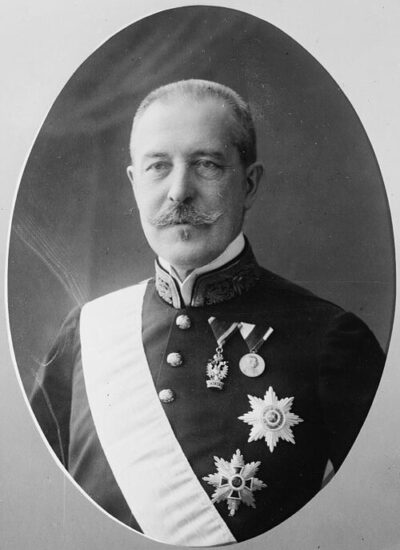
Count Alois Lexa von Aehrenthal
Count Alois Lexa von Aehrenthal was a Czech nobleman. Born September 27, 1854, in Hrubá Skála. Died February 17, 1912, in Vienna. Positions held include foreign minister of Austria-Hungary (1906–1912) and ambassador of Austria-Hungary to Russia (1899–1906). Educated at University of Bonn and Charles University. Awards include Knight of the Seraphim, Order of St. Andrew and Order of Saint Stephen of Hungary.
Facts
32 facts · 2 confirmed by two sources · 9 cited · 21 from one source
Where this comes from
Papalocal keeps its own record. It started from these sources; what each one said is kept here as it was copied, so a change on their side never changes this page by itself. Tap one to read its version.
What Wikidata says · copied November 18, 2026 · revision 2568176377
- Described as
- Czech nobleman (1854-1912)
- Other names
- Alois Graf Lexa von Aehrenthal, Alexis von Aehrental
- Born
- September 27, 1854 · 6 references
- Died
- February 17, 1912 · 7 references
- Born in
- Hrubá Skála · 4 references
- Died in
- Vienna · 5 references
- Citizen of
- Cisleithania (1867–); Austrian Empire (–1867)
- Occupation
- diplomat · 2 references; politician · 1 reference; foreign minister · 1 reference; minister · 1 reference
- Positions held
- foreign minister of Austria-Hungary (1906–1912); ambassador of Austria-Hungary to Russia (1899–1906)
- Political party
- independent politician
- Education
- University of Bonn; Charles University
- Awards
- Knight of the Seraphim; Order of St. Andrew; Order of Saint Stephen of Hungary · 1 reference; Order of Leopold · 1 reference; Order of the Iron Crown (Kingdom of Italy) · 1 reference; Order of the Black Eagle · 1 reference; Order of the Most Holy Annunciation · 1 reference; Order of Saint Alexander Nevsky · 1 reference
- Spouse
- Pauline Gräfin Széchényi (1902–) · 1 reference
- Children
- Caroline Lexa Gräfin von Aehrenthal · 1 reference; Johann Lexa Graf von Aehrenthal · 1 reference; Elisabeth Lexa Gräfin von Aehrenthal · 1 reference
- Father
- Johann Baptist Lexa von Aehrenthal
- Mother
- Maria von Thun und Hohenstein
- Siblings
- Felix von Aehrenthal; Franz Aehrenthal
- Religion
- Catholicism
- Wikipedias with a page
- 23
Wikidata item Q542902 (wikidata.org/wiki/Q542902), public domain (CC0). Copied November 18, 2026.
What Wikipedia says · copied November 18, 2026 · revision 1378702434
Alois Leopold Johann Baptist Graf Lexa von Aehrenthal (27 September 1854 – 17 February 1912) was a diplomat of the Austro-Hungarian Empire. According to his biographer Solomon Wank, he exuded a strong monarchical-conservative outlook, loyalty to the Empire, and optimism regarding its ability to survive and flourish in the early-20th century. He became best known for promoting an energetic Austro-Hungarian foreign-policy in the Balkans, seeking cooperation with Russia and approval of Germany for actions that angered the South Slav element in the Balkans.
As Imperial Foreign Minister between 1906 and 1912, Aehrenthal formulated and executed the Austro-Hungarian annexation of Bosnia and Herzegovina and their integration in 1908 into the Austro-Hungarian Empire. With the annexation he sought to permanently block in the Balkan south of the empire the emergence there of inter- and intra-ethnic nationalisms amongst the multiplicity of peoples on the basis of their shared religious beliefs and ethnic affiliations. His actions precipitated the Bosnian Crisis because he sought to achieve his objectives by negotiation of Russian acceptance of the annexation in exchange for Austro-Hungarian support for greater Russian access from the Black Sea to the Mediterranean through the Straits of the Dardanelles (at the expense of the Ottoman Empire). Aehrenthal expected that Britain and France would accept this deal since they had recently become aligned with Russia.
Seeking to limit objections in Russia to any support for the annexation, Aehrenthal began secret negotiations with Russian foreign minister Alexander Izvolsky before Vienna made its move. The annexation ultimately damaged Austro-Russian collaboration on settling Balkan questions. It also stirred chauvinist popular emotion in Russia, which felt humiliated in a sphere of vital interest to it.
- Born, in its opening lines
- September 27, 1854
- Died, in its opening lines
- February 17, 1912
From the Wikipedia article “Alois Lexa von Aehrenthal” (en.wikipedia.org/wiki/Alois_Lexa_von_Aehrenthal), by its contributors, under CC BY-SA 4.0 (creativecommons.org/licenses/by-sa/4.0/). Copied November 18, 2026; not changed.
Confirmed Two sources agree. Cited One source, and it names where it got it. One source One source, without a reference of its own. Sources disagree The sources disagree. We show the best-supported value and keep theirs below.
