
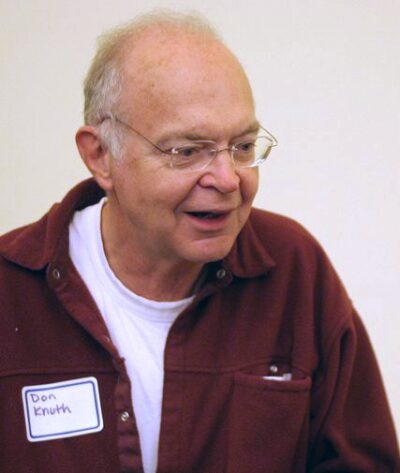
Donald Knuth
Donald Knuth is an American computer scientist and mathematician. Born January 10, 1938, in Milwaukee. Positions held include professor. Known for TeX, Metafont and The Art of Computer Programming. Educated at Case Western Reserve University and California Institute of Technology. Awards include Guggenheim Fellowship, Turing Award and IEEE John von Neumann Medal.
Facts
58 facts · 1 confirmed by two sources · 37 cited · 20 from one source
Where this comes from
Papalocal keeps its own record. It started from these sources; what each one said is kept here as it was copied, so a change on their side never changes this page by itself. Tap one to read its version.
What Wikidata says · copied November 13, 2026 · revision 2557856763
- Described as
- American computer scientist and mathematician (born 1938)
- Other names
- Donald E. Knuth, Don Knuth, Donald Ervin Knuth, D.E.K., DEK, Knuth
- Born
- January 10, 1938 · 7 references
- Born in
- Milwaukee · 2 references
- Citizen of
- United States
- Occupation
- mathematician · 1 reference; computer scientist · 2 references; historian of mathematics; writer; programmer; university teacher · 1 reference; engineer; academic · 1 reference
- Positions held
- professor
- Worked for
- Stanford University · 1 reference; Burroughs Corporation (1960–1968); Institute for Defense Analyses (1968–1969); California Institute of Technology · 1 reference
- Education
- Case Western Reserve University (–1960) · 1 reference; California Institute of Technology (1960–1963) · 2 references; Milwaukee Lutheran High School (–1956) · 1 reference
- Member of
- French Academy of Sciences (1992–) · 1 reference; Norwegian Academy of Science and Letters · 1 reference; National Academy of Sciences (1975–) · 2 references; American Academy of Arts and Sciences (1973–) · 2 references; Russian Academy of Sciences (2008–) · 1 reference; Bavarian Academy of Sciences and Humanities (1998–) · 1 reference; National Academy of Engineering (1981–) · 1 reference; Association for Computing Machinery (1982–) · 1 reference; Institute of Electrical and Electronics Engineers (1982–) · 1 reference; American Philosophical Society (2012–)
- Instrument
- organ
- Known for
- TeX · 1 reference; Metafont · 1 reference; The Art of Computer Programming · 1 reference; Computer Modern; WEB; CWEB; literate programming
- Awards
- Guggenheim Fellowship (1972) · 1 reference; Turing Award (1974) · 2 references; IEEE John von Neumann Medal (1995) · 1 reference; Harvey Prize (1995) · 1 reference; National Medal of Science (1979) · 2 references; Faraday Medal (2011) · 1 reference; Grace Murray Hopper Award (1971) · 1 reference; Josiah Willard Gibbs Lectureship (1978); Foreign Member of the Royal Society (2003) · 1 reference; Turing Talk (2011) · 1 reference; Computer History Museum Fellow (1998) · 1 reference; Franklin Medal (1988) · 1 reference; Kyoto Prize in Advanced Technology (1996) · 1 reference; ACM Software System Award (1986) · 1 reference; W. Wallace McDowell Award (1980) · 1 reference
- Field
- combinatorics; computer science · 1 reference; analysis of algorithms
- Religion
- Lutheranism
- Website
- https://www-cs-faculty.stanford.edu/~knuth · 1 reference; https://profiles.stanford.edu/donald-knuth
- Wikipedias with a page
- 95
Wikidata item Q17457 (wikidata.org/wiki/Q17457), public domain (CC0). Copied November 13, 2026.
What Wikipedia says · copied November 13, 2026 · revision 1379836531
Donald Ervin Knuth ( kə-NOOTH; born January 10, 1938) is an American computer scientist and mathematician. He is a professor emeritus at Stanford University. He is the 1974 recipient of the ACM Turing Award, informally considered the Nobel Prize of computer science. Knuth has been called the "father of the analysis of algorithms".
Knuth is the author of the multi-volume work The Art of Computer Programming. He contributed to the development of the rigorous analysis of the computational complexity of algorithms and systematized formal mathematical techniques for it. In the process, he also popularized the asymptotic notation. In addition to fundamental contributions in several branches of theoretical computer science, Knuth is the creator of the TeX computer typesetting system, the related METAFONT font definition language and rendering system, and the Computer Modern family of typefaces.
As a writer and scholar, Knuth created the WEB and CWEB computer programming systems designed to encourage and facilitate literate programming, and designed the MIX/MMIX instruction set architectures. He strongly opposes the granting of software patents, and has expressed his opinion to the United States Patent and Trademark Office and European Patent Organisation.
- Born, in its opening lines
- January 10, 1938
From the Wikipedia article “Donald Knuth” (en.wikipedia.org/wiki/Donald_Knuth), by its contributors, under CC BY-SA 4.0 (creativecommons.org/licenses/by-sa/4.0/). Copied November 13, 2026; not changed.
Confirmed Two sources agree. Cited One source, and it names where it got it. One source One source, without a reference of its own. Sources disagree The sources disagree. We show the best-supported value and keep theirs below.
