
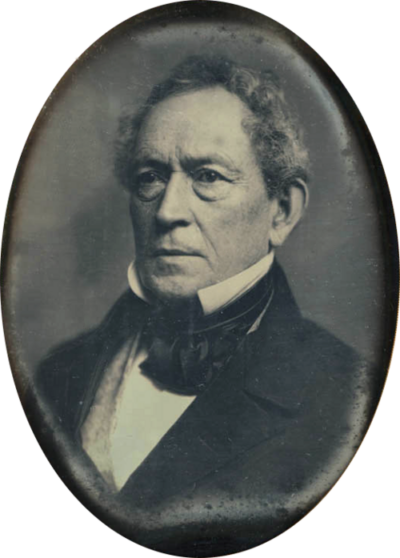
Edward Everett
Edward Everett was an American politician, pastor, educator, diplomat and orator. Born April 11, 1794, in Dorchester. Died January 15, 1865, in Boston. Positions held include United States representative, Governor of Massachusetts (1836–1840) and United States Secretary of State (1852–1853). Educated at Harvard University and University of Göttingen. Awards include Fellow of the American Academy of Arts and Sciences.
Facts
40 facts · 2 confirmed by two sources · 12 cited · 26 from one source
Where this comes from
Papalocal keeps its own record. It started from these sources; what each one said is kept here as it was copied, so a change on their side never changes this page by itself. Tap one to read its version.
What Wikidata says · copied November 15, 2026 · revision 2568594772
- Described as
- American politician, pastor, educator, diplomat and orator (1794–1865)
- Born
- April 11, 1794 · 6 references
- Died
- January 15, 1865 · 6 references
- Born in
- Dorchester
- Died in
- Boston · 1 reference
- Buried in
- Mount Auburn Cemetery · 1 reference
- Citizen of
- United States
- Occupation
- politician · 1 reference; diplomat · 1 reference; university teacher; writer · 2 references; theologian · 1 reference; orator · 1 reference; governor · 1 reference; philologist · 1 reference
- Positions held
- United States representative; Governor of Massachusetts (1836–1840); United States Secretary of State (1852–1853); ambassador; Eliot Professor of Greek Literature (1819–1825); United States senator (1853–1854) · 1 reference; senator · 1 reference
- Political party
- Whig Party; Republican Party
- Worked for
- Harvard University
- Education
- Harvard University; University of Göttingen; Phillips Exeter Academy · 1 reference
- Member of
- American Academy of Arts and Sciences; American Antiquarian Society; American Philosophical Society (1831–)
- Awards
- Fellow of the American Academy of Arts and Sciences
- Spouse
- Charlotte Gray Brooks
- Children
- William Everett; Charlotte Brooks Everett
- Father
- Oliver Everett · 1 reference
- Mother
- Lucy Hill Everett
- Siblings
- Sarah Preston Everett Hale; Alexander Hill Everett
- Religion
- Unitarianism
- Lived in
- Edward Everett House · 1 reference
- Wikipedias with a page
- 34
Wikidata item Q434905 (wikidata.org/wiki/Q434905), public domain (CC0). Copied November 15, 2026.
What Wikipedia says · copied November 15, 2026 · revision 1385701613
Edward Everett (April 11, 1794 – January 15, 1865) was an American politician, Unitarian pastor, educator, diplomat, and orator from Massachusetts. Everett, as a Whig, served as U.S. representative, U.S. senator, the 15th governor of Massachusetts, minister to Great Britain, and United States secretary of state. He also taught at Harvard University and served as its president.
Everett was an American orator of the antebellum and Civil War eras. He was the featured orator at the dedication ceremony of the Gettysburg National Cemetery in 1863, where he spoke for over two hours—immediately before President Abraham Lincoln delivered his famous two-minute Gettysburg Address.
Everett was educated at Harvard, and briefly ministered at Boston's Brattle Street Church before taking a teaching job at Harvard. The position included preparatory studies in Europe, so Everett spent two years in studies at the University of Göttingen, and another two years traveling around Europe. At Harvard he taught ancient Greek literature for several years before starting an extensive and popular speaking career. He served ten years in the United States Congress before winning election as Governor of Massachusetts in 1835. As Governor he introduced the state Board of Education, the first of its type in the nation. In 1831, he was elected as a member to the American Philosophical Society.
After being narrowly defeated in the 1839 election, Everett was appointed Minister to Great Britain, serving until 1845. He next became President of Harvard, a job he quickly came to dislike. In 1849, he became an assistant to longtime friend and colleague Daniel Webster, who had been appointed Secretary of State. Upon Webster's death Everett served as Secretary of State for a few months until he was sworn in as U.S. Senator from Massachusetts. In the later years of his life, Everett traveled and gave speeches all over the country. He supported efforts to maintain the Union before the Civil War, running for Vice President on the Constitutional Union Party ticket in 1860. He was active in supporting the Union effort during the war and supported Lincoln in the 1864 election.
- Born, in its opening lines
- April 11, 1794
- Died, in its opening lines
- January 15, 1865
From the Wikipedia article “Edward Everett” (en.wikipedia.org/wiki/Edward_Everett), by its contributors, under CC BY-SA 4.0 (creativecommons.org/licenses/by-sa/4.0/). Copied November 15, 2026; not changed.
Confirmed Two sources agree. Cited One source, and it names where it got it. One source One source, without a reference of its own. Sources disagree The sources disagree. We show the best-supported value and keep theirs below.
