
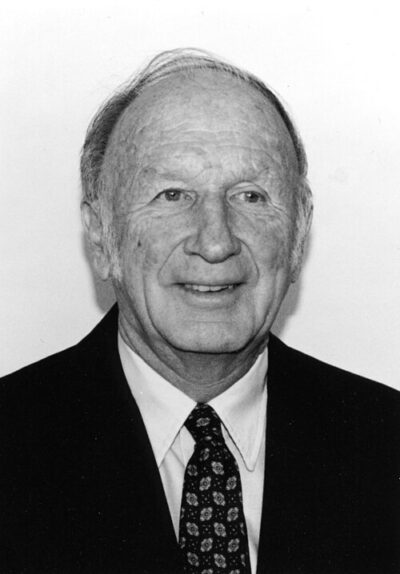
Edward Norton Lorenz
Edward Norton Lorenz was an American mathematician and meteorologist. Born May 23, 1917, in West Hartford. Died April 16, 2008, in Cambridge. Known for butterfly effect, Lorenz system and The nature and theory of the general circulation of the atmosphere / Edward N. Lorenz. - 1967. Educated at Dartmouth College and Harvard University. Awards include Elliott Cresson Medal, Buys Ballot Medal and Carl-Gustaf Rossby Research Medal.
Facts
35 facts · 2 confirmed by two sources · 25 cited · 8 from one source
Where this comes from
Papalocal keeps its own record. It started from these sources; what each one said is kept here as it was copied, so a change on their side never changes this page by itself. Tap one to read its version.
What Wikidata says · copied November 13, 2026 · revision 2568723306
- Described as
- American mathematician and meteorologist (1917–2008)
- Born
- May 23, 1917 · 9 references
- Died
- April 16, 2008 · 10 references
- Born in
- West Hartford · 2 references
- Died in
- Cambridge · 2 references
- Buried in
- Waterville Valley Cemetery · 1 reference
- Cause of death
- cancer · 1 reference
- Citizen of
- United States
- Occupation
- mathematician · 1 reference; meteorologist · 1 reference; university teacher
- Worked for
- Massachusetts Institute of Technology; United States Air Force (1942–1946) · 1 reference
- Education
- Dartmouth College (–1938) · 2 references; Harvard University (1938–1941) · 2 references; Massachusetts Institute of Technology (1946–1948) · 1 reference
- Member of
- National Academy of Sciences (1975–) · 1 reference; American Academy of Arts and Sciences (1961–) · 1 reference; Russian Academy of Sciences (1988–) · 1 reference; Royal Society of London (1990–) · 1 reference
- Known for
- butterfly effect; Lorenz system; The nature and theory of the general circulation of the atmosphere / Edward N. Lorenz. - 1967; fontaine chaotique
- Awards
- Elliott Cresson Medal (1989) · 2 references; Buys Ballot Medal (2004) · 1 reference; Carl-Gustaf Rossby Research Medal (1969) · 2 references; Lomonosov Gold Medal (2004); International Meteorological Organization Prize (2000) · 1 reference; Kyoto Prize in Basic Sciences (1991) · 1 reference; Crafoord Prize in Geosciences (1983) · 1 reference; Foreign Member of the Royal Society (1990) · 1 reference; Roger Revelle Medal (1992) · 2 references; Symons Gold Medal (1973) · 1 reference
- Field
- study of complex systems · 1 reference; chaos theory · 1 reference
- Wikipedias with a page
- 44
Wikidata item Q174808 (wikidata.org/wiki/Q174808), public domain (CC0). Copied November 13, 2026.
What Wikipedia says · copied November 13, 2026 · revision 1377173159
Edward Norton Lorenz (May 23, 1917 – April 16, 2008) was an American mathematician and meteorologist who established the theoretical basis of weather and climate predictability, as well as the basis for computer-aided atmospheric physics and meteorology. He founded modern chaos theory, a branch of mathematics focusing on the behavior of dynamical systems that are highly sensitive to initial conditions.
His discovery of deterministic chaos "profoundly influenced a wide range of basic sciences and brought about one of the most dramatic changes in mankind's view of nature since Sir Isaac Newton", according to the committee that awarded him the 1991 Kyoto Prize for basic sciences in the field of earth and planetary sciences.
- Born, in its opening lines
- May 23, 1917
- Died, in its opening lines
- April 16, 2008
From the Wikipedia article “Edward Norton Lorenz” (en.wikipedia.org/wiki/Edward_Norton_Lorenz), by its contributors, under CC BY-SA 4.0 (creativecommons.org/licenses/by-sa/4.0/). Copied November 13, 2026; not changed.
Confirmed Two sources agree. Cited One source, and it names where it got it. One source One source, without a reference of its own. Sources disagree The sources disagree. We show the best-supported value and keep theirs below.
