
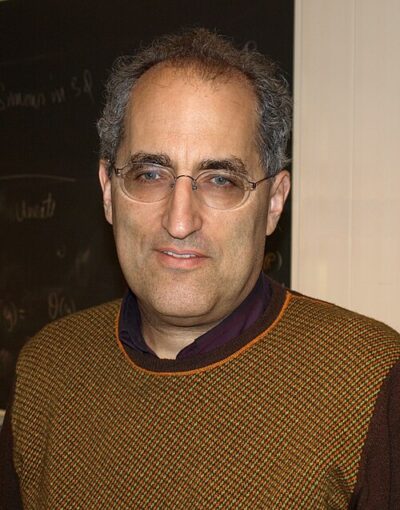
Edward Witten
Edward Witten is an American theoretical physicist. Born August 26, 1951, in Baltimore. Known for M-theory. Educated at Princeton University and University of Wisconsin–Madison. Awards include Fields medal, MacArthur Fellows Program and Isaac Newton Medal.
Facts
47 facts · 1 confirmed by two sources · 29 cited · 17 from one source
Where this comes from
Papalocal keeps its own record. It started from these sources; what each one said is kept here as it was copied, so a change on their side never changes this page by itself. Tap one to read its version.
What Wikidata says · copied November 13, 2026 · revision 2568594777
- Described as
- American theoretical physicist
- Other names
- Ed Witten
- Born
- August 26, 1951 · 5 references
- Born in
- Baltimore · 1 reference
- Citizen of
- United States
- Occupation
- mathematician · 1 reference; physicist · 1 reference; university teacher; theoretical physicist; string theorist
- Worked for
- Princeton University; Institute for Advanced Study · 1 reference
- Education
- Princeton University (–1976) · 1 reference; University of Wisconsin–Madison; Brandeis University; Park School of Baltimore · 1 reference
- Member of
- French Academy of Sciences (2000–) · 1 reference; Pontifical Academy of Sciences (2006–) · 1 reference; National Academy of Sciences (1988–) · 1 reference; American Academy of Arts and Sciences (1984–) · 1 reference; American Philosophical Society (1994–) · 1 reference; American Physical Society (1984–) · 1 reference; Royal Society of London (1999–) · 1 reference; American Mathematical Society (2012–) · 2 references
- Known for
- M-theory · 1 reference
- Awards
- Fields medal (1990) · 1 reference; MacArthur Fellows Program (1982); Isaac Newton Medal (2010) · 1 reference; Lorentz Medal (2010) · 1 reference; Harvey Prize (2005) · 1 reference; Oskar Klein Medal (1998) · 1 reference; Henri Poincaré Prize (2006) · 1 reference; Breakthrough Prize in Fundamental Physics (2012) · 1 reference; National Medal of Science (2002) · 1 reference; Josiah Willard Gibbs Lectureship (1998) · 1 reference; Albert Einstein World Award of Science (2016) · 1 reference; Alan T. Waterman Award (1986) · 1 reference; Kyoto Prize in Basic Sciences (2014) · 1 reference; Fellow of the American Physical Society (1984) · 1 reference; Albert Einstein Medal (1985) · 1 reference
- Field
- physics; mathematical physics · 1 reference; string theory · 1 reference
- Spouse
- Chiara Nappi
- Children
- Daniela Witten · 1 reference; Ilana Witten · 1 reference
- Father
- Louis Witten · 1 reference
- Lived in
- Princeton · 1 reference
- Website
- https://www.ias.edu/sns/witten · 1 reference
- Wikipedias with a page
- 56
Wikidata item Q201513 (wikidata.org/wiki/Q201513), public domain (CC0). Copied November 13, 2026.
What Wikipedia says · copied November 13, 2026 · revision 1384251128
Edward Witten (born August 26, 1951) is an American theoretical physicist known for his contributions to string theory, topological quantum field theory, general relativity and various areas of mathematics. He is a professor emeritus in the school of natural sciences at the Institute for Advanced Study in Princeton. Witten is a researcher in string theory, quantum gravity, supersymmetric quantum field theories, and other areas of mathematical physics. Witten's work has also significantly impacted pure mathematics. In 1990, he became the first physicist to be awarded a Fields Medal by the International Mathematical Union, for his mathematical insights in physics, such as his 1981 proof of the positive energy theorem in general relativity, and his interpretation of the Jones invariants of knots as Feynman integrals. He is considered the practical founder of M-theory.
- Born, in its opening lines
- August 26, 1951
From the Wikipedia article “Edward Witten” (en.wikipedia.org/wiki/Edward_Witten), by its contributors, under CC BY-SA 4.0 (creativecommons.org/licenses/by-sa/4.0/). Copied November 13, 2026; not changed.
Confirmed Two sources agree. Cited One source, and it names where it got it. One source One source, without a reference of its own. Sources disagree The sources disagree. We show the best-supported value and keep theirs below.
