
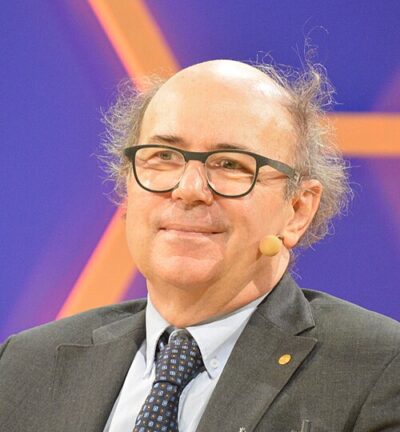
Frank Wilczek
Frank Wilczek is an American theoretical physicist. Born May 15, 1951, in Mineola. Known for quantum chromodynamics. Educated at Princeton University and University of Chicago. Awards include Nobel Prize in Physics, MacArthur Fellows Program and Lorentz Medal.
Facts
39 facts · 1 confirmed by two sources · 25 cited · 13 from one source
Where this comes from
Papalocal keeps its own record. It started from these sources; what each one said is kept here as it was copied, so a change on their side never changes this page by itself. Tap one to read its version.
What Wikidata says · copied November 13, 2026 · revision 2567918330
- Described as
- American theoretical physicist
- Other names
- Frank Anthony Wilczek, Frank A. Wilczek, Frank A Wilczek
- Born
- May 15, 1951 · 6 references
- Born in
- Mineola · 1 reference
- Citizen of
- United States · 3 references
- Occupation
- physicist · 2 references; professor · 2 references; theoretical physicist; university teacher · 2 references
- Worked for
- Massachusetts Institute of Technology; University of California, Santa Barbara · 1 reference; Leiden University (1998–) · 1 reference
- Education
- Princeton University; University of Chicago; Martin Van Buren High School · 1 reference
- Member of
- National Academy of Sciences (1990–) · 1 reference; American Academy of Arts and Sciences (1993–) · 1 reference; Royal Netherlands Academy of Arts and Sciences (2000–) · 1 reference; American Philosophical Society · 1 reference; American Physical Society (2004–) · 1 reference; European Academy of Sciences (2007–) · 1 reference
- Known for
- quantum chromodynamics · 1 reference
- Awards
- Nobel Prize in Physics (2004) · 2 references; MacArthur Fellows Program (1982) · 1 reference; Lorentz Medal (2002) · 1 reference; King Faisal Prize in Science (2005) · 1 reference; Oskar Klein Medal (2013) · 1 reference; High Energy and Particle Physics Prize (2003) · 1 reference; Julius Wess Prize (2008) · 1 reference; ICTP Dirac Medal (1994) · 1 reference; Fellow of the American Physical Society (2004) · 1 reference; Lilienfeld Prize (2003) · 1 reference; Sakurai Prize (1986) · 2 references; Fellow of the American Association for the Advancement of Science (2000) · 1 reference; honorary doctor of the Maria Curie-Skłodowska University (2012); honorary doctor of the Jagiellonian University of Krakow (2012) · 1 reference; Commander of the Cross of the Order of Merit of the Republic of Poland
- Field
- theoretical physics
- Spouse
- Betsy Devine (1973–)
- Religion
- agnosticism
- Website
- https://frankawilczek.com
- Wikipedias with a page
- 73
Wikidata item Q107450 (wikidata.org/wiki/Q107450), public domain (CC0). Copied November 13, 2026.
What Wikipedia says · copied November 13, 2026 · revision 1383306206
Frank Anthony Wilczek ( or ; born May 15, 1951) is an American theoretical physicist. He shared the 2004 Nobel Prize in Physics with David Gross and H. David Politzer "for the discovery of asymptotic freedom in the theory of the strong interaction".
Wilczek is the Herman Feshbach Professor of Physics at the Massachusetts Institute of Technology (MIT), Founding Director of T. D. Lee Institute (Shanghai) and Chief Scientist at the Wilczek Quantum Center, Shanghai Jiao Tong University (SJTU), distinguished professor at Arizona State University (ASU) during February and March and full professor at Stockholm University. He has written popular science. Longing For the Harmonies (1988), cowritten with his wife Betsy Devine, draws on parallels between physics and music. A Beautiful Question (2015) looks at the universe as a work of art. In May 2022, he was awarded the Templeton Prize for his "investigations into the fundamental laws of nature", that have "transformed our understanding of the forces that govern our universe".
- Born, in its opening lines
- May 15, 1951
From the Wikipedia article “Frank Wilczek” (en.wikipedia.org/wiki/Frank_Wilczek), by its contributors, under CC BY-SA 4.0 (creativecommons.org/licenses/by-sa/4.0/). Copied November 13, 2026; not changed.
Confirmed Two sources agree. Cited One source, and it names where it got it. One source One source, without a reference of its own. Sources disagree The sources disagree. We show the best-supported value and keep theirs below.
