
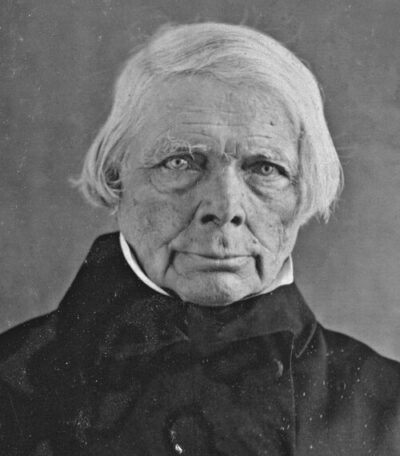
Friedrich Wilhelm Joseph Schelling
Friedrich Wilhelm Joseph Schelling was a German philosopher. Born January 27, 1775, in Leonberg. Died August 20, 1854, in Bad Ragaz. Positions held include professor. Known for The Ages of the World. Educated at University of Tübingen and Leipzig University. Awards include Pour le Mérite for Sciences and Arts order and Bavarian Maximilian Order for Science and Art.
Facts
43 facts · 2 confirmed by two sources · 15 cited · 26 from one source
Where this comes from
Papalocal keeps its own record. It started from these sources; what each one said is kept here as it was copied, so a change on their side never changes this page by itself. Tap one to read its version.
What Wikidata says · copied November 16, 2026 · revision 2565535148
- Described as
- German philosopher (1775–1854)
- Other names
- Friedrich Schelling, Friedrich Wilhelm Schelling, Friedrich von Schelling, Schelling, Friedrich Wilhelm Joseph von Schelling
- Born
- January 27, 1775 · 14 references
- Died
- August 20, 1854 · 14 references
- Born in
- Leonberg · 2 references
- Died in
- Bad Ragaz · 3 references
- Name at birth
- Friedrich Wilhelm Joseph Schelling
- Citizen of
- Kingdom of Württemberg; Switzerland · 1 reference
- Occupation
- philosopher · 5 references; university teacher; writer · 2 references; librettist · 1 reference
- Positions held
- professor
- Worked for
- LMU Munich; University of Würzburg; University of Jena; Humboldt-Universität zu Berlin; University of Erlangen–Nuremberg · 1 reference
- Education
- University of Tübingen; Leipzig University · 1 reference; Tübinger Stift
- Member of
- Bavarian Academy of Sciences and Humanities; Hungarian Academy of Sciences; Royal Prussian Academy of Sciences
- Known for
- The Ages of the World
- Awards
- Pour le Mérite for Sciences and Arts order; Bavarian Maximilian Order for Science and Art (1853)
- Field
- natural philosophy; natural science; aesthetics; metaphysics; epistemology
- Spouse
- Pauline Gotter · 1 reference; Caroline Schelling (1803–1809) · 1 reference
- Children
- Clara Waitz · 1 reference; Hermann Schelling · 1 reference; Julie von Eichhorn · 1 reference; Carl Friedrich August Schelling · 1 reference; Paul Heinrich Joseph Schelling · 1 reference
- Father
- Joseph Friedrich Schelling · 1 reference
- Mother
- Gottliebin Maria Schelling · 1 reference
- Siblings
- Carl Eberhard Ritter von Schelling · 1 reference; August Ludwig Schelling · 1 reference
- Religion
- Lutheranism
- Wikipedias with a page
- 93
Wikidata item Q60070 (wikidata.org/wiki/Q60070), public domain (CC0). Copied November 16, 2026.
What Wikipedia says · copied November 16, 2026 · revision 1385024032
Friedrich Wilhelm Joseph Schelling (German: [ˈfʁiːdʁɪç ˈvɪlhɛlm ˈjoːzɛf ˈʃɛlɪŋ]; 27 January 1775 – 20 August 1854) was a German philosopher. Standard histories of philosophy make him the midpoint in the development of German idealism, situating him between Johann Gottlieb Fichte, his mentor in his early years, and Georg Wilhelm Friedrich Hegel, his one-time university roommate, early friend, and later rival. Interpreting Schelling's philosophy is regarded as difficult because of its evolving nature.
Schelling's thought in the main has been neglected, especially in the English-speaking world. An important factor in this was the ascendancy of Hegel, whose mature works portray Schelling as a mere footnote in the development of idealism. Schelling's Naturphilosophie also has been attacked by scientists for its tendency to analogize and lack of empirical orientation. However, some later philosophers have shown interest in re-examining Schelling's body of work.
- Born, in its opening lines
- January 27, 1775
- Died, in its opening lines
- August 20, 1854
From the Wikipedia article “Friedrich Wilhelm Joseph Schelling” (en.wikipedia.org/wiki/Friedrich_Wilhelm_Joseph_Schelling), by its contributors, under CC BY-SA 4.0 (creativecommons.org/licenses/by-sa/4.0/). Copied November 16, 2026; not changed.
Confirmed Two sources agree. Cited One source, and it names where it got it. One source One source, without a reference of its own. Sources disagree The sources disagree. We show the best-supported value and keep theirs below.
