
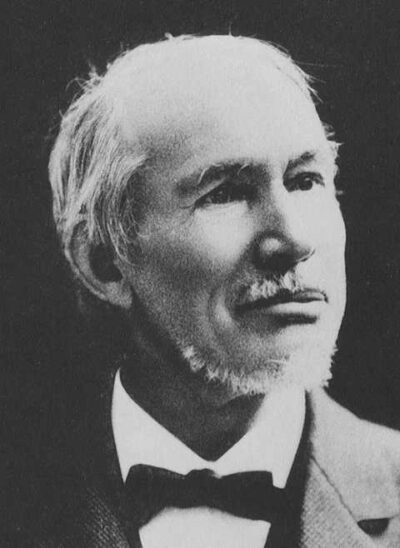
George William Hill
George William Hill was an American astronomer and mathematician. Born March 3, 1838, in New York City. Died April 16, 1914, in Nyack. Positions held include chairperson (1895–1896). Known for On the part of the motion of the lunar perigee which is a function of the mean motions of the sun and moon, Hill differential equation and Hill sphere. Educated at Rutgers University. Awards include Copley Medal, Gold Medal of the Royal Astronomical Society and Bruce Medal.
Facts
32 facts · 2 confirmed by two sources · 14 cited · 16 from one source
Where this comes from
Papalocal keeps its own record. It started from these sources; what each one said is kept here as it was copied, so a change on their side never changes this page by itself. Tap one to read its version.
What Wikidata says · copied November 15, 2026 · revision 2567561775
- Described as
- American astronomer and mathematician (1838–1914)
- Other names
- George W. Hill
- Born
- March 3, 1838 · 6 references
- Died
- April 16, 1914 · 6 references
- Born in
- New York City · 2 references
- Died in
- Nyack · 1 reference
- Buried in
- Clarkstown Reformed Church Cemetery · 1 reference
- Citizen of
- United States
- Occupation
- astronomer · 1 reference; mathematician
- Positions held
- chairperson (1895–1896) · 1 reference
- Worked for
- US Nautical Almanac Office (1861–1898) · 1 reference; Columbia University (1898–1901) · 1 reference
- Education
- Rutgers University (1855–1862) · 1 reference
- Member of
- Royal Society of London (1902–); Royal Swedish Academy of Sciences; Royal Academy of Science, Letters and Fine Arts of Belgium; Norwegian Academy of Science and Letters; Royal Netherlands Academy of Arts and Sciences; Accademia Nazionale dei Lincei (1913–) · 1 reference; Royal Society of Edinburgh; American Academy of Arts and Sciences; French Academy of Sciences · 1 reference; National Academy of Sciences (1874–)
- Known for
- On the part of the motion of the lunar perigee which is a function of the mean motions of the sun and moon; Hill differential equation; Hill sphere
- Awards
- Copley Medal (1909) · 1 reference; Gold Medal of the Royal Astronomical Society (1887) · 1 reference; Bruce Medal (1909) · 1 reference; Foreign Member of the Royal Society (1902) · 1 reference; Damoiseau prize (1898) · 1 reference
- Field
- astronomy · 1 reference
- Father
- John William Hill · 1 reference
- Wikipedias with a page
- 33
Wikidata item Q370136 (wikidata.org/wiki/Q370136), public domain (CC0). Copied November 15, 2026.
What Wikipedia says · copied November 15, 2026 · revision 1372385914
George William Hill (March 3, 1838 – April 16, 1914) was an American astronomer and mathematician. Working independently and largely in isolation from the wider scientific community, he made major contributions to celestial mechanics and to the theory of ordinary differential equations. The importance of his work was explicitly acknowledged by Henri Poincaré in 1905. In 1909 Hill was awarded the Royal Society's Copley Medal, "on the ground of his researches in mathematical astronomy". Hill is remembered for the Hill differential equation, along with the Hill sphere.
- Born, in its opening lines
- March 3, 1838
- Died, in its opening lines
- April 16, 1914
From the Wikipedia article “George William Hill” (en.wikipedia.org/wiki/George_William_Hill), by its contributors, under CC BY-SA 4.0 (creativecommons.org/licenses/by-sa/4.0/). Copied November 15, 2026; not changed.
Confirmed Two sources agree. Cited One source, and it names where it got it. One source One source, without a reference of its own. Sources disagree The sources disagree. We show the best-supported value and keep theirs below.
