
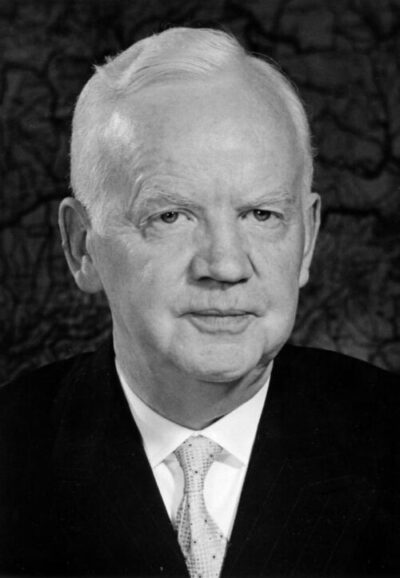
Heinrich Lübke
Heinrich Lübke was a German politician. Born October 14, 1894, in Sundern (Sauerland). Died April 6, 1972, in Bonn. Positions held include president of Germany (1959–1969), member of the German Bundestag (2 times) (1949–1959) and member of the Landtag of North Rhine-Westphalia. Educated at University of Bonn. Awards include honorary citizen of Berlin, Order of the Rajamitrabhorn and Grand Cross 1st class of the Order of Merit of the Federal Republic of Germany.
Facts
37 facts · 2 confirmed by two sources · 7 cited · 28 from one source
Where this comes from
Papalocal keeps its own record. It started from these sources; what each one said is kept here as it was copied, so a change on their side never changes this page by itself. Tap one to read its version.
What Wikidata says · copied November 16, 2026 · revision 2568843983
- Described as
- German politician (1894-1972)
- Born
- October 14, 1894 · 10 references
- Died
- April 6, 1972 · 5 references
- Born in
- Sundern (Sauerland)
- Died in
- Bonn · 1 reference
- Cause of death
- stomach cancer
- Citizen of
- Germany
- Occupation
- politician · 1 reference; engineer
- Positions held
- president of Germany (1959–1969); member of the German Bundestag (2 times) (1949–1959) · 1 reference; member of the Landtag of North Rhine-Westphalia · 2 references; member of Landtag of Prussia
- Political party
- Centre Party (1930–1933); Christian Democratic Union (1945–1972)
- Education
- University of Bonn
- Member of
- K. D. St. V. Ascania Bonn
- Awards
- honorary citizen of Berlin (1962); Order of the Rajamitrabhorn (1962) · 1 reference; Grand Cross 1st class of the Order of Merit of the Federal Republic of Germany (1957) · 1 reference; Harnack medal (1964); Order of Ojaswi Rajanya; Grand Cross Special Class of the Order of Merit of the Federal Republic of Germany (1959); Knight Grand Cross with Collar of the Order of Merit of the Italian Republic (1965); Knight Grand Cross of the Order of the Falcon; Grand Cross of the Order of Merit for Agriculture (1955) · 1 reference; Knight Grand Cross of the Order of Merit of the Italian Republic; honorary citizen of Bonn (1966); Iron Cross · 1 reference; Order of Pahlavi · 1 reference; Order of Chula Chom Klao · 1 reference; Order of Sikatuna · 1 reference
- Spouse
- Wilhelmine Lübke · 1 reference
- Siblings
- Friedrich Wilhelm Lübke · 1 reference
- Religion
- Catholic Church
- Military branch
- Imperial German Army · 1 reference
- Military rank
- captain · 1 reference
- Website
- http://www.heinrichluebke.de/
- Wikipedias with a page
- 62
Wikidata item Q2582 (wikidata.org/wiki/Q2582), public domain (CC0). Copied November 16, 2026.
What Wikipedia says · copied November 16, 2026 · revision 1354078228
Karl Heinrich Lübke (German: [ˈhaɪnʁɪç ˈlʏpkə] ; 14 October 1894 – 6 April 1972) was a German politician, who served as president of West Germany from 1959 to 1969.
He suffered from deteriorating health towards the end of his career and is known for a series of embarrassing incidents that may have resulted from his health issues. Lübke resigned three months before the scheduled end of his second term amid a scandal as to his involvement with the Nazi regime during World War II.
- Born, in its opening lines
- October 14, 1894
- Died, in its opening lines
- April 6, 1972
From the Wikipedia article “Heinrich Lübke” (en.wikipedia.org/wiki/Heinrich_Lübke), by its contributors, under CC BY-SA 4.0 (creativecommons.org/licenses/by-sa/4.0/). Copied November 16, 2026; not changed.
Confirmed Two sources agree. Cited One source, and it names where it got it. One source One source, without a reference of its own. Sources disagree The sources disagree. We show the best-supported value and keep theirs below.
