
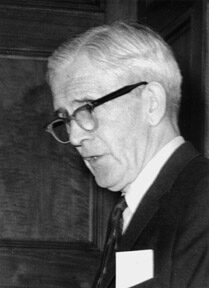
Henry DeWolf Smyth
Henry DeWolf Smyth was an American physicist and diplomat. Born May 1, 1898, in Clinton. Died September 11, 1986, in Princeton. Educated at University of Cambridge and Princeton University. Awards include Atoms for Peace Award, Guggenheim Fellowship and Fellow of the American Physical Society.
Facts
24 facts · 2 confirmed by two sources · 9 cited · 13 from one source
Where this comes from
Papalocal keeps its own record. It started from these sources; what each one said is kept here as it was copied, so a change on their side never changes this page by itself. Tap one to read its version.
What Wikidata says · copied November 18, 2026 · revision 2534407787
- Described as
- American physicist and diplomat (1898–1986)
- Other names
- Henry De Wolf Smyth
- Born
- May 1, 1898 · 3 references
- Died
- September 11, 1986 · 3 references
- Born in
- Clinton · 2 references
- Died in
- Princeton · 1 reference
- Buried in
- Philadelphia
- Cause of death
- myocardial infarction
- Citizen of
- United States · 1 reference
- Occupation
- physicist · 2 references; diplomat · 2 references; nuclear physicist; university teacher
- Political party
- Democratic Party
- Worked for
- Princeton University · 1 reference
- Education
- University of Cambridge · 1 reference; Princeton University · 1 reference; Gonville and Caius College
- Member of
- American Physical Society; American Academy of Arts and Sciences; Phi Beta Kappa Society; American Philosophical Society (1947–)
- Awards
- Atoms for Peace Award; Guggenheim Fellowship (1931) · 1 reference; Fellow of the American Physical Society
- Field
- physics
- Wikipedias with a page
- 16
Wikidata item Q451199 (wikidata.org/wiki/Q451199), public domain (CC0). Copied November 18, 2026.
What Wikipedia says · copied November 18, 2026 · revision 1374344896
Henry DeWolf "Harry" Smyth (; May 1, 1898 – September 11, 1986) was an American physicist, diplomat, and bureaucrat. He played a number of key roles in the early development of nuclear energy, as a participant in the Manhattan Project, a member of the U.S. Atomic Energy Commission (AEC), and U.S. ambassador to the International Atomic Energy Agency (IAEA).
Educated at Princeton University and the University of Cambridge, he was a faculty member in Princeton's Department of Physics from 1924 to 1966. He chaired the department from 1935 to 1949. His early research was on the ionization of gases, but his interests shifted toward nuclear physics beginning in the mid-1930s.
During World War II he was a member of the National Defense Research Committee's Uranium Committee and an administrator consultant on the Manhattan Project. He wrote the Manhattan Project's first public official history, which came to be known as the Smyth Report.
On the AEC from 1949 to 1954, Smyth initially argued unsuccessfully against a crash course to develop the hydrogen bomb and in favor of international control of nuclear weapons, before switching to support of the weapon. Following the 1954 Oppenheimer security hearing, Smyth was the sole member of the commission to vote against stripping J. Robert Oppenheimer's security clearance. As IAEA ambassador from 1961 to 1970 he played an important role in the realization of the Nuclear Non-Proliferation Treaty.
He received the Atoms for Peace Award in 1968 and the U.S. State Department's Distinguished Honor Award in 1970. The American Nuclear Society's award for "nuclear statesmanship", of which he was the first recipient, is named in his honor.
- Born, in its opening lines
- May 1, 1898
- Died, in its opening lines
- September 11, 1986
From the Wikipedia article “Henry DeWolf Smyth” (en.wikipedia.org/wiki/Henry_DeWolf_Smyth), by its contributors, under CC BY-SA 4.0 (creativecommons.org/licenses/by-sa/4.0/). Copied November 18, 2026; not changed.
Confirmed Two sources agree. Cited One source, and it names where it got it. One source One source, without a reference of its own. Sources disagree The sources disagree. We show the best-supported value and keep theirs below.
